IMPROVEMENT IN FOUNTAIN-PENS
A page per dip: an 1876 reservoir pen built around ordinary steel nibs
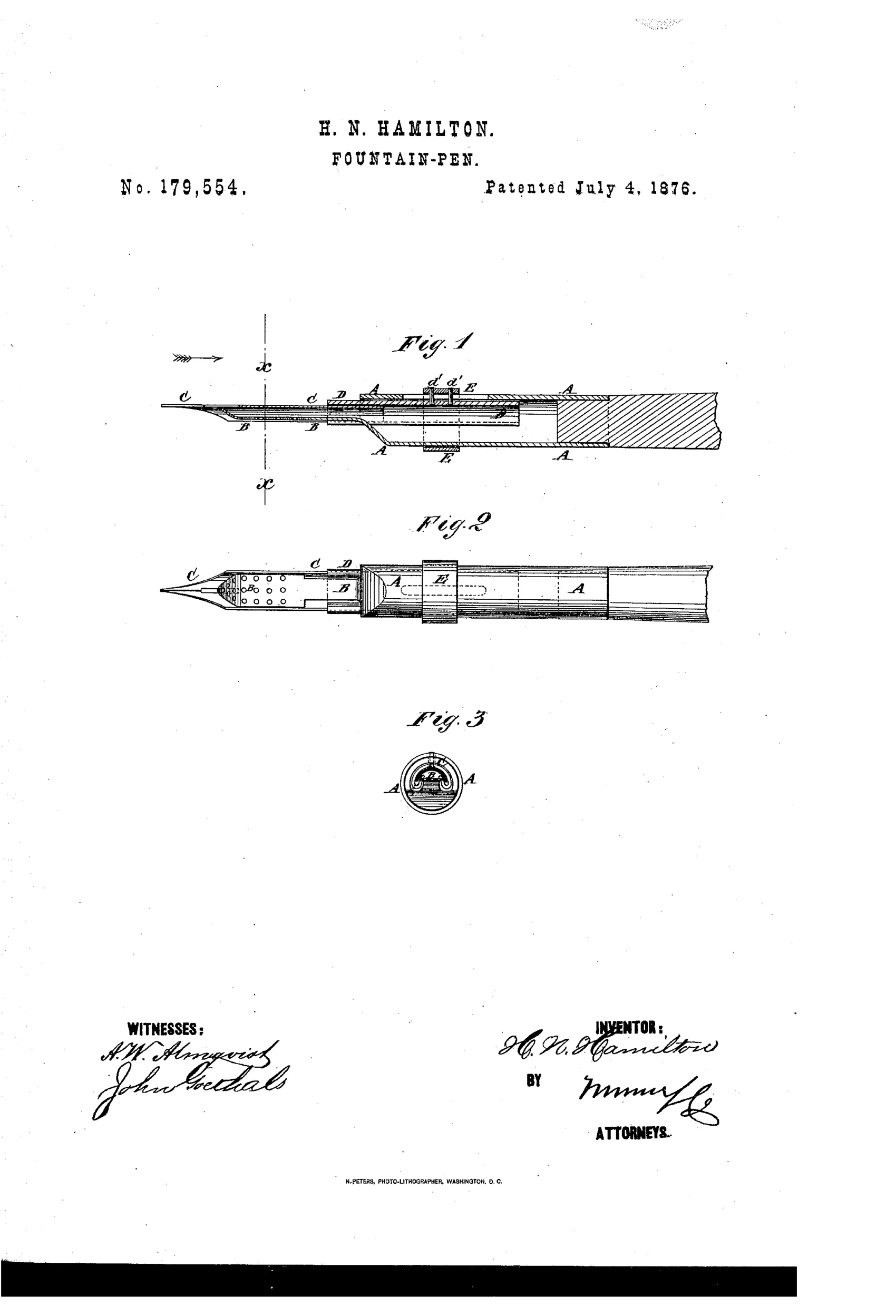
Ink-reservoir fountain pen with removable nib holder
✒ How it works
The pen tube A holds an ink chamber formed by a beveled shoulder closed with a plate extended into a perforated tongue B, which fits into the hollow of an ordinary pen C to hold ink by capillary attraction through numerous small holes. The nib C is inserted into a half-ring tube holder D, whose concave side faces the tongue B, and the holder is secured by pins d' passing through a slot in tube A into a ring E. Sliding ring E along the slotted tube allows the holder D to be projected outward, permitting the nib to be removed for cleaning or replaced by sliding the ring back into place.
✒ What was claimed
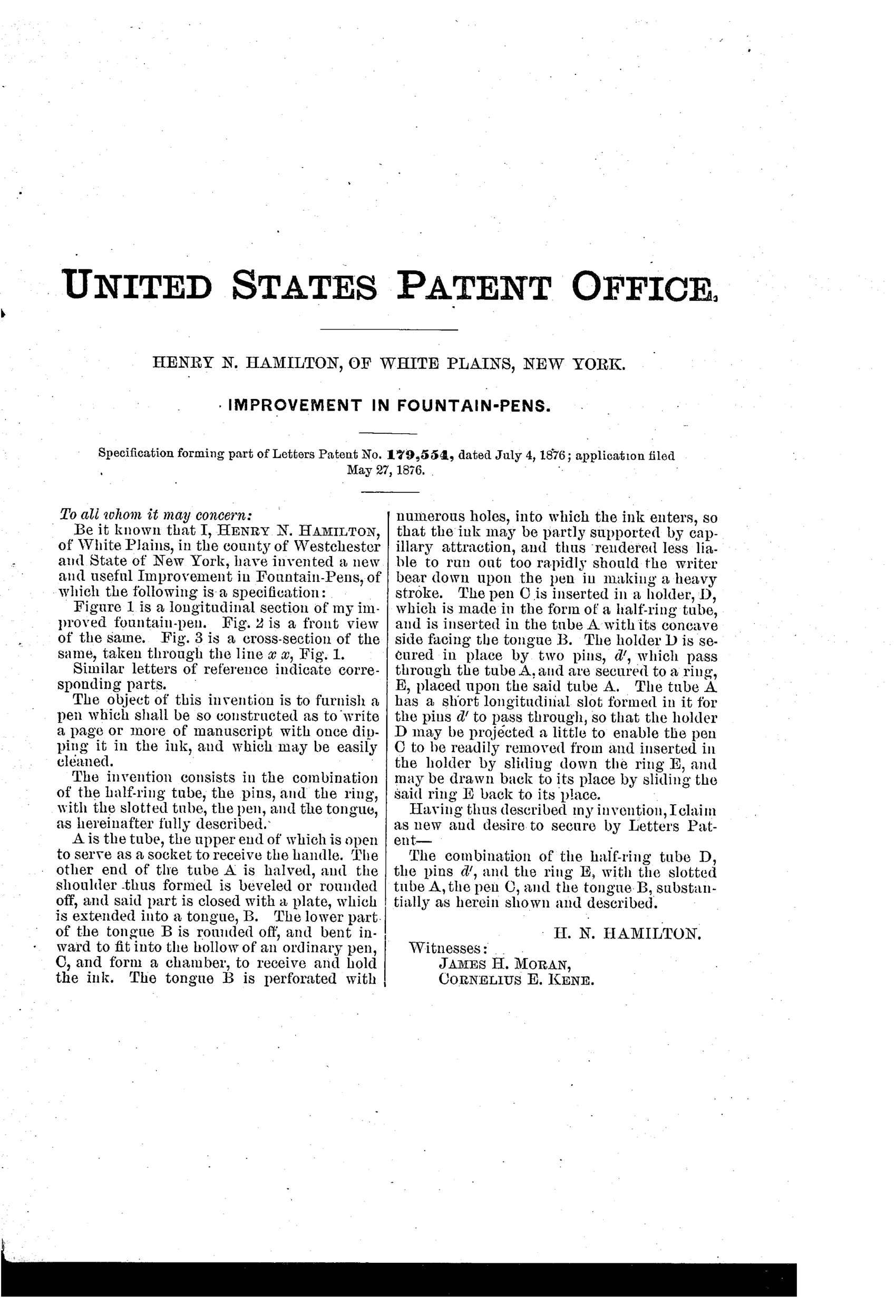
“The combination of the half-ring tube D, the pins d', and the ring E, with the slotted tube A, the pen C, and the tongue B, substantially as herein shown and described.”
In plain English: The claim covers the combined assembly of a half-ring nib holder, securing pins, a sliding ring, a slotted ink tube, the pen nib, and a perforated ink-retaining tongue, all working together as described.
✒ In the inventor’s words
“The object of this invention is to furnish a pen which shall be so constructed as to write a page or more of manuscript with once dipping it in the ink, and which may be easily cleaned.”— Henry N. Hamilton, from the specification
Fate unknown
No maker or marked example of this design is documented; reservoir-dip hybrids of the 1870s were occasionally sold, so a surviving specimen would settle it.
✒ Commentary
Read the stated object carefully — Hamilton isn't promising a pen that writes all day from a sealed reservoir. He wants one that will "write a page or more of manuscript with once dipping it in the ink." This is really a super-charged dip pen: the perforated tongue B sits inside the hollow of a common steel nib and holds a small charge of ink by capillary attraction through its many little holes. You can see the perforations dotted along the tongue in Fig. 2, tucked under the nib like a sponge made of metal.
The genuinely thoughtful part is the nib-changing mechanism. The nib rides in a half-ring holder D, pinned through a slot in the main tube to a sliding ring E. Slide the ring forward and the holder projects out so you can pull the nib for cleaning or swap in a fresh one — no tools, no disassembly. In 1876, when steel nibs were cheap consumables and corroded fast, designing around a replaceable nib was sensible economics, not a compromise.
Where it sits historically: this is the pre-Waterman stratum, when inventors were still negotiating between the dip pen everyone trusted and the leaky reservoir pens nobody did. Hamilton splits the difference. It would probably work about as advertised — a page per dip is a modest, achievable claim — but it solves a problem the true fountain pen would soon erase entirely. A dead end, and an honest one.
Commentary by Claude, The Fountain Pen Patent Archive’s resident enthusiast