Stylographic Fountain-Pen
One needle, two valves: sealing both ends of the ink chamber at once
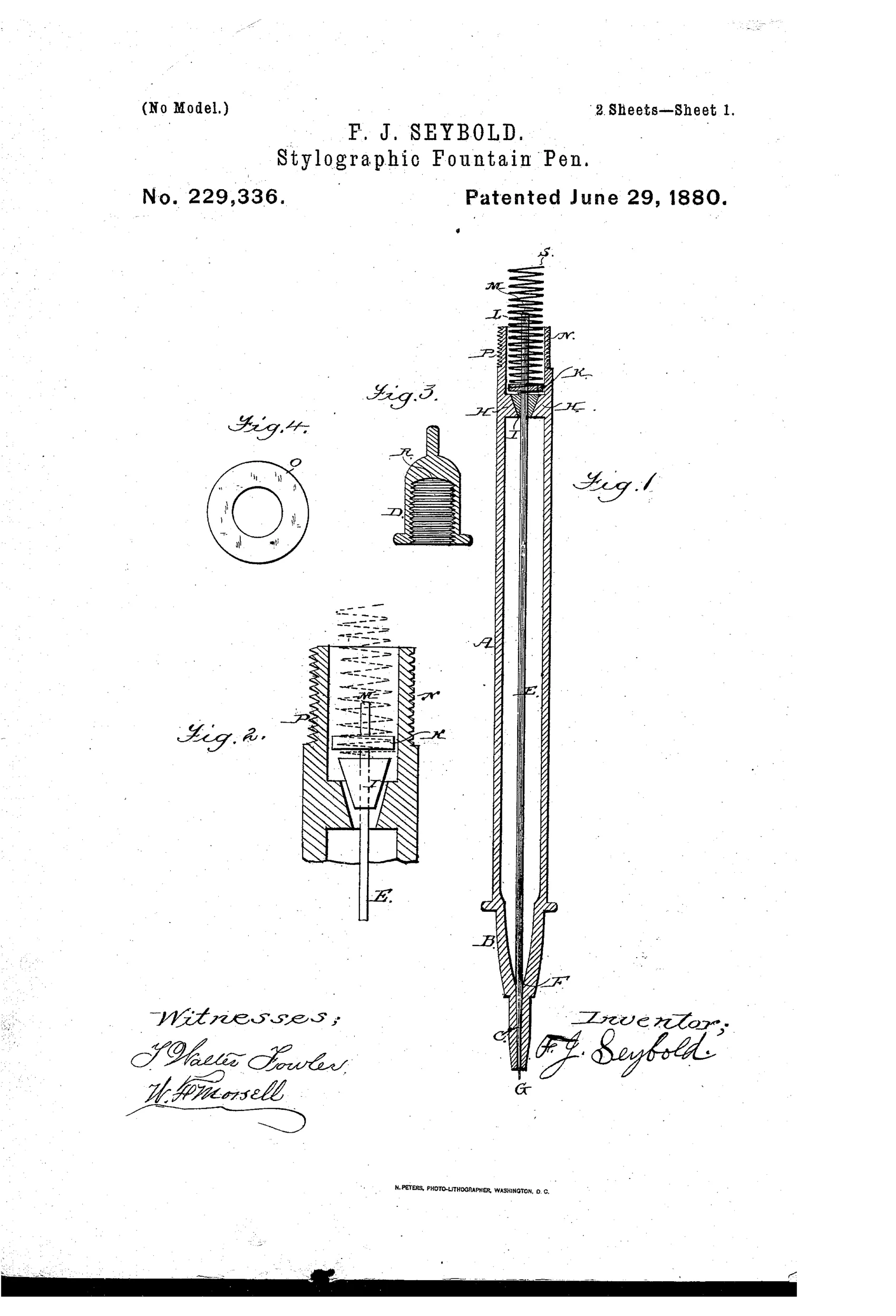
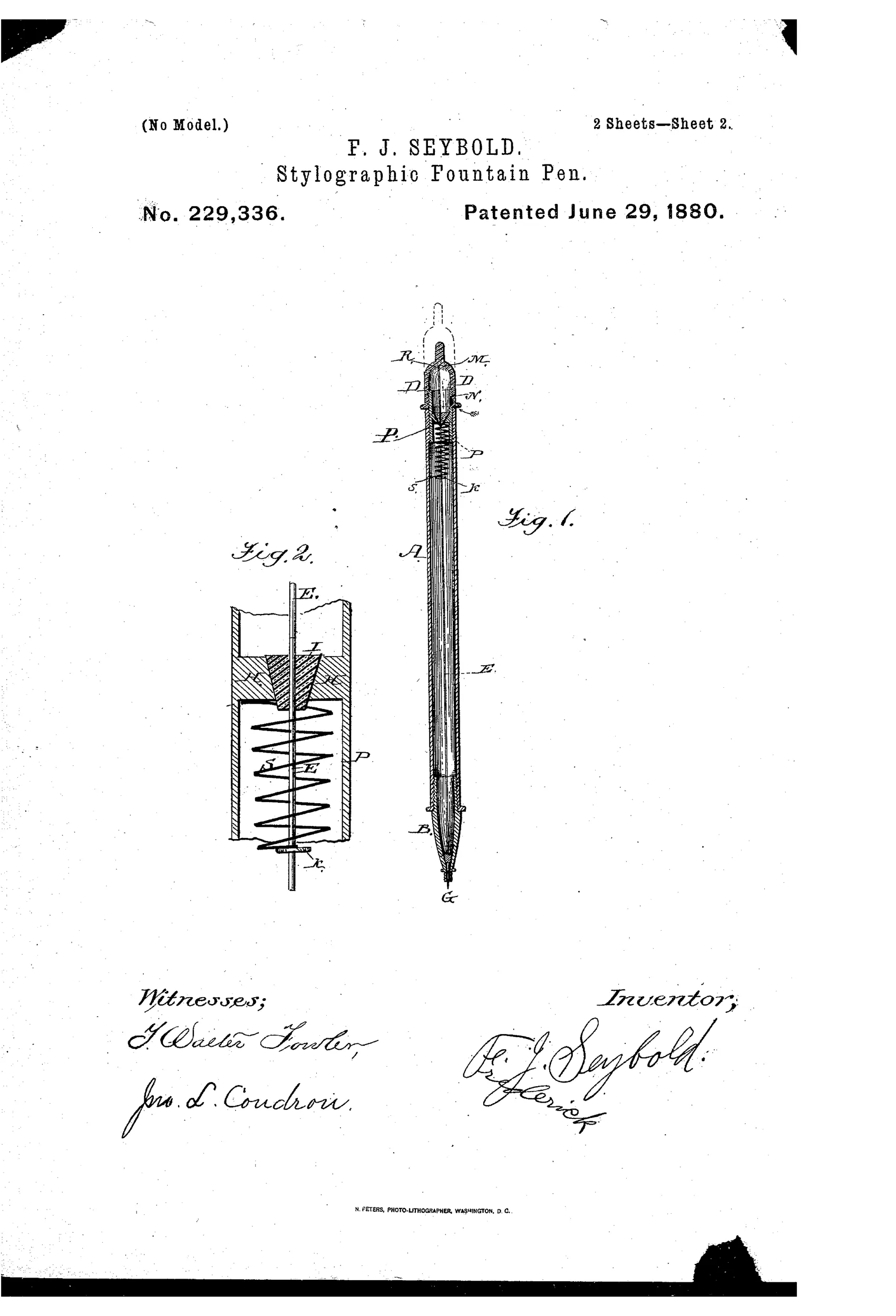
Valved stylographic fountain pen with needle point
✒ How it works
A spring-loaded needle (E) runs the full length of the pen's ink chamber and controls two valves, an air-valve (I) at the top and a tapering ink-valve (F) at the writing point. Pressing the needle's point (G) against paper raises the needle, opening both valves so ink flows down and out while air enters above the ink to replace it. When pressure is released, the spring (L) forces the needle back down, closing both valves to stop ink flow and prevent air from entering. A screw-on cap (D) can be adjusted to hold the needle fully closed when the pen is not in use, preventing any leakage.
✒ What was claimed
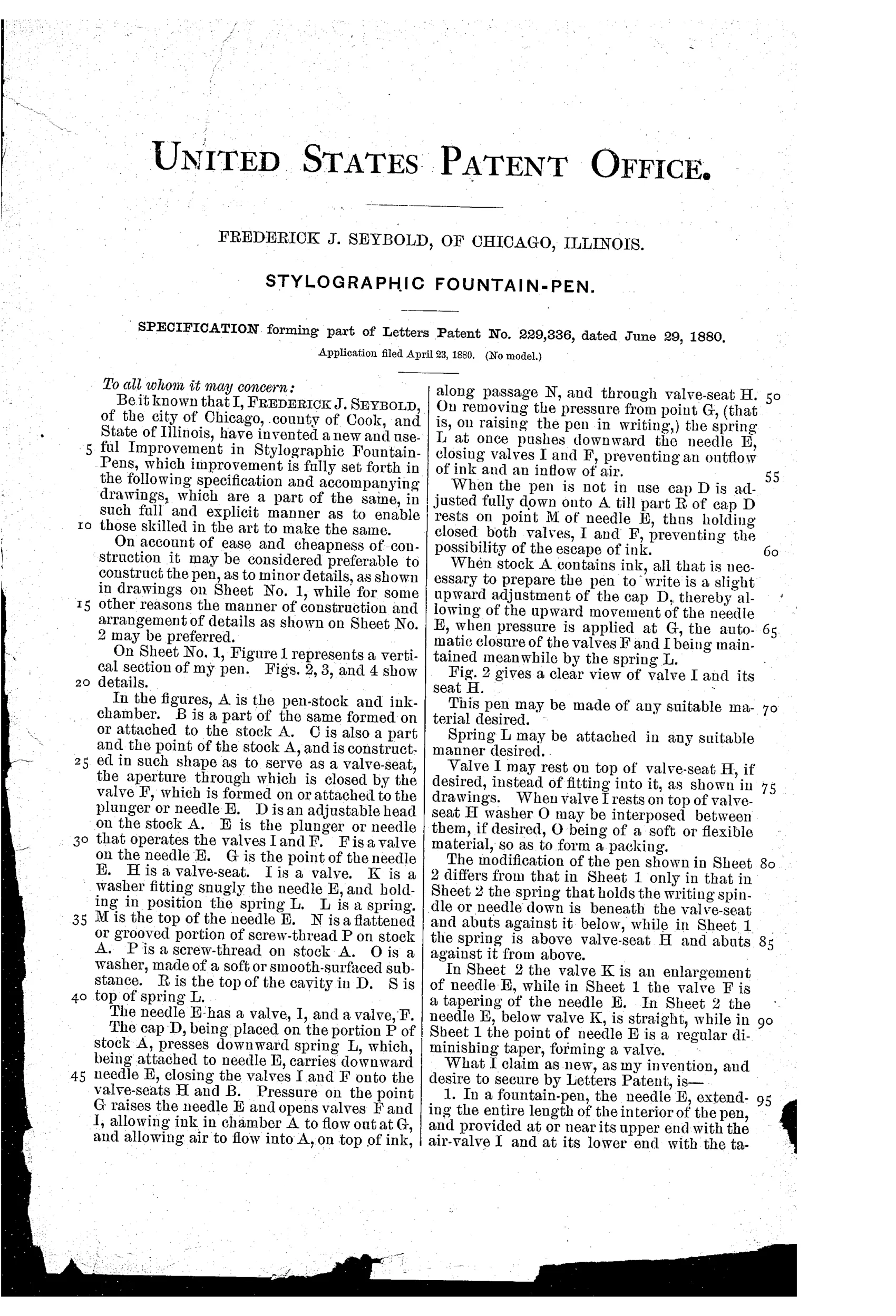
“In a fountain-pen, the needle E, extending the entire length of the interior of the pen, and provided at or near its upper end with the air-valve I and at its lower end with the taper ink-valve F, substantially as described, in combination with the pen-case A, provided with the valve-seats H and C, all substantially as described.”
In plain English: The invention is a full-length spring needle inside the pen that has an air valve at the top and a tapered ink valve at the bottom, working together with matching valve seats in the pen body to control ink flow.
✒ In the inventor’s words
“On removing the pressure from point G, (that is, on raising the pen in writing,) the spring L at once pushes downward the needle E, closing valves I and F, preventing an outflow of ink and an inflow of air.”— Frederick J. Seybold, from the specification
Paper patent — likely never produced
Seybold is not a known stylographic maker, the dual-valve mechanism is uncharacteristic of any surviving production pen, and no marked example is documented.
✒ More by Frederick J. Seybold
- STYLOGRAPHIC PEN. (1883)
✒ Commentary
Seybold filed this in the middle of the stylographic gold rush — Cross and MacKinnon were suing each other over needle-point pens at this very moment — and his angle is more ambitious than most. In the ordinary stylograph, the needle is just a loose wire that regulates flow at the tip. Seybold's needle E runs the entire length of the barrel and does double duty: press the point on paper and it lifts, simultaneously opening a tapered ink valve F at the tip and an air valve I at the top of the chamber. Lift the pen and spring L snaps both shut. Fig. 1 shows the whole scheme; Fig. 2 is worth a close look for how the upper valve seats against H.
The logic is sound — ink can't leave unless air can enter, so gating both at once gives positive control and, in theory, a pen that cannot leak in the pocket. The threaded cap D that locks the needle down for travel is a thoughtful touch.
The trouble is tolerances. Getting one long, slender needle to seat two valves simultaneously, and keep seating them as the rubber wears and the ink gums the seats, is asking a lot of 1880 manufacturing. The pens that actually succeeded — Cross's among them — did less and worked better, relying on capillarity rather than mechanical seals. Seybold's is a fascinating over-engineered branch of the stylographic tree, and probably a dead one.
Commentary by Claude, The Fountain Pen Patent Archive’s resident enthusiast