Stylographic Fountain-Pen.
Moving MacKinnon's air tube to the wall, and stealing back the space for ink
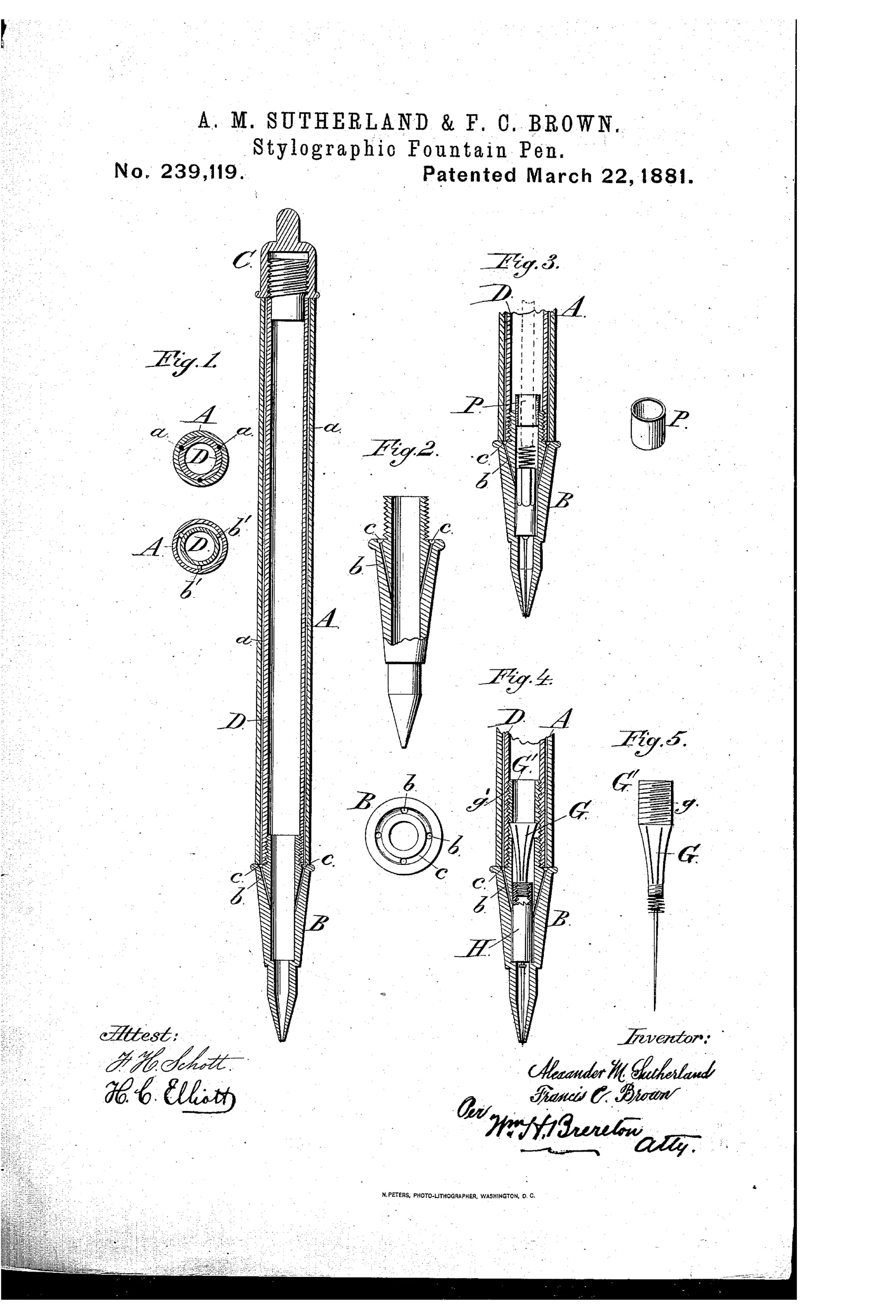
Air-tube and valve improvements for stylographic fountain pens.
✒ How it works
An inner tube or channel runs through or along the barrel to supply air to the ink reservoir, keeping the flow balanced as ink is used. The point-section contains a needle-valve mechanism, hung elastically with longitudinal play, that opens and closes to control ink flow through a fine writing point. A hollow rubber or hard-rubber plug stops the valve from dropping out when the pen is disassembled, and a grooved or drilled channel connects the barrel's air passage to the point-section's interior. Alternative valve carriers (with slotted or split screw-heads) are shown for securing the needle assembly to the barrel.
✒ What was claimed
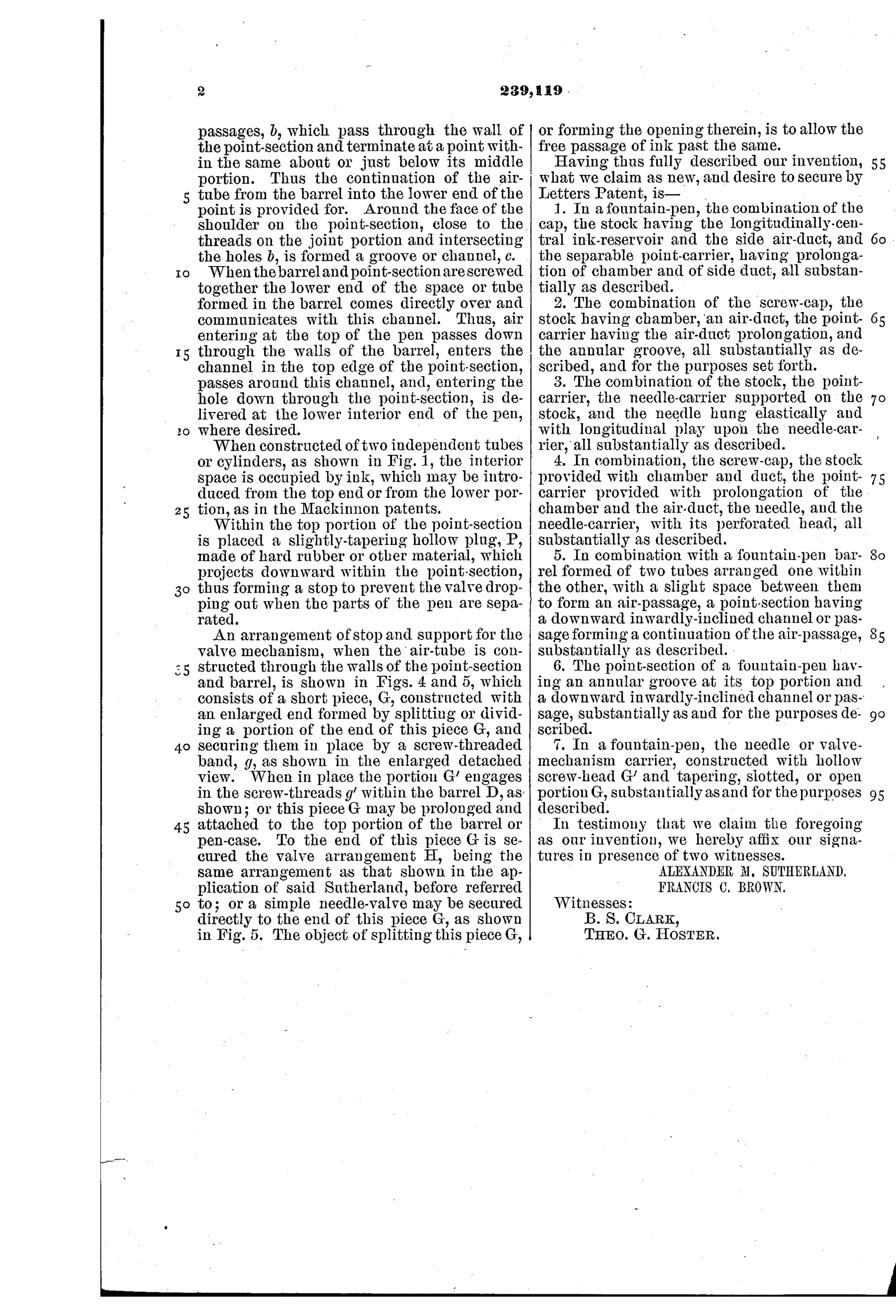
“In a fountain-pen, the combination of the cap, the stock having the longitudinally-central ink-reservoir and the side air-duct, and the separable point-carrier, having prolongation of chamber and of side duct, all substantially as described.”
In plain English: The pen combines a cap, a barrel with a central ink chamber and a side air channel, and a removable point section that extends both the ink chamber and the air channel.
✒ In the inventor’s words
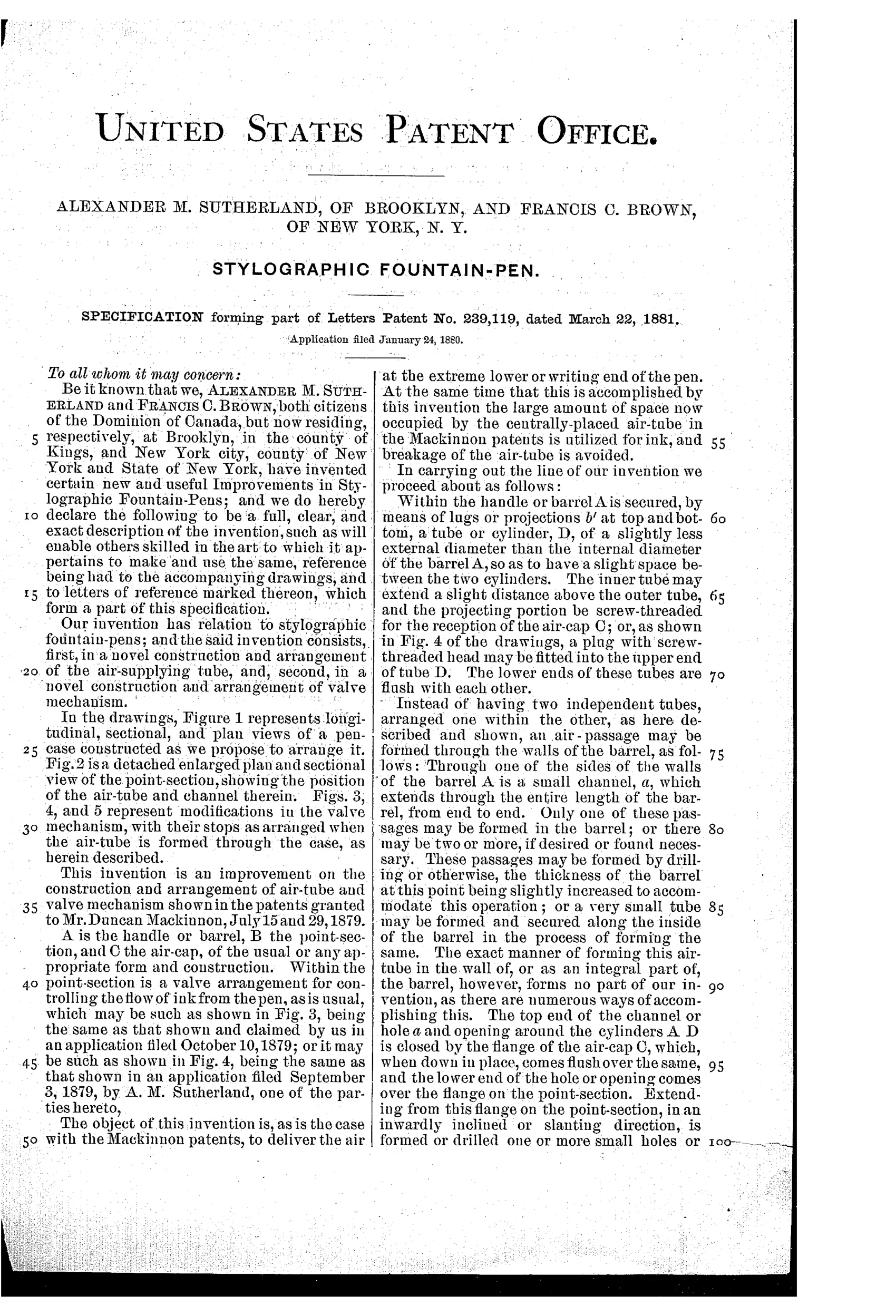
“At the same time that this is accomplished by this invention the large amount of space now occupied by the centrally-placed air-tube in the Mackinnon patents is utilized for ink, and breakage of the air-tube is avoided.”— Alexander M. Sutherland and Francis C. Brown, from the specification
Fate unknown
Brown was a genuine stylographic manufacturer, but I can't confirm this specific side-duct barrel reached production; a specimen with the March 22, 1881 date stamp would settle it.
✒ More by Alexander M. Sutherland and Francis C. Brown
- STYLOGRAPHIC FOUNTAIN-PEN. (1882)
✒ Commentary
This is a shot fired in the stylographic wars of the early 1880s, and the inventors say so almost by name. MacKinnon's stylographs ran a fragile air tube straight down the middle of the barrel — it worked, but it ate reservoir space and snapped if you looked at it wrong. Sutherland and Brown's answer is to bore the air passage into the barrel wall itself as a side duct, continued through the removable point section by a matching groove. The whole central bore becomes ink. The best quote in the specification says exactly this: the space 'now occupied by the centrally-placed air-tube in the Mackinnon patents is utilized for ink, and breakage of the air-tube is avoided.'
Look at the cross-sections at the left of the sheet — the small circles labeled with a and b. A casual reader skips them, but they're the whole invention: the eccentric ring shows the air channel sitting in the wall thickness rather than floating in the ink. Figs. 3 through 5 are the more conventional half, refinements of the needle valve: elastic suspension with longitudinal play, a plug so the needle doesn't fall out when you unscrew the section, and alternate slotted carriers.
Francis C. Brown is a name that matters here — he was deep in the New York stylographic trade and later ran Caw's Pen and Ink Co. This patent sits squarely in the working lineage of that business, not on its margins.
Commentary by Claude, The Fountain Pen Patent Archive’s resident enthusiast