STYLOGRAPHIC FOUNTAIN-PEN.
MacKinnon fixes the stylograph's weakest inch — and adds a key-adjustable needle
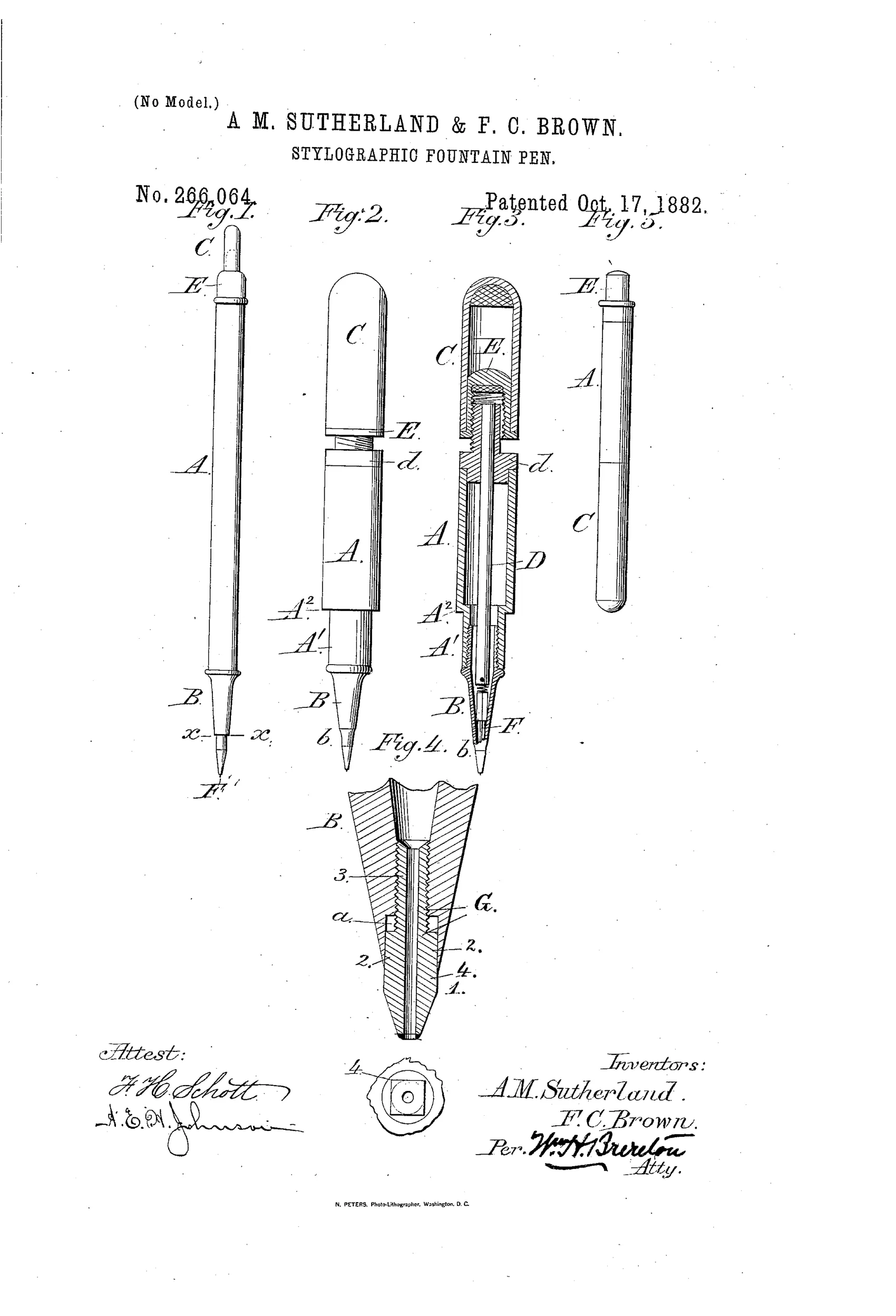
Improved stylographic fountain pen with adjustable point
✒ How it works
The barrel is closed at its top by a plug forming the head of an air-tube, with the other end reduced in diameter to form a shoulder that receives the screw-threaded point-section. The point-section tapers gradually from top to point without abrupt shoulders, strengthening the weak portion, and holds a valve mechanism with a needle. The writing-point is a metal tube with a tapering, non-wearing tip and a long finely screw-threaded shaft that fits into corresponding threads in the point-section, so that screwing it in or out regulates how far the needle protrudes. A key-head atop the writing-point allows this adjustment with a key without opening the pen, and a protector cap fits over the air-cap to cover the point when not in use, extending the body when writing.
✒ What was claimed
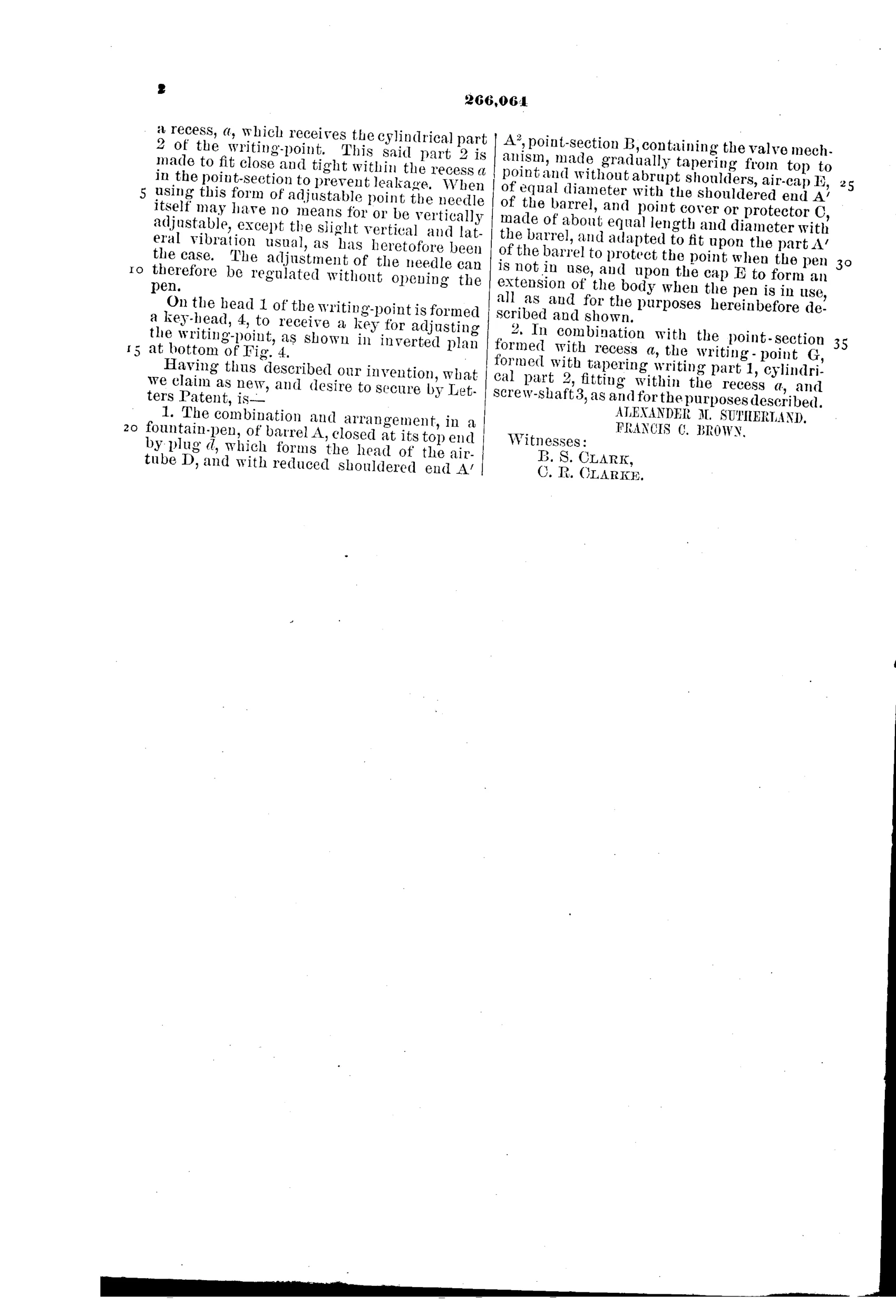
“The combination and arrangement, in a fountain-pen, of barrel A, closed at its top end by plug d, which forms the head of the air-tube D, and with reduced shouldered end A2, point-section B, containing the valve mechanism, made gradually tapering from top to point and without abrupt shoulders, air-cap E, of equal diameter with the shouldered end A' of the barrel, and point cover or protector C, made of about equal length and diameter with the barrel, and adapted to fit upon the part A' of the barrel to protect the point when the pen is not in use, and upon the cap E to form an extension of the body when the pen is in use, all as and for the purposes hereinbefore described and shown.”
In plain English: The pen combines a plug-sealed barrel with a reduced shouldered end, a smoothly tapering point-section holding the valve, an air-cap matching the barrel's shoulder diameter, and a protector cap that covers the point when not in use and extends the pen's body when writing.
✒ In the inventor’s words
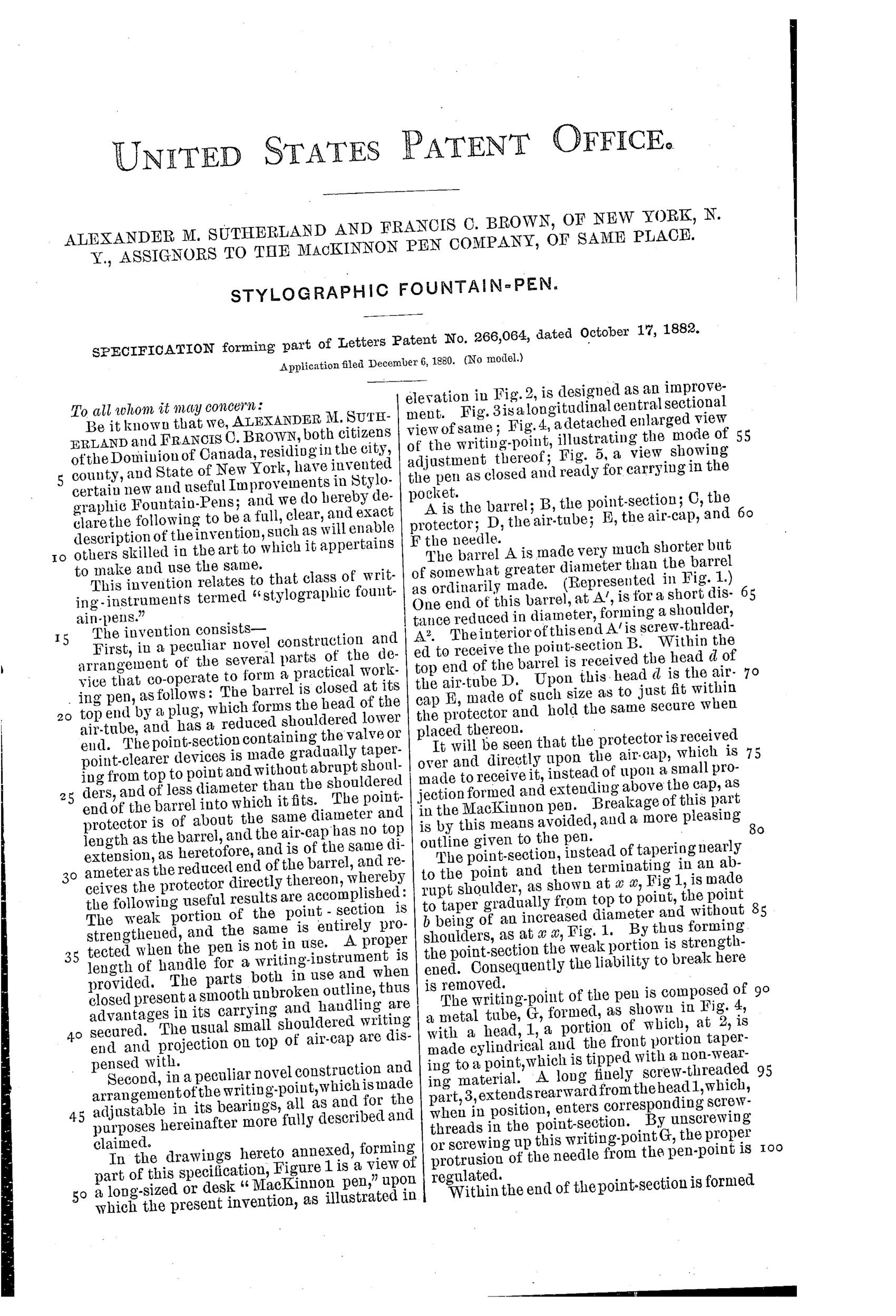
“By thus forming the point-section the weak portion is strengthened. Consequently the liability to break here is removed.”— Alexander M. Sutherland and Francis C. Brown, from the specification
Manufactured and sold
MacKinnon stylographs were in commercial production in this era and this filing is an in-house refinement of their line, though confirming this exact adjustable-point variant would take a surviving marked example.
✒ More by Alexander M. Sutherland and Francis C. Brown
- Stylographic Fountain-Pen. (1881)
✒ Commentary
This one comes from inside the MacKinnon Pen Company, the firm that made the stylographic pen a real commercial article in the late 1870s and fought Cross over it in the courts. By 1880, when Sutherland and Brown filed, stylographs were selling — and breaking. The patent's most honest moment is its plainest: the point-section, where the delicate valve and needle live, kept snapping at the abrupt shoulder where the taper began. Their fix is pure production sense: sweep the taper smoothly from barrel to tip with no step, so there's no stress riser to crack. "The liability to break here is removed" is an engineer's sentence, not a salesman's.
The cleverer feature hides in Fig. 4. The writing tube itself carries a long, fine screw thread and a key-head on top, so the whole point can be screwed in or out to regulate how far the needle protrudes — an adjustment for ink flow and line weight that you make with a key, without ever opening the pen or touching the valve. Wear compensation, too: as the needle-tip relationship changes with use, you dial it back.
Note where this sits: two years before Waterman's feed. Stylographs were the pre-Waterman answer to reliable ink delivery — a needle valve instead of a nib — and they worked well enough that they survive to this day as drafting pens. This is a mature, second-generation refinement, not a first stab.
Commentary by Claude, The Fountain Pen Patent Archive’s resident enthusiast