IMPROVEMENT IN FOUNTAIN-PENS
A paintbrush hidden behind the nib, feeding ink by capillarity in 1860
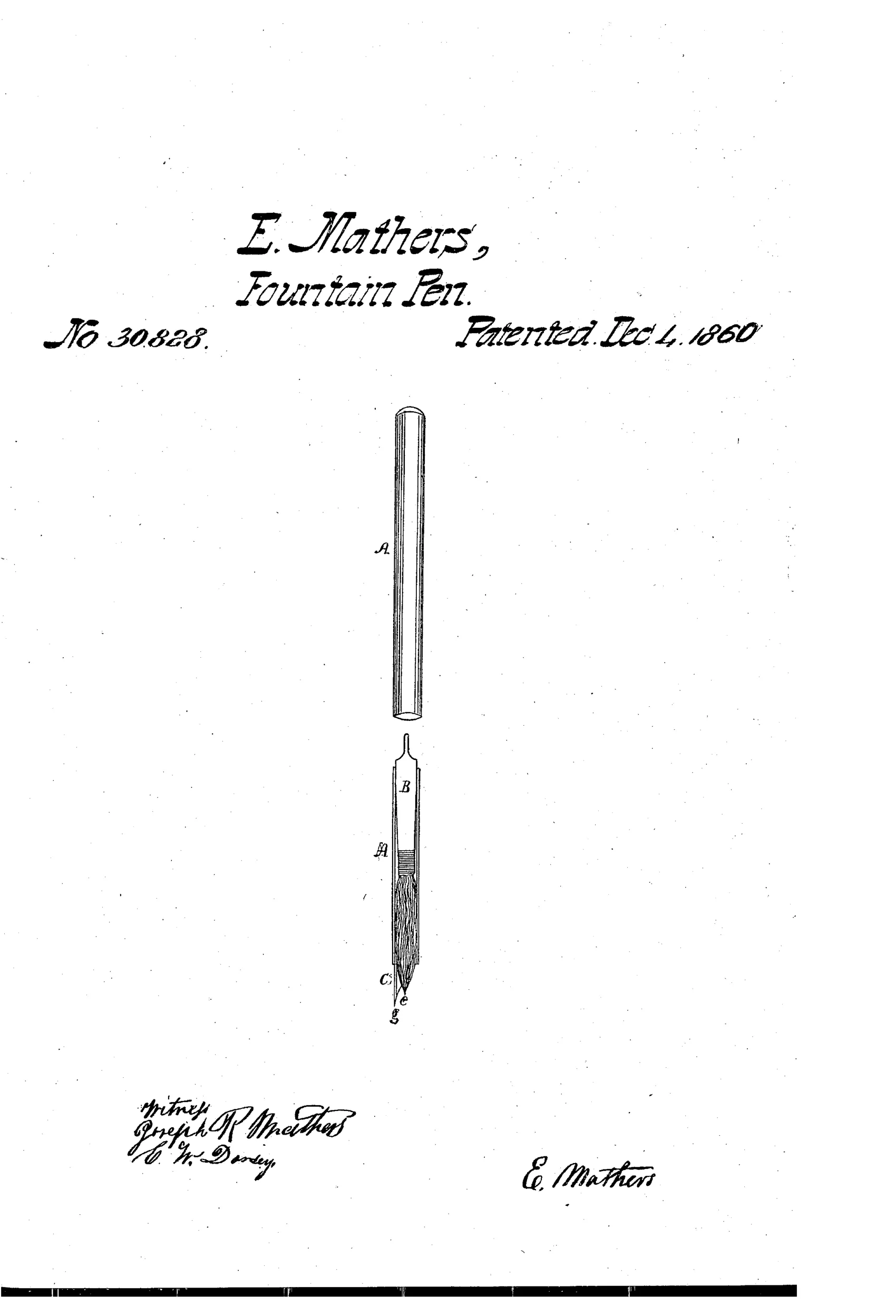
Fountain pen with hair-brush ink reservoir
✒ How it works
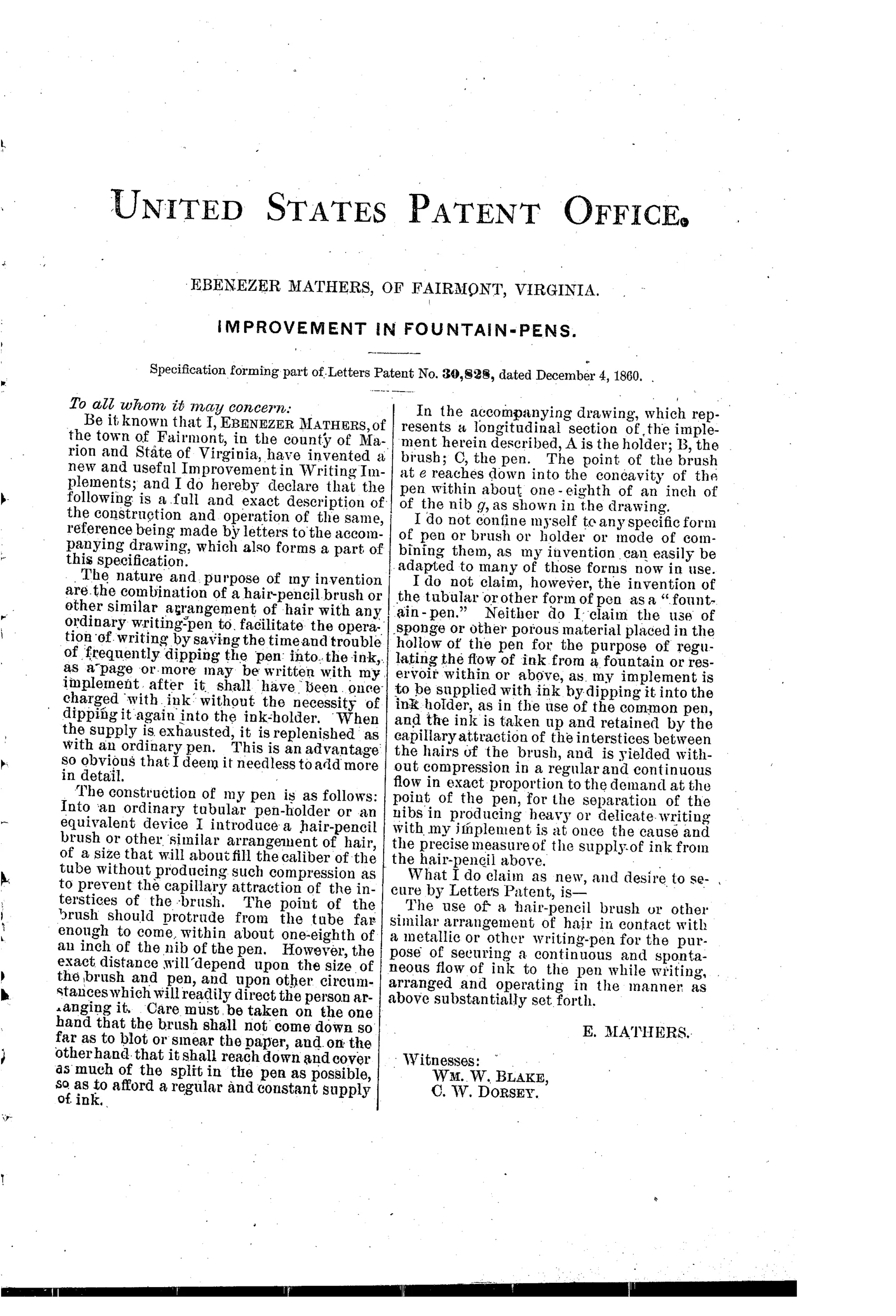
A hair-pencil brush or similar hair arrangement is inserted into an ordinary tubular pen-holder, sized to fill the tube's caliber without compressing the hairs. The brush point protrudes to within about one-eighth of an inch of the pen's nib, contacting the split in the pen. Ink is drawn up and held by capillary attraction between the hairs of the brush, then released in a steady flow proportional to the demand at the writing point. The device is recharged by dipping the whole implement into an ink holder, as with a common pen, rather than using a sponge or reservoir.
✒ What was claimed
“The use of a hair-pencil brush or other similar arrangement of hair in contact with a metallic or other writing-pen for the purpose of securing a continuous and spontaneous flow of ink to the pen while writing, arranged and operating in the manner as above substantially set forth.”
In plain English: The invention claims placing a hair brush in contact with a pen's nib to provide a steady, self-regulating flow of ink while writing.
✒ In the inventor’s words
“When the supply is exhausted, it is replenished as with an ordinary pen.”— Ebenezer Mathers, from the specification
Fate unknown
The device is cheap enough that small production is plausible, but no marked or documented example is known; a surviving specimen would settle it.
✒ Patented the same day
- FOUNTAIN-PEN — G. W. Woolley
✒ Commentary
Ebenezer Mathers of Fairmont, Virginia, looked at the fountain pen problem — how do you hold more ink than a dip will carry, and let it out only as fast as the nib needs it — and reached for the humblest possible answer: stuff a hair-pencil brush into an ordinary tubular holder so its point rests against the nib's slit. The hairs hold a charge of ink by capillary attraction and surrender it, in his words, in a flow proportional to the demand at the writing point. You recharge by dipping the whole thing, like a common pen.
What's easy to miss in the drawing is how honest the geometry is. The brush B fills the tube's bore without compressing the hairs — Mathers understood that packed hair loses its capillary channels — and the point stops an eighth of an inch shy of the nib tip, so it feeds the slit rather than dragging on paper. That's a real, if crude, statement of the principle Waterman would formalize in 1884: regulated capillary delivery, ink out at the rate the pen writes.
It is still a dip pen with a bigger tank, not a true reservoir pen, and hair swells, mats, and clogs with dried ink. But as a pre-Waterman attempt it's charmingly minimal — no valves, no pistons, just physics you could buy at an art-supply counter.
Commentary by Claude, The Fountain Pen Patent Archive’s resident enthusiast