FOUNTAIN-PEN
A finger-pumped valve pen from 1863, dosing ink stroke by stroke
Adjustable-flow fountain pen with valve mechanism
✒ How it works
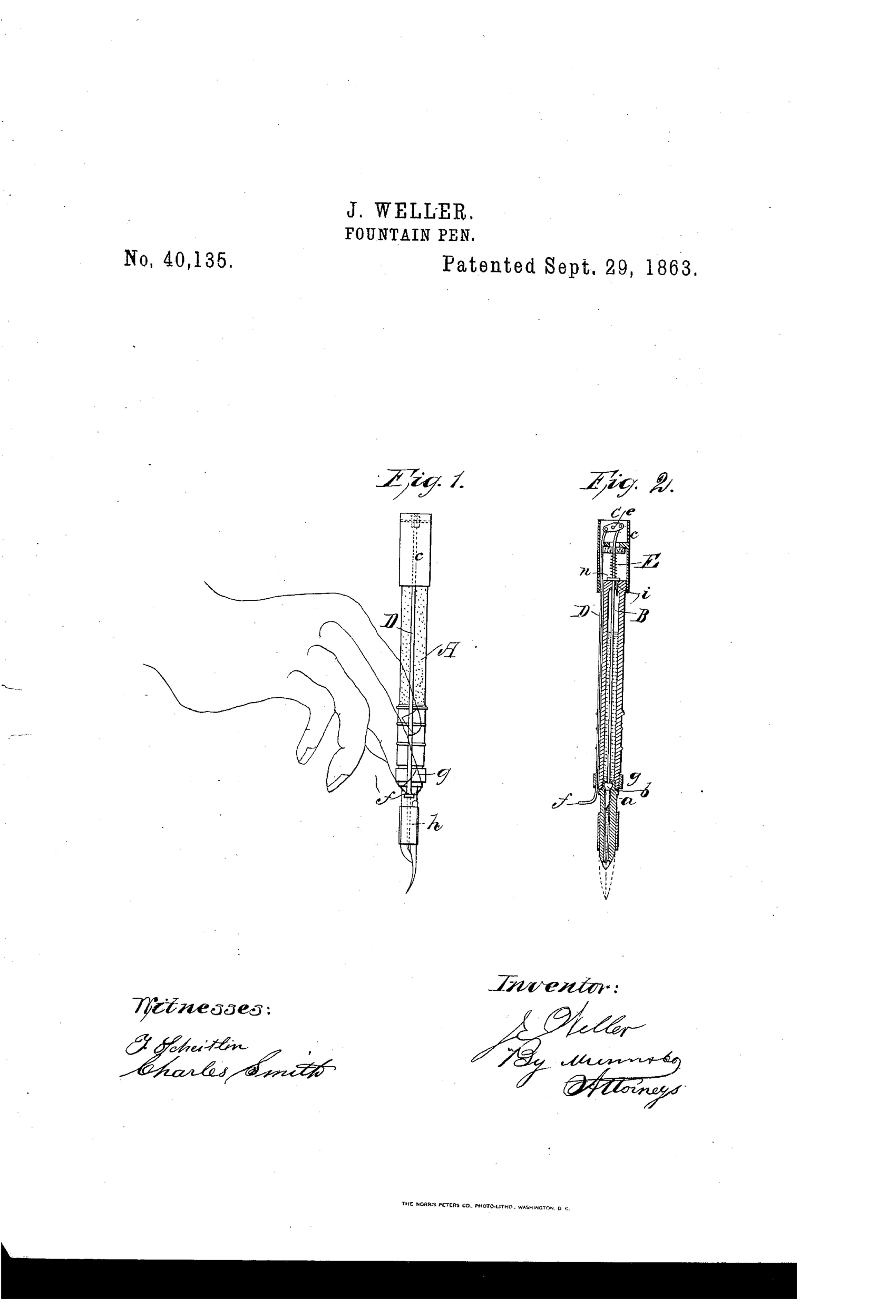
A tubular case forms both the ink fountain and holder, with an inner tube (a) carrying fluid to the nib via a screw-threaded, tight-fitting joint. A central rod (B) with a conical shoulder or stopper (b) normally seals a countersink in the tube, blocking ink flow, while a plug (i) simultaneously seals an air-vent above the fountain. Pressing a foot (f) on an external rod (D) pivots a rocking lever (C), which lifts both the stopper and the air-vent plug together, admitting air and releasing ink through the tapering rod to the pen. Releasing pressure lets a helical spring (E) return the stopper and plug to their sealed positions, stopping the flow.
✒ What was claimed
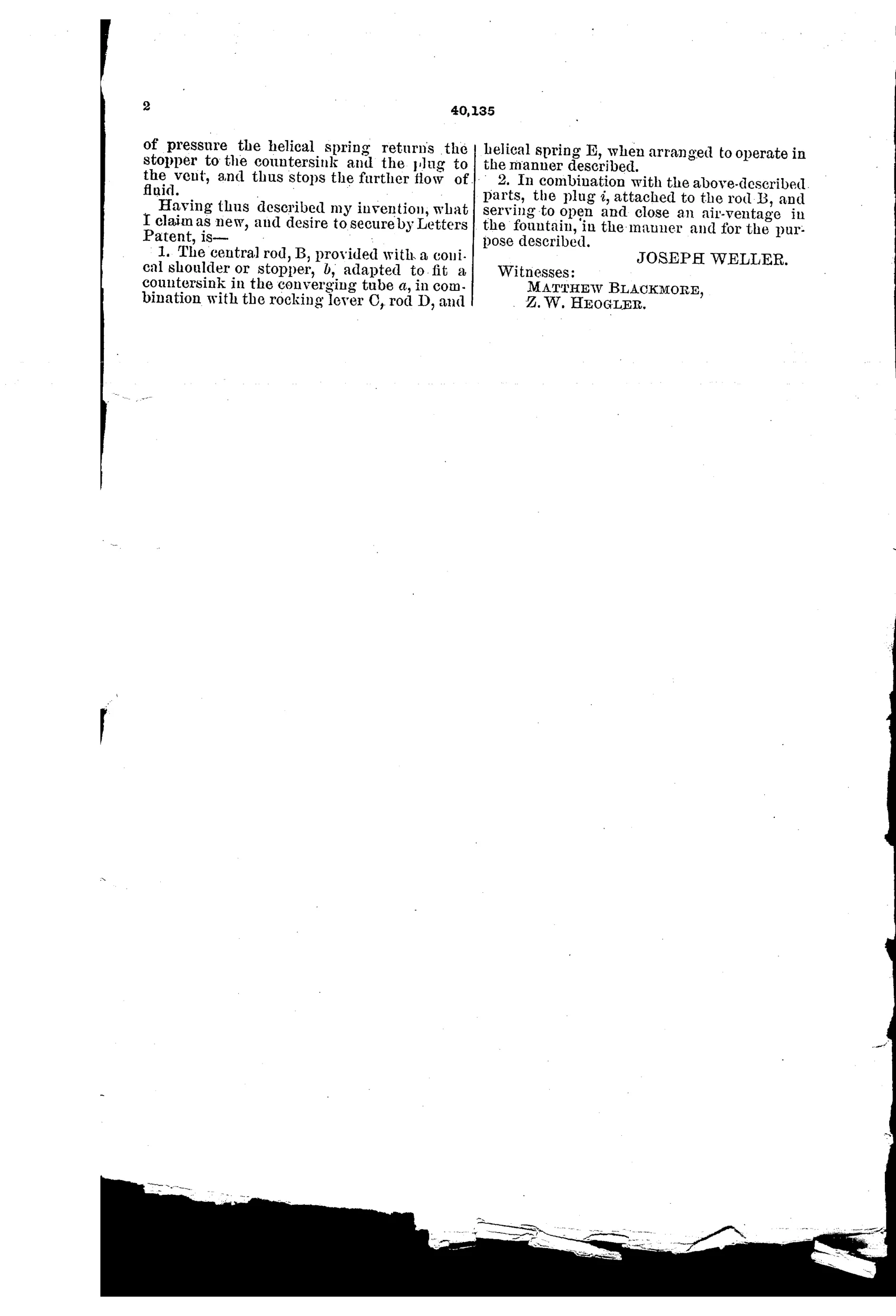
“1. The central rod, B, provided with a conical shoulder or stopper, b, adapted to fit a countersink in the converging tube a, in combination with the rocking lever C, rod D, and helical spring E, when arranged to operate in the manner described.”
In plain English: A claim covering the central rod with a cone-shaped stopper that fits a matching taper in the ink tube, working together with a rocking lever, control rod, and spring to regulate ink flow.
✒ In the inventor’s words
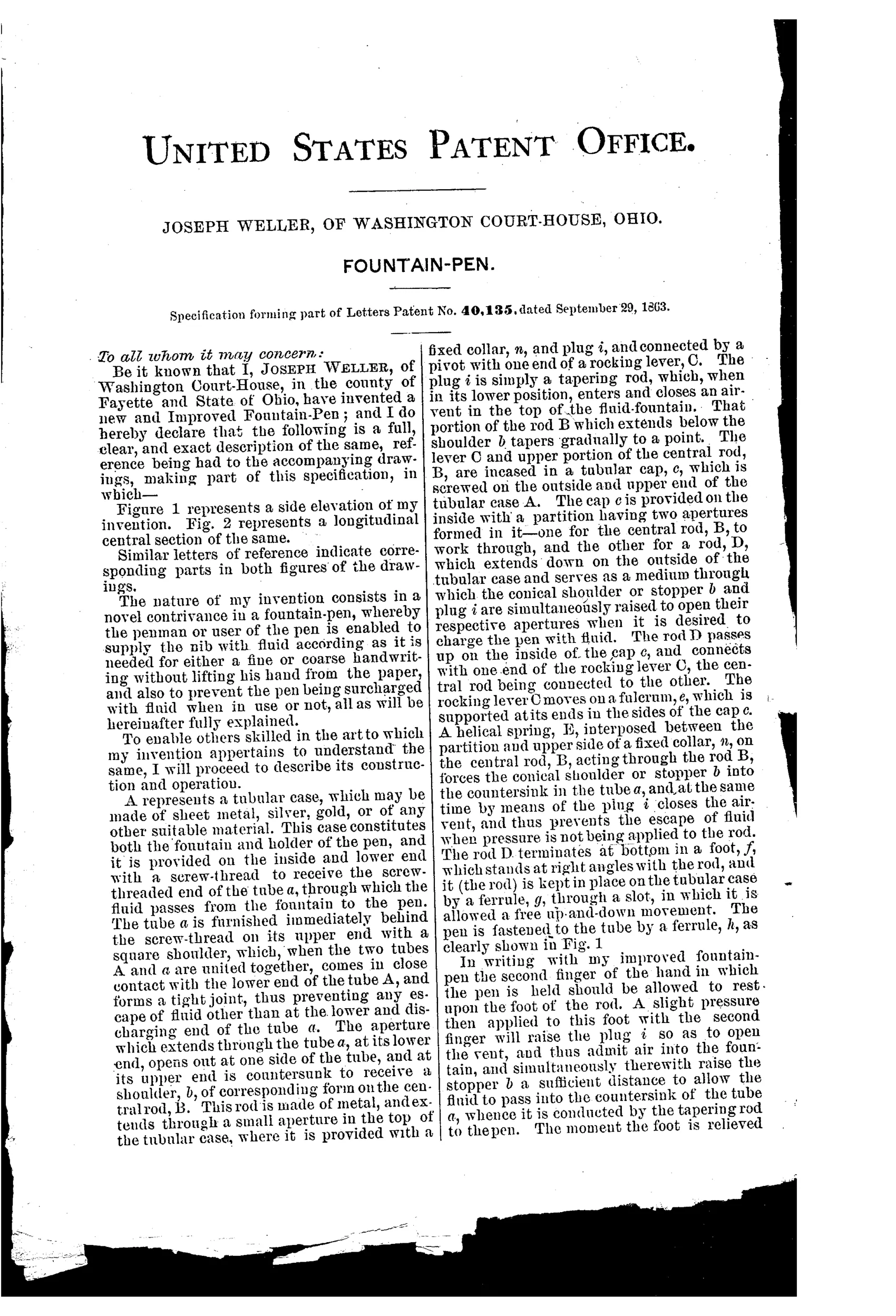
“The nature of my invention consists in a novel contrivance in a fountain-pen, whereby the penman or user of the pen is enabled to supply the nib with fluid according as it is needed for either a fine or coarse handwriting without lifting his hand from the paper, and also to prevent the pen being surcharged with fluid when in use or not, all as will be hereinafter fully explained.”— Joseph Weller, from the specification
Paper patent — likely never produced
No Weller-marked pen or production record is known, and the machined double-valve linkage would have been costly to build in 1863; a surviving example would overturn this.
✒ Commentary
Twenty-one years before Waterman solved ink flow with capillary channels, Joseph Weller of Washington Court-House, Ohio, tried to solve it with plumbing. His pen is essentially a shut-off valve you operate with your writing hand: the barrel is the reservoir, a conical stopper seals a matching countersink at the bottom, and pressing the little foot (f, visible under the index finger in Fig. 1) rocks a lever that lifts the stopper. Release, and a helical spring snaps it shut.
The genuinely thoughtful detail is easy to miss in Fig. 2: the same lever that lifts the ink stopper also lifts a plug (i) sealing an air vent at the top. Weller understood the core problem of every early reservoir pen — ink can't leave unless air gets in, and if air gets in uncontrolled, ink floods out. His answer was to gate both openings with one motion, so the pen is hermetically dead except in the instant you ask it to feed. He even pitches it as flow control for fine versus coarse handwriting, adjusted without lifting hand from paper.
Where it fails is where all the pre-Waterman valve pens failed: the writer becomes the feed. You'd be pumping a spring-loaded valve mid-sentence, and the dose per press would be anything but repeatable. It's a dead end, but an intelligent one — mechanical regulation attempting what capillarity would later do passively, for free.
Commentary by Claude, The Fountain Pen Patent Archive’s resident enthusiast