FOUNTAIN-PEN
A Civil War-era rotary stopcock for ink, twenty years before Waterman
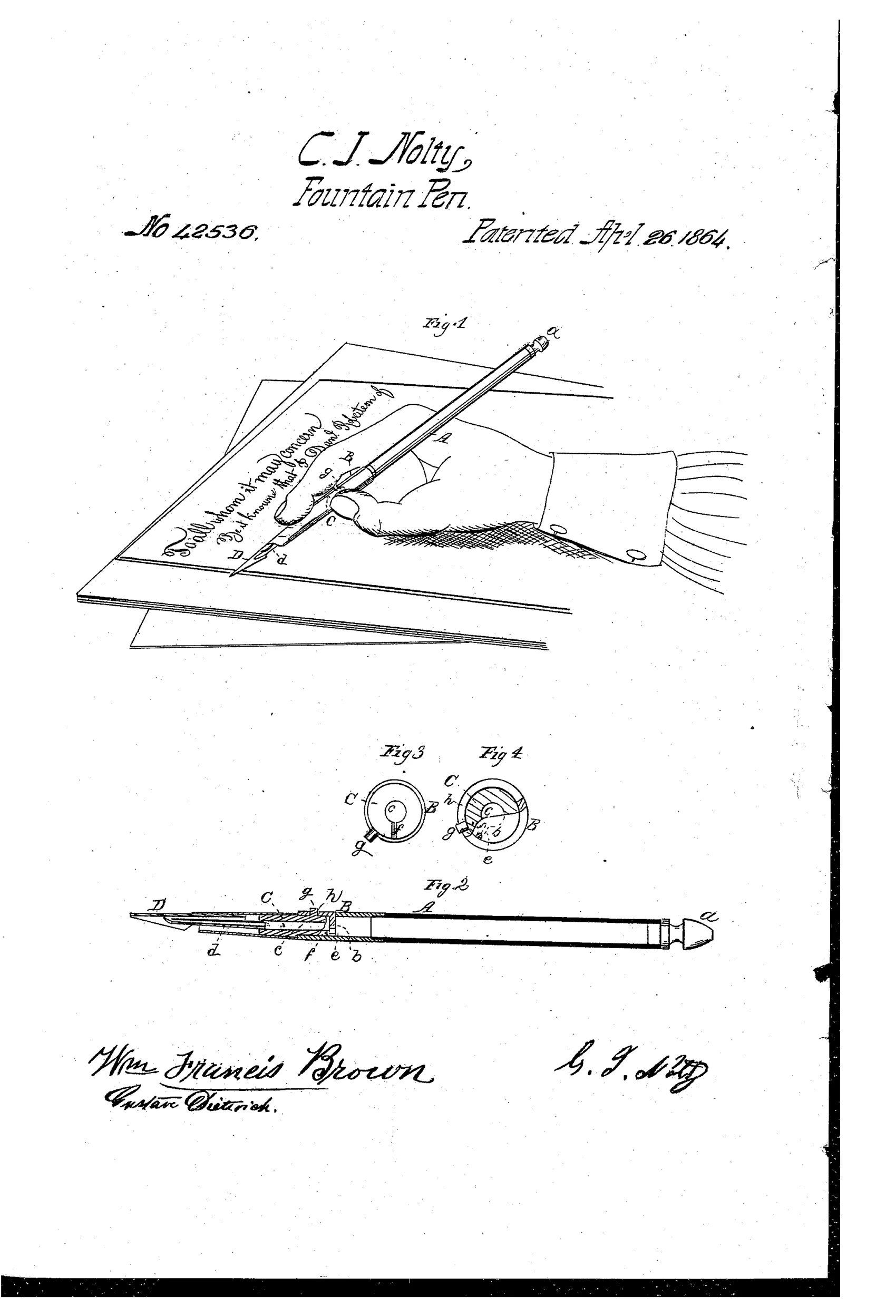
Fountain pen with adjustable ink-flow valve
✒ How it works
An ink-fountain tube A connects at its lower end to a socket B containing a stationary partition b with a small hole e near its edge. A rubber plug C fits into the socket against the partition, with a central channel c and a face groove f leading to it. Turning the plug via a button g projecting through a slot h aligns or misaligns the groove with the hole, thereby starting or stopping the flow of ink through tube d to the pen nib D.
✒ What was claimed
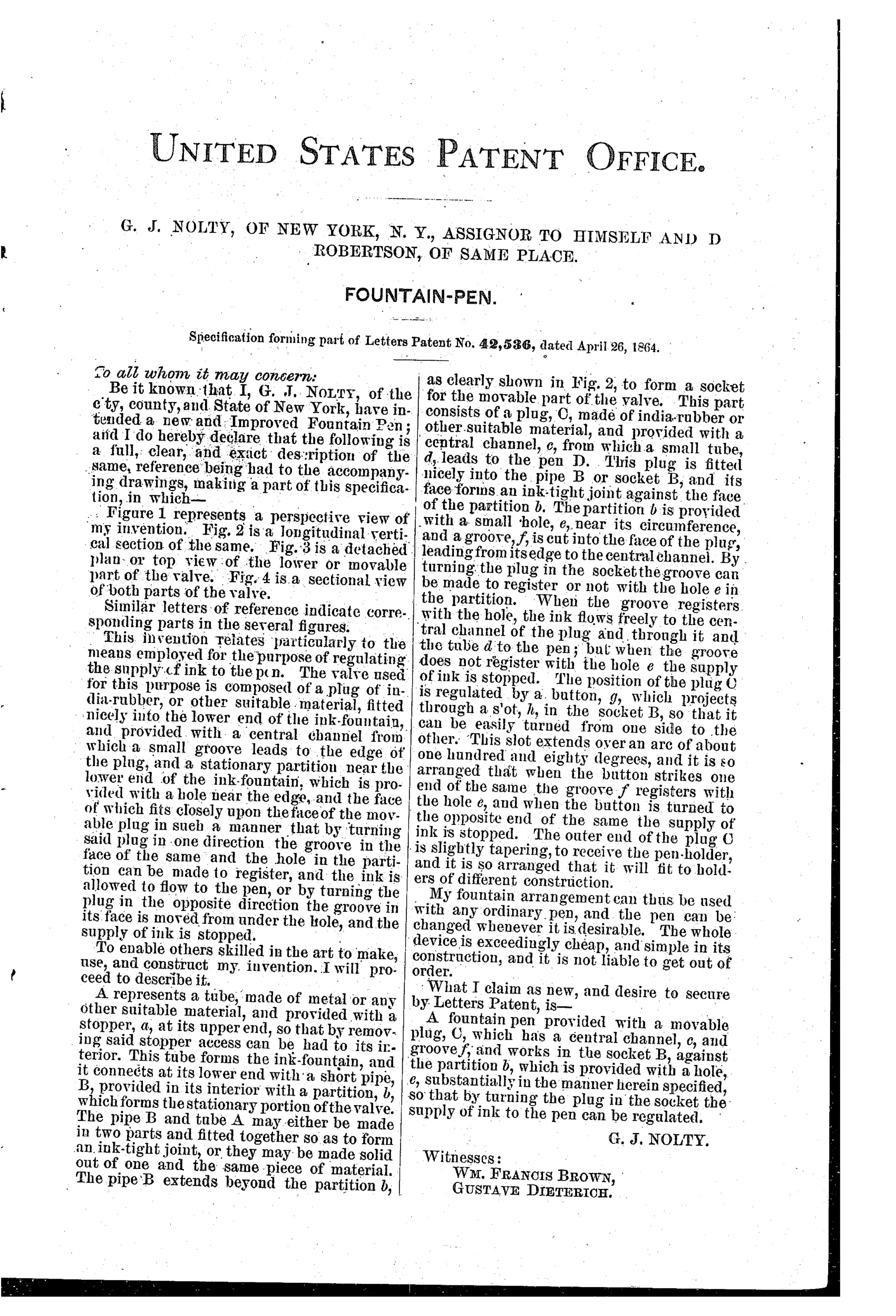
“A fountain pen provided with a movable plug, C, which has a central channel, c, and groove f, and works in the socket B, against the partition, b, which is provided with a hole, e, substantially in the manner herein specified, so that by turning the plug in the socket the supply of ink to the pen can be regulated.”
In plain English: The invention claims a fountain pen with a rotatable rubber plug that has a channel and groove fitting into a socket with a partition hole, so turning the plug controls the ink flow to the pen.
✒ In the inventor’s words
“The whole device is exceedingly cheap, and simple in its construction, and it is not liable to get out of order.”— G. J. Nolty, from the specification
Fate unknown
The assignment to D. Robertson suggests commercial intent, but no marked example is documented; a surviving pen with this valve would settle it.
✒ Commentary
This is 1864 — two decades before Waterman's capillary feed made fountain pens trustworthy — and Nolty's answer to the era's great problem is disarmingly direct: put a faucet in the pen. A rubber plug sits in a socket against a fixed partition; the partition has a small hole near its edge, the plug has a groove leading to a central channel. Twist a little button riding in a slot and the groove either meets the hole or doesn't. Ink on, ink off, or anything in between.
Figures 3 and 4 are the ones to study. That face groove f is the whole invention: rather than a valve that merely opens and closes, the degree of overlap between groove and hole throttles the flow. Nolty is claiming an adjustable regulator, not just a shutoff, which is a genuinely thoughtful move in a decade when most reservoir pens simply drooled.
The trouble is what every pre-Waterman inventor missed: ink won't flow reliably unless air can get back into the reservoir. A valve controls the exit but does nothing to meter the exchange, so the pen would still run in gulps — flood when warm, starve when the vacuum builds. The patent's boast that it is 'exceedingly cheap, and simple' is fair, but simplicity aimed at the wrong problem. A charming, honest dead end from the era of doomed reservoir attempts, with an assignee already lined up.
Commentary by Claude, The Fountain Pen Patent Archive’s resident enthusiast