FOUNTAIN-PEN.
A loose ball inside the feed, hired to referee the ink flow
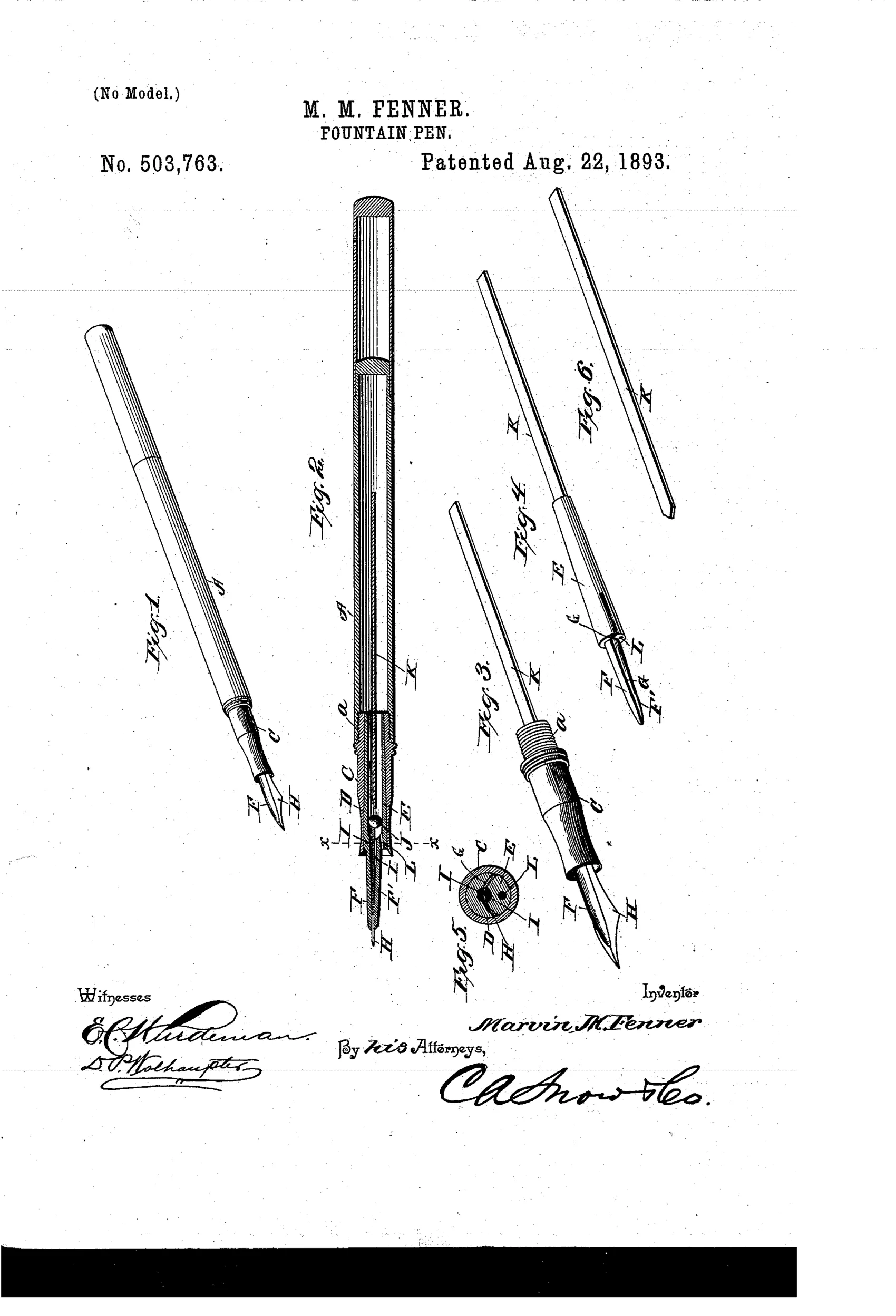
A double-feed fountain pen with regulating ball valve
✒ How it works
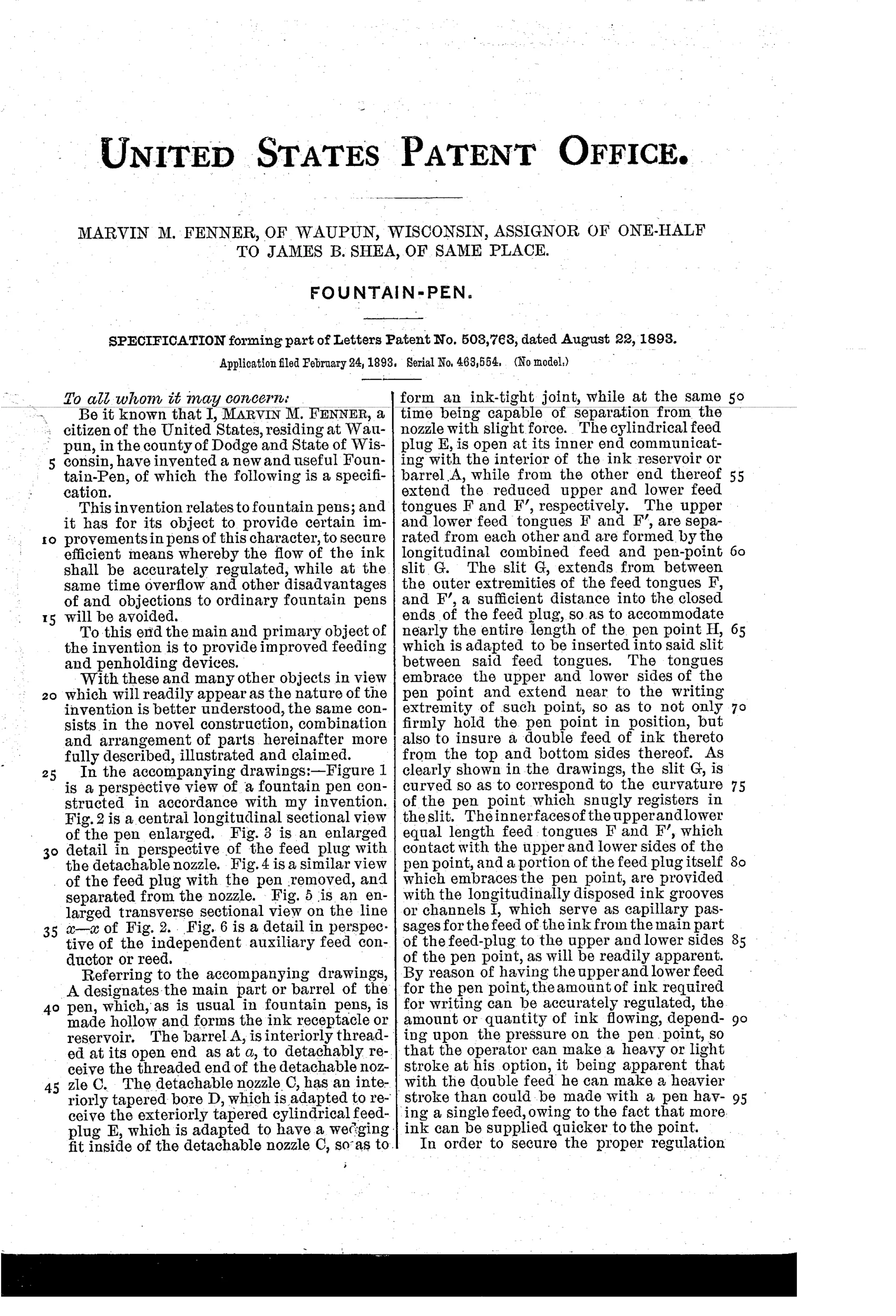
The pen barrel forms a hollow ink reservoir threaded to receive a detachable nozzle with a tapered bore. A tapered hollow feed plug wedges into the nozzle and has upper and lower feed tongues separated by a curved slit that grips the pen point from both sides, with capillary ink grooves feeding the top and bottom of the nib for a heavier or lighter stroke as desired. A ball valve rests inside the feed plug on the inner end of the pen point, using the ink's weight to regulate flow, while a separate flat conductor reed extends from the feed plug into the barrel to return ink and prevent bubbling; a vent hole under the lower tongue lets air escape without forcing ink out when the pen is capped.
✒ What was claimed
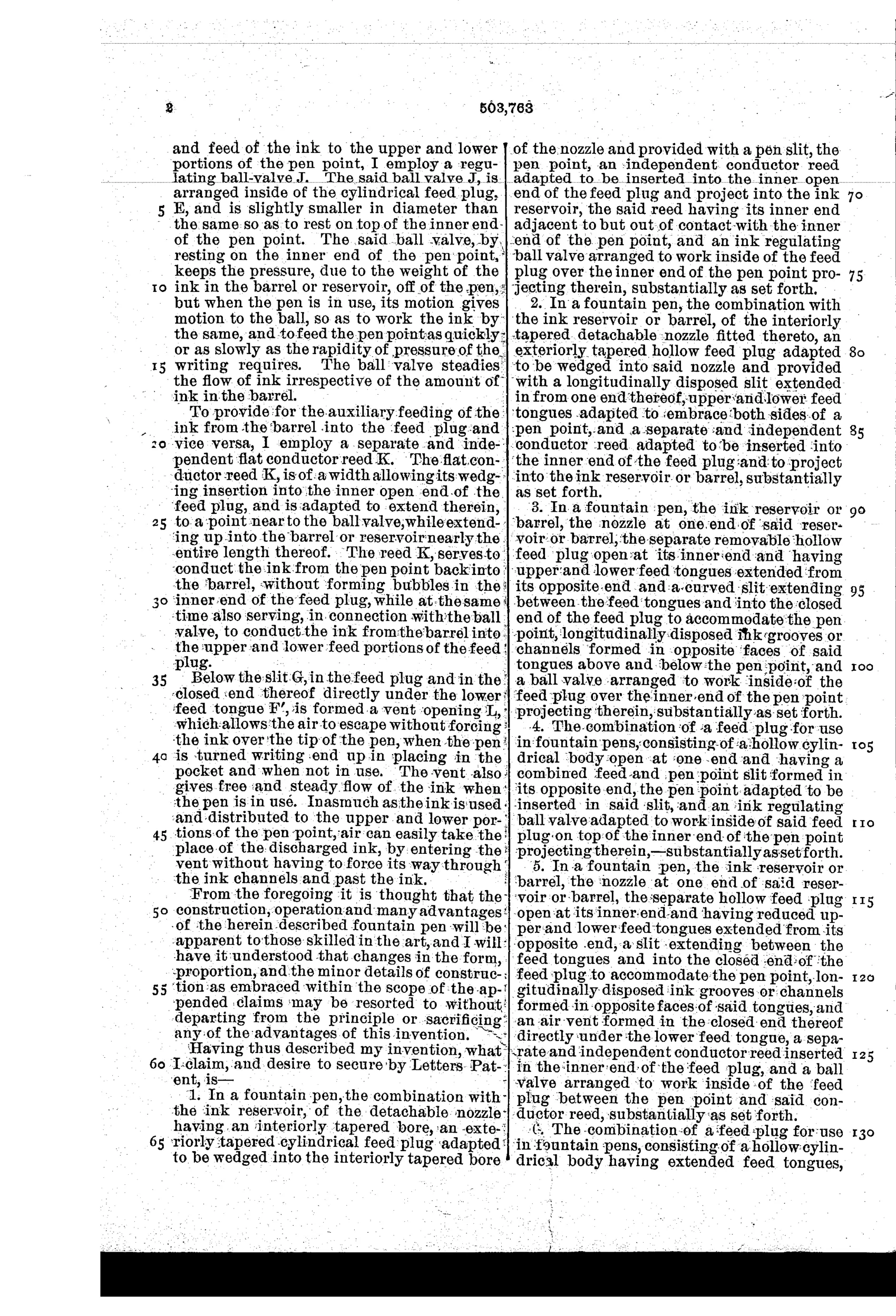
“1. In a fountain pen, the combination with the ink reservoir, of the detachable nozzle having an interiorly tapered bore, an exteriorly tapered cylindrical feed plug adapted to be wedged into the interiorly tapered bore of the nozzle and provided with a pen slit, the pen point, an independent conductor reed adapted to be inserted into the inner open end of the feed plug and project into the ink reservoir, the said reed having its inner end adjacent to but out of contact with the inner end of the pen point, and an ink regulating ball valve arranged to work inside of the feed plug over the inner end of the pen point projecting therein, substantially as set forth.”
In plain English: The pen combines a tapered detachable nozzle, a wedged feed plug slit to hold the pen point, a separate conductor reed reaching from the feed plug into the ink barrel without touching the nib, and a ball valve inside the feed plug that regulates ink flow over the nib's inner end.
✒ In the inventor’s words
“By reason of having the upper and lower feed for the pen point, the amount of ink required for writing can be accurately regulated, the amount or quantity of ink flowing, depending upon the pressure on the pen point, so that the operator can make a heavy or light stroke at his option.”— Marvin M. Fenner, from the specification
Fate unknown
Fenner and assignee Shea match no documented pen maker's line; a surviving marked specimen or trade advertisement would settle it.
✒ Commentary
Fenner's pen arrives nine years after Waterman's capillary feed showed the industry the way, and it hedges its bets. The double feed — tongues gripping the nib from above and below, with grooves on both faces — is a legitimate idea from the feed-wars era; over-and-under feeds were being tried by serious makers, on the theory that feeding both sides of the slit gave you finer control over line weight. His pitch that the writer 'can make a heavy or light stroke at his option' is the standard promise of that whole school.
The curiosity is the ball valve. A loose ball sits inside the feed plug, resting on the inner end of the nib, meant to use the ink's own weight to meter flow. Look at Fig. 2 and you can see how much faith this asks of a tiny sphere in a viscous, gummy liquid: ink residue, surface tension, and any tilt of the pen all conspire against a valve that must seat and unseat delicately hundreds of times per page. Waterman's insight was that you don't need moving parts — a fissure does the regulating. Fenner is adding a mechanism where physics already offered one for free.
The independent conductor reed reaching back into the barrel is the soundest piece here, an early anti-blobbing return channel. Workmanlike double feed, dubious valve — a snapshot of the field mid-argument.
Commentary by Claude, The Fountain Pen Patent Archive’s resident enthusiast