FOUNTAIN-PEN
An 1865 valve pen that already grasped the feed's job — twenty years early
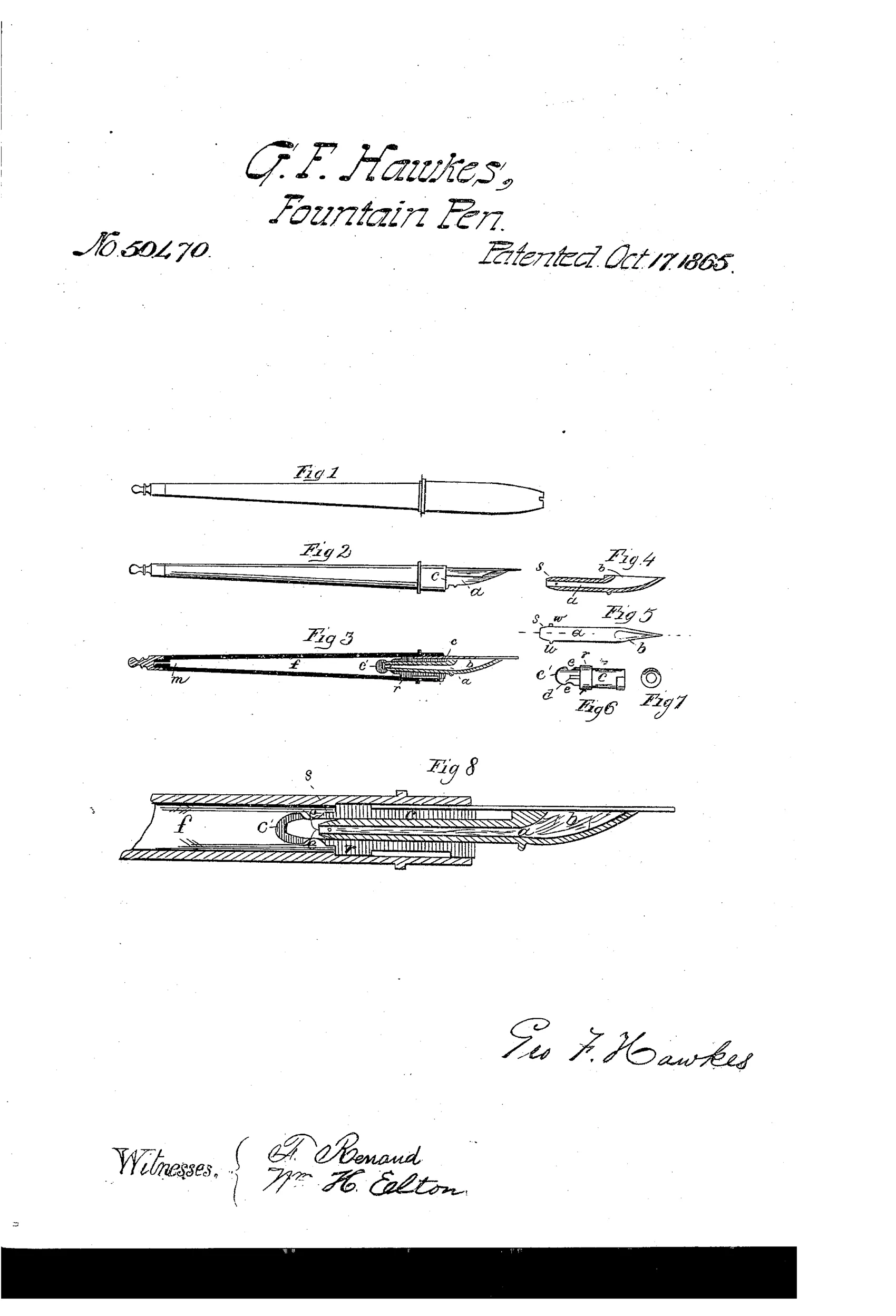
Fountain pen with sliding ink-feeder and stopper
✒ How it works
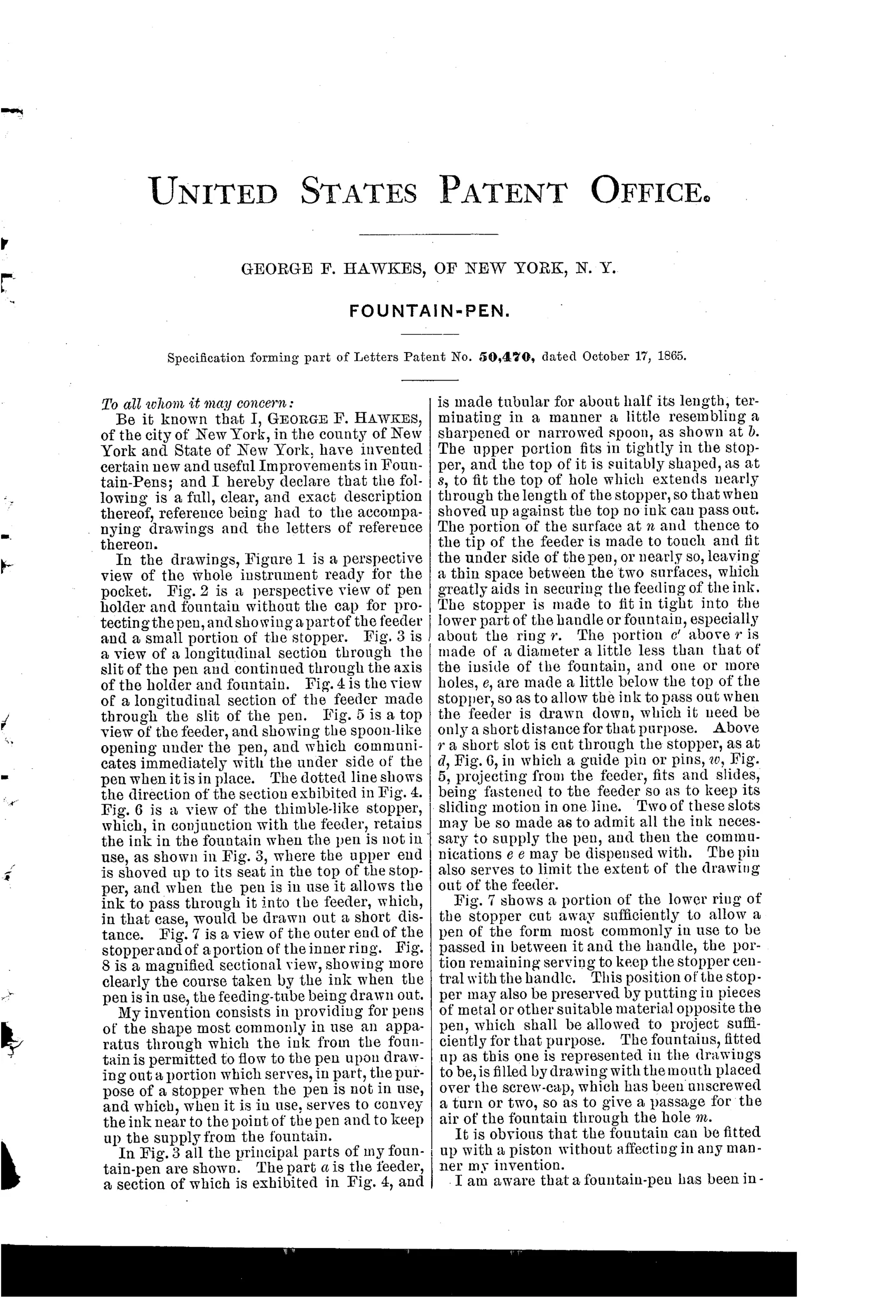
A tubular feeder fits into a hollow handle/fountain and terminates in a spoon-shaped opening that contacts the underside of the pen nib to convey ink by capillary-like action. A thimble-like stopper seated in the handle blocks ink flow when the pen is not in use, and is drawn back with the feeder to allow ink to pass through small holes near its top when writing. A guide pin projecting from the feeder rides in a slot cut through the stopper, keeping the sliding motion in a straight line and limiting how far the feeder can be drawn out. A ring or equivalent support centers the stopper in its seat within the handle, reducing leakage and securing the pen's hold.
✒ What was claimed
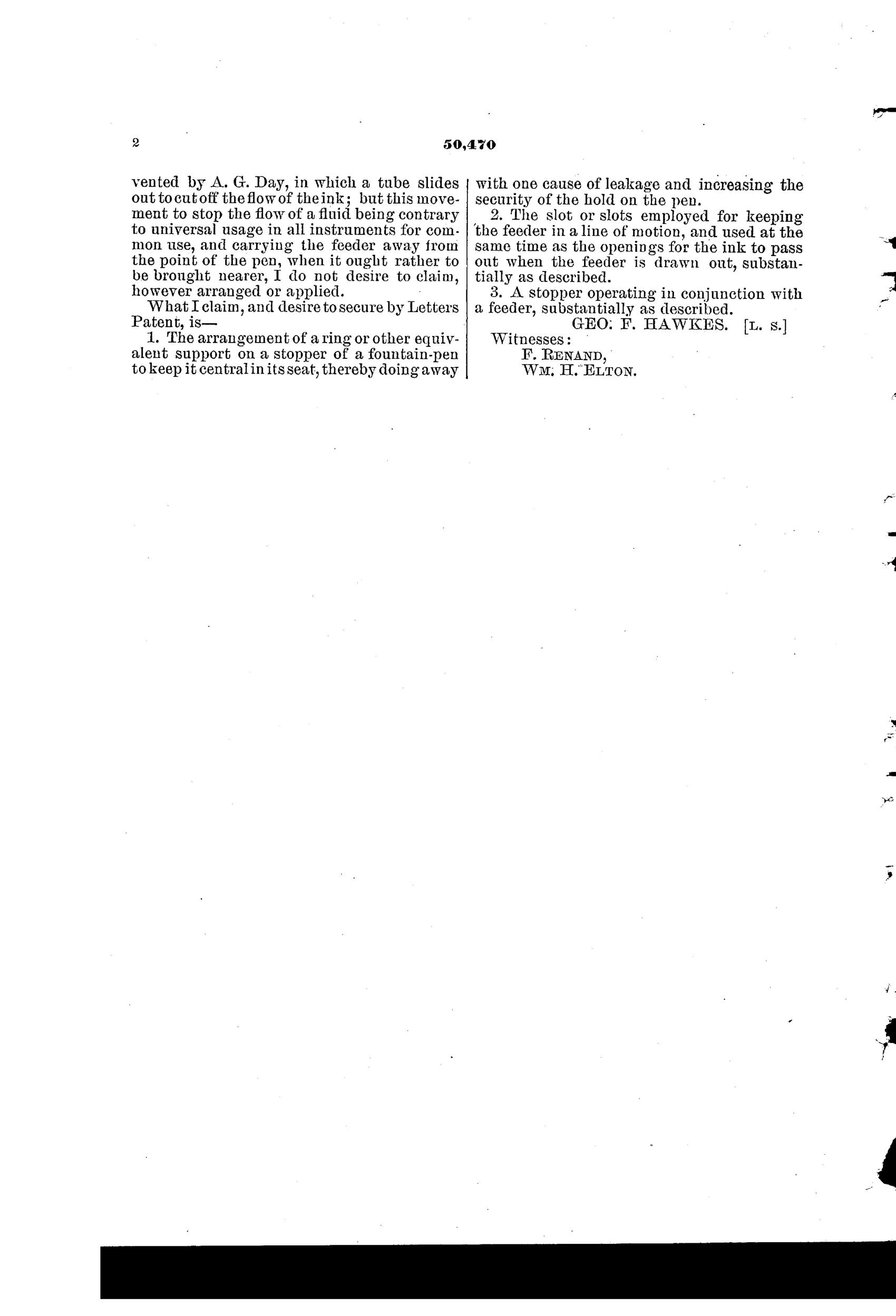
“1. The arrangement of a ring or other equivalent support on a stopper of a fountain-pen to keep it central in its seat, thereby doing away with one cause of leakage and increasing the security of the hold on the pen.”
In plain English: A ring or similar support that centers the stopper in its seat, which prevents leakage and holds the pen more securely.
✒ In the inventor’s words
“I am aware that a fountain-pen has been invented by A. G. Day, in which a tube slides out to cut off the flow of the ink; but this movement to stop the flow of a fluid being contrary to universal usage in all instruments for common use, and carrying the feeder away from the point of the pen, when it ought rather to be brought nearer, I do not desire to claim, however arranged or applied.”— George F. Hawkes, from the specification
Fate unknown
No Hawkes pen matching this sliding-stopper design is documented among surviving pre-Waterman pens; a marked specimen would settle it.
✒ Commentary
Nineteen years before Waterman, George Hawkes is worrying about exactly the right things. His feeder is a sliding tube ending in a spoon-shaped opening (Fig. 5) that presses against the underside of the nib — a genuine capillary feed, delivering ink where the slit can take it. The trouble with pre-Waterman pens was never getting ink out; it was getting it out in a controlled, air-balanced trickle. Hawkes doesn't solve the air-exchange problem, but he clearly understood that the feeder must live at the nib's point, not somewhere back in the barrel.
The best evidence of that understanding is his swipe at a rival. He knows of A. G. Day's pen, where a tube slides out to cut off flow, and he objects on two grounds: it violates 'universal usage' (you pull out to open a valve, not to close one) and it carries the feeder away from the pen point 'when it ought rather to be brought nearer.' That second complaint is the whole future of the fountain pen in one clause.
The actual claimed novelty is humbler — a centering ring on the thimble-like stopper (Figs. 6-7) to keep it seated square and stop one source of leakage, plus a pin-and-slot guide to keep the sliding motion straight. Fig. 8's magnified section is worth a close look: the ink path threading past the retracted stopper is delicate machining for 1865, and probably delicate in the hand too. A refinement of a doomed genre, but a thoughtful one.
Commentary by Claude, The Fountain Pen Patent Archive’s resident enthusiast