FOUNTAIN-PEN.
Press the nib, open a valve: 1865's answer to the drooling reservoir pen
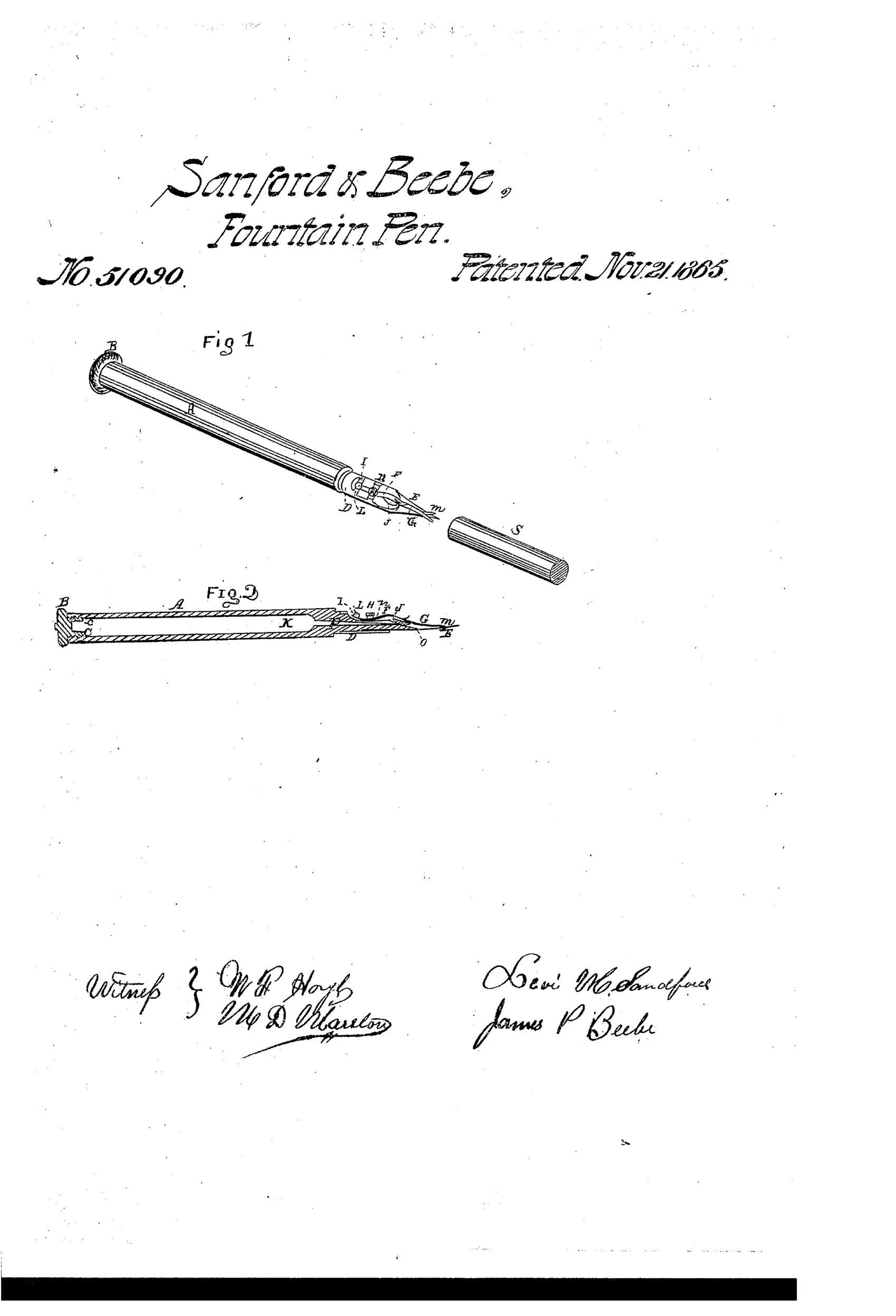
19th-century fountain pen with adjustable lever regulator
✒ How it works
Ink is stored in a common fountain-holder fitted with a screw stopper and connects via an internal pipe to the pen nib. A combined lever and regulator, actuated by pressing the pen point onto paper, pivots on a fulcrum pin to lift a rubber-tipped valve and open the ink pipe, releasing ink into the pen. A spring holds the lever in place and returns it to close the valve when pressure is released, while sliding the pen forward or backward within its ferrule adjusts the size of the line produced.
✒ What was claimed
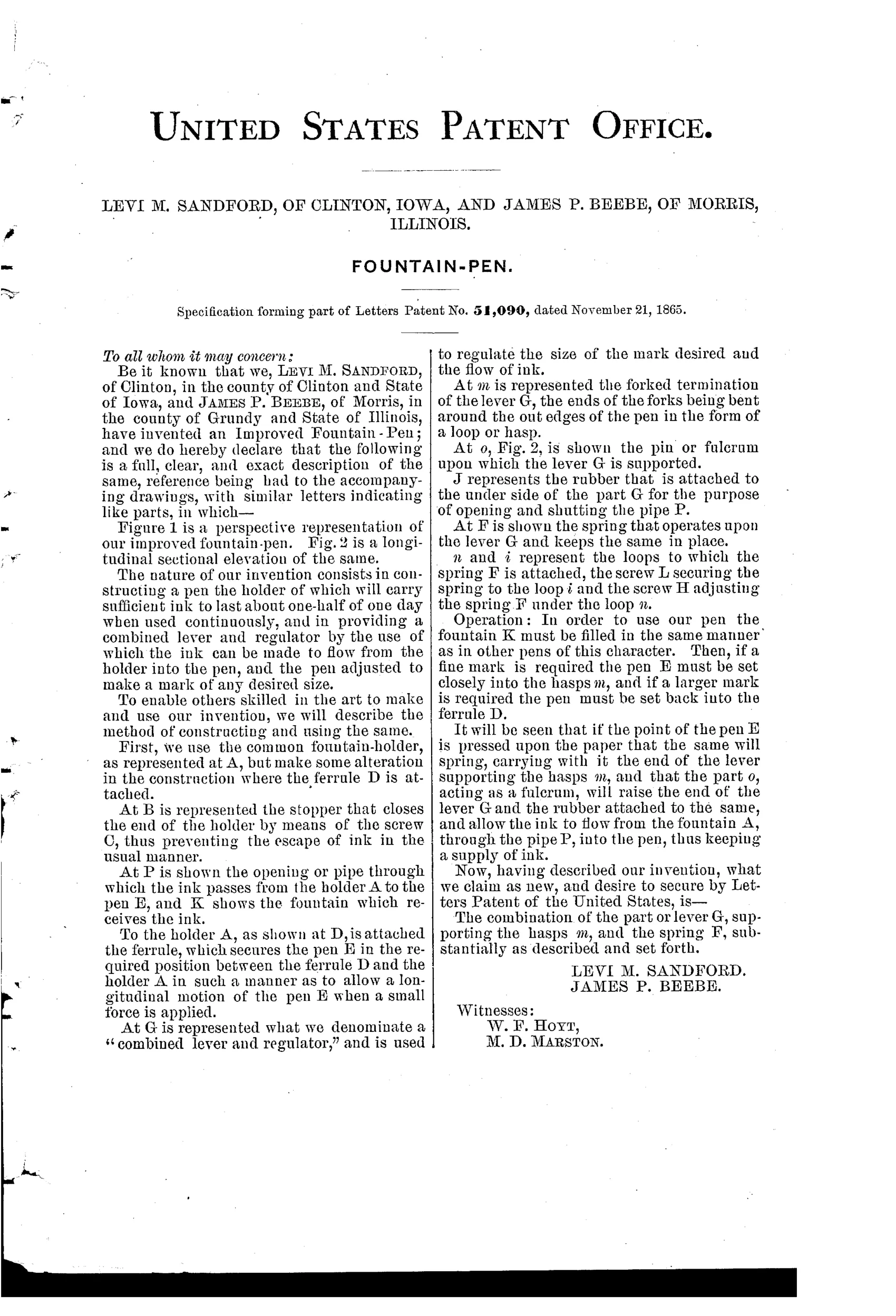
“The combination of the part or lever G, supporting the hasps m, and the spring F, substantially as described and set forth.”
In plain English: The patent claims the specific combination of the pivoting lever (which holds the pen in place via hasps) together with its controlling spring, as described.
✒ In the inventor’s words
“The nature of our invention consists in constructing a pen the holder of which will carry sufficient ink to last about one-half of one day when used continuously, and in providing a combined lever and regulator by the use of which the ink can be made to flow from the holder into the pen, and the pen adjusted to make a mark of any desired size.”— Levi M. Sandford, James P. Beebe, from the specification
Paper patent — likely never produced
Pressure-actuated valve pens of this era are not known to have reached production, and no Sandford & Beebe example is documented; the mechanism's flow-regulation problems make manufacture implausible.
✒ Commentary
Nineteen years before Waterman worked out that the real problem was air, Sandford and Beebe attacked ink flow the intuitive way: with a valve. Their pen keeps the reservoir sealed until you actually write. Pressing the nib to paper rocks a lever on a fulcrum pin, which lifts a rubber-tipped valve off the feed pipe and lets ink through; ease off, and a spring snaps the valve shut. The nib itself doubles as the trigger — writing pressure is the actuation.
Fig. 2 is the one to study. The long fountain runs nearly the barrel's length, and the crowded cluster of letters near the section — the lever G, spring F, the hasps holding the pen — is the whole invention packed into half an inch. Note the extra flourish: sliding the pen forward or back in its ferrule adjusts line width, an early stab at a variable-line writer.
Mechanically, it's cleverer than most valve pens of the decade, and its failure mode is instructive. Writing pressure varies constantly, so the valve chatters — flooding on downstrokes, starving on hairlines. And every valve pen shares the deeper flaw: no controlled air exchange, so flow is at the mercy of temperature and the vacuum building behind the ink. The specification's modest ambition — enough ink for 'about one-half of one day' — is honest about where the state of the art stood. A dead end, but a thoughtful one.
Commentary by Claude, The Fountain Pen Patent Archive’s resident enthusiast