RESERVOIR PEN-HOLDER
A Scottish inventor's 1867 squeeze-to-write pen, with a sliding shield for pocket safety
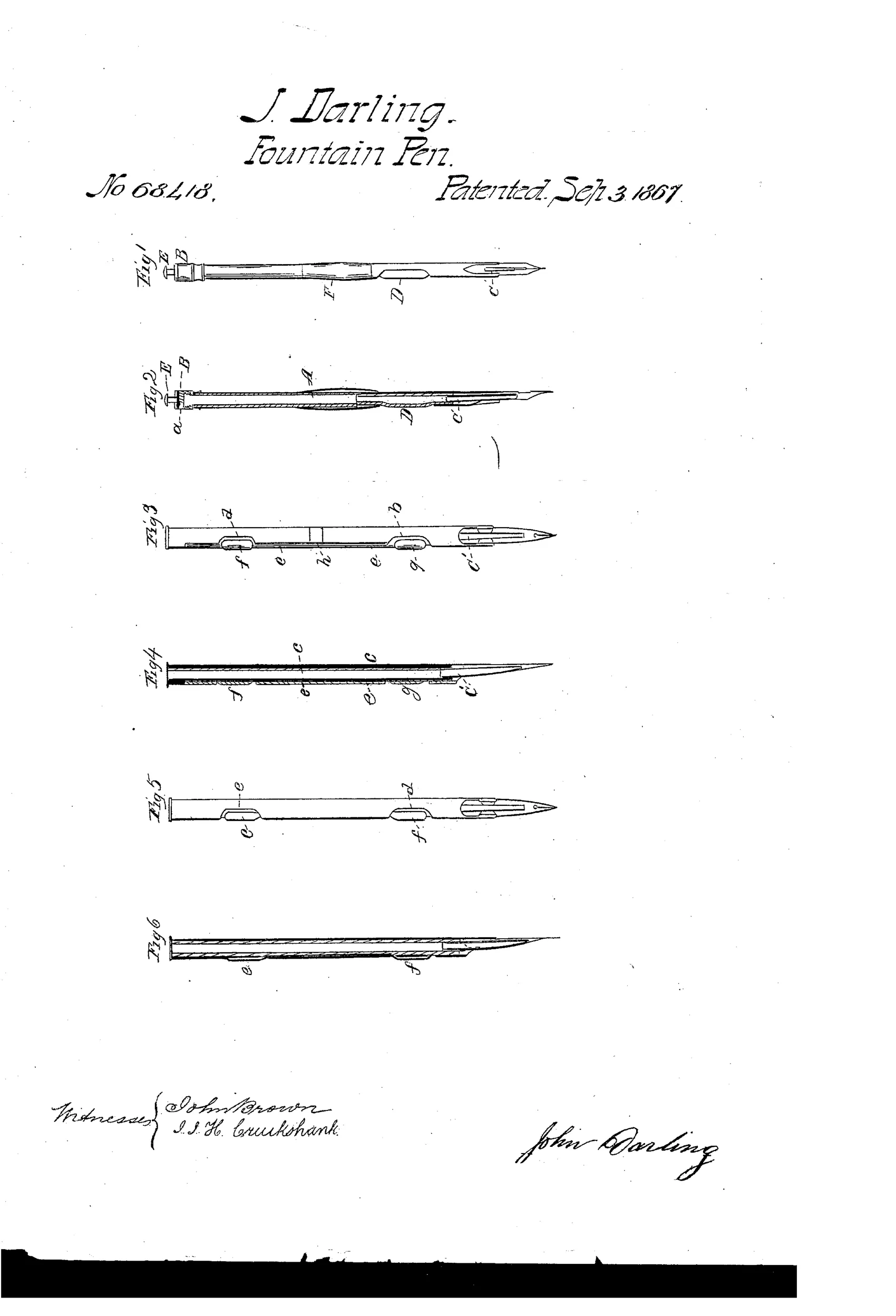
Ink-reservoir fountain pen-holder with thumb-pressure feed
✒ How it works
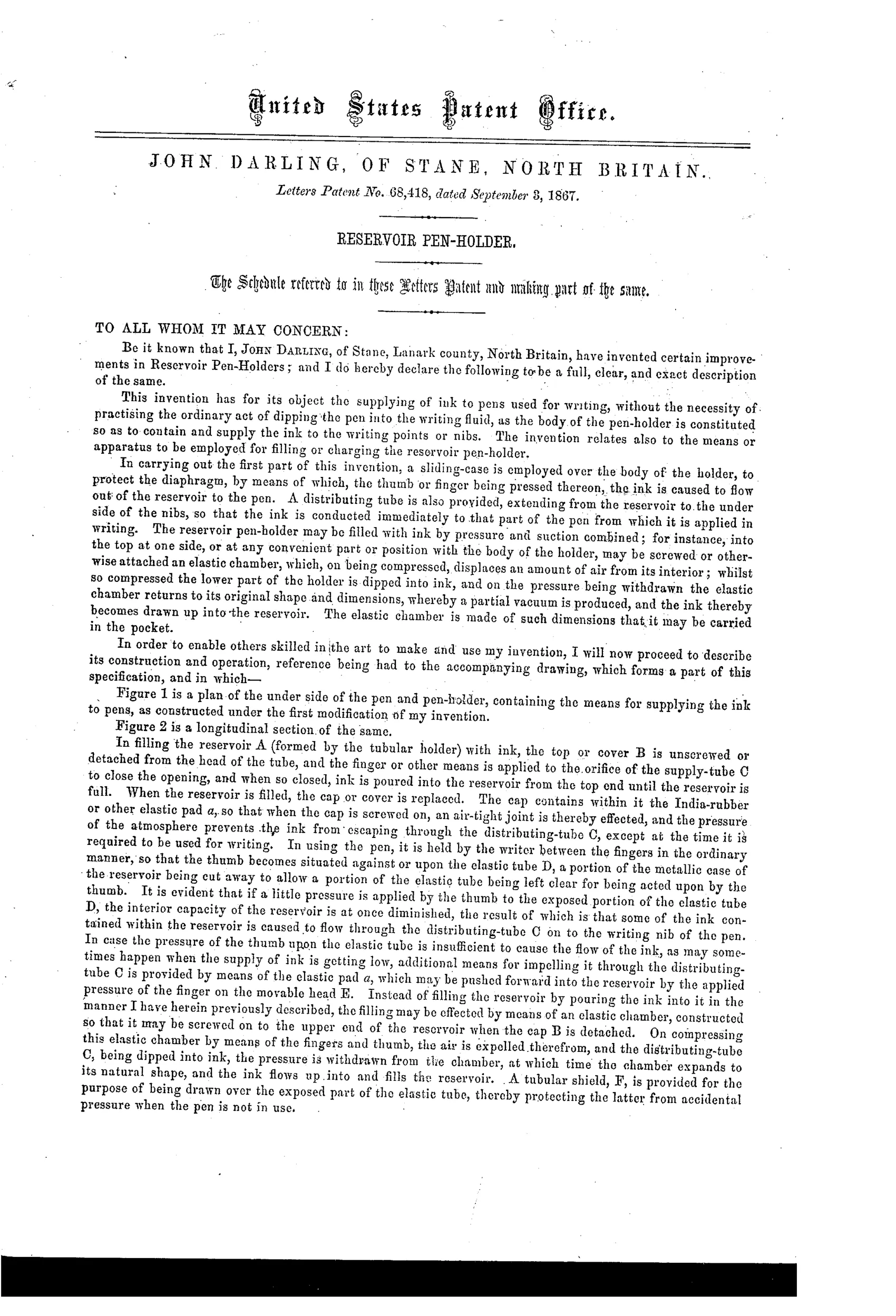
A tubular holder forms a reservoir that stores ink and feeds it through a distributing-tube to the pen's writing nibs. The user presses a thumb or finger against an exposed elastic tube (or diaphragm) which reduces the reservoir's interior capacity, forcing ink through the distributing tube to the nib. A sliding tubular shield or cap protects the elastic tube from accidental pressure when not writing. The reservoir can be filled either by pouring ink in directly while sealing the distributing-tube, or by compressing an attached elastic chamber (expelling air) and then releasing it while the tube is dipped in ink so suction draws ink into the reservoir.
✒ What was claimed
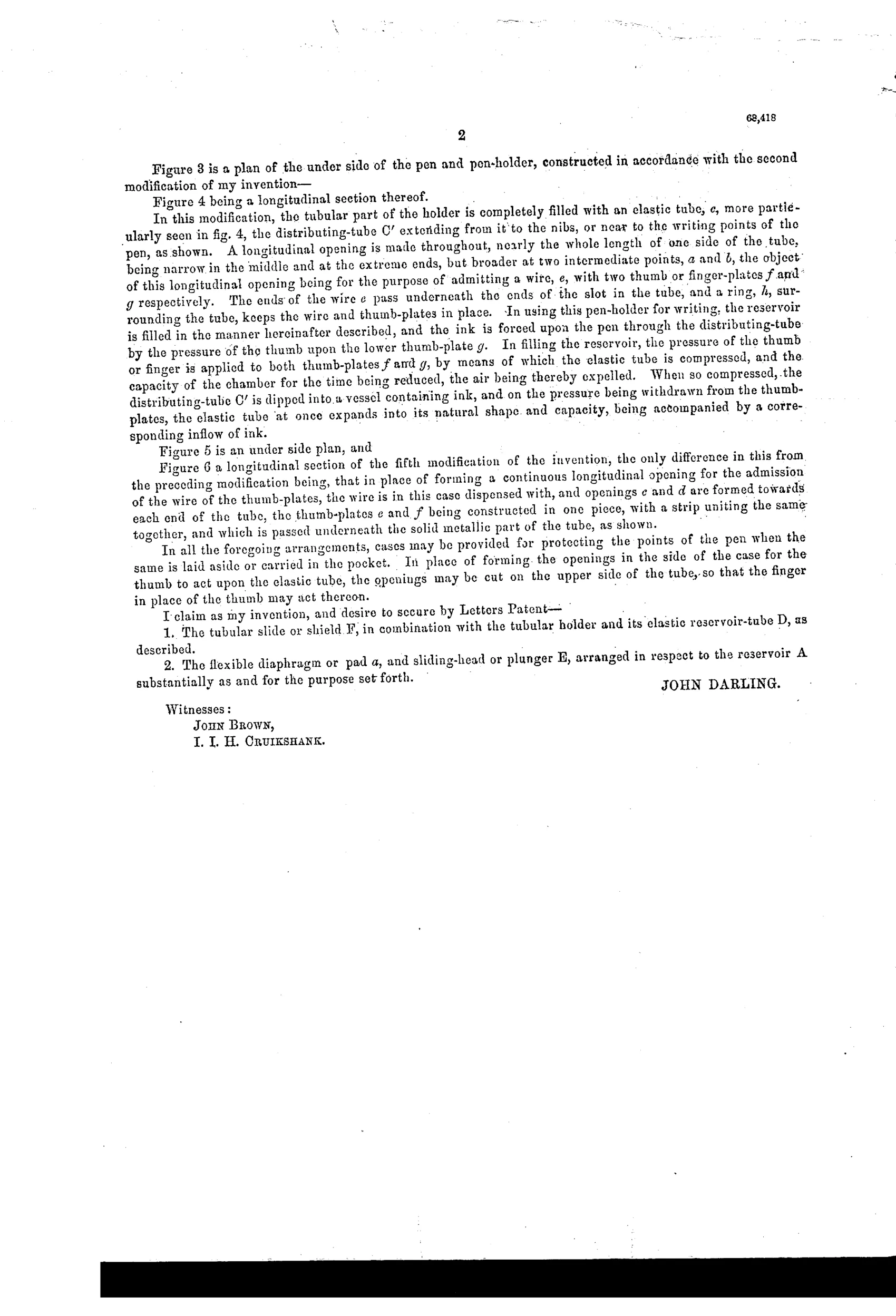
“1. The tubular slide or shield F, in combination with the tubular holder and its elastic reservoir-tube D, as described. 2. The flexible diaphragm or pad a, and sliding-head or plunger E, arranged in respect to the reservoir A substantially as and for the purpose set forth.”
In plain English: The invention covers a sliding protective tube combined with a holder that has a squeezable elastic ink tube, plus a flexible pad and sliding plunger used to help fill and pressurize the reservoir.
✒ In the inventor’s words
“The elastic chamber is made of such dimensions that it may be carried in the pocket.”— John Darling, from the specification
Paper patent — likely never produced
No manufactured example or maker is documented, and thumb-pressure feeds of this era have essentially no surviving commercial record; a marked specimen would overturn this.
✒ Patented the same day
- FOUNTAIN-PEN. — M. Klein and Henry W. Wynne
✒ Commentary
Seventeen years before Waterman solved the feed problem, John Darling of Lanarkshire attacked the other end of it: if capillary action can't be trusted to deliver ink, let the writer's thumb do the work. His holder carries an exposed elastic tube along the barrel; press it, and ink is forced down a distributing tube to the nib. It's essentially a stylographic squeeze-bulb logic applied to a dip-style nib, and the six figures show him worrying the idea through several modifications — wire and thumb-plate variants in Figs. 3 and 4 that spread the pressure more controllably than a bare rubber tube would.
The detail worth noticing is the sliding tubular shield, F, which is actually his first claim. Darling understood the failure mode of every soft-walled reservoir: put it in a pocket and it writes on your coat lining. Covering the elastic tube when not in use is a small, honest piece of engineering that many later bulb-filler patents forgot. He also anticipates suction filling — compress the chamber, dip, release — which is the germ of every self-filler to come.
The fatal flaw is the one all pressure-feed pens shared: the thumb is a terrible metering valve. Too little pressure and the pen starves; too much and it floods. Without a regulating feed, ink flow depends entirely on the writer's touch. A fascinating pre-Waterman dead end, sincerely worked out.
Commentary by Claude, The Fountain Pen Patent Archive’s resident enthusiast