FOUNTAIN-PEN.
Press a rod to write: 1867 Iowa's answer to the leaking reservoir pen
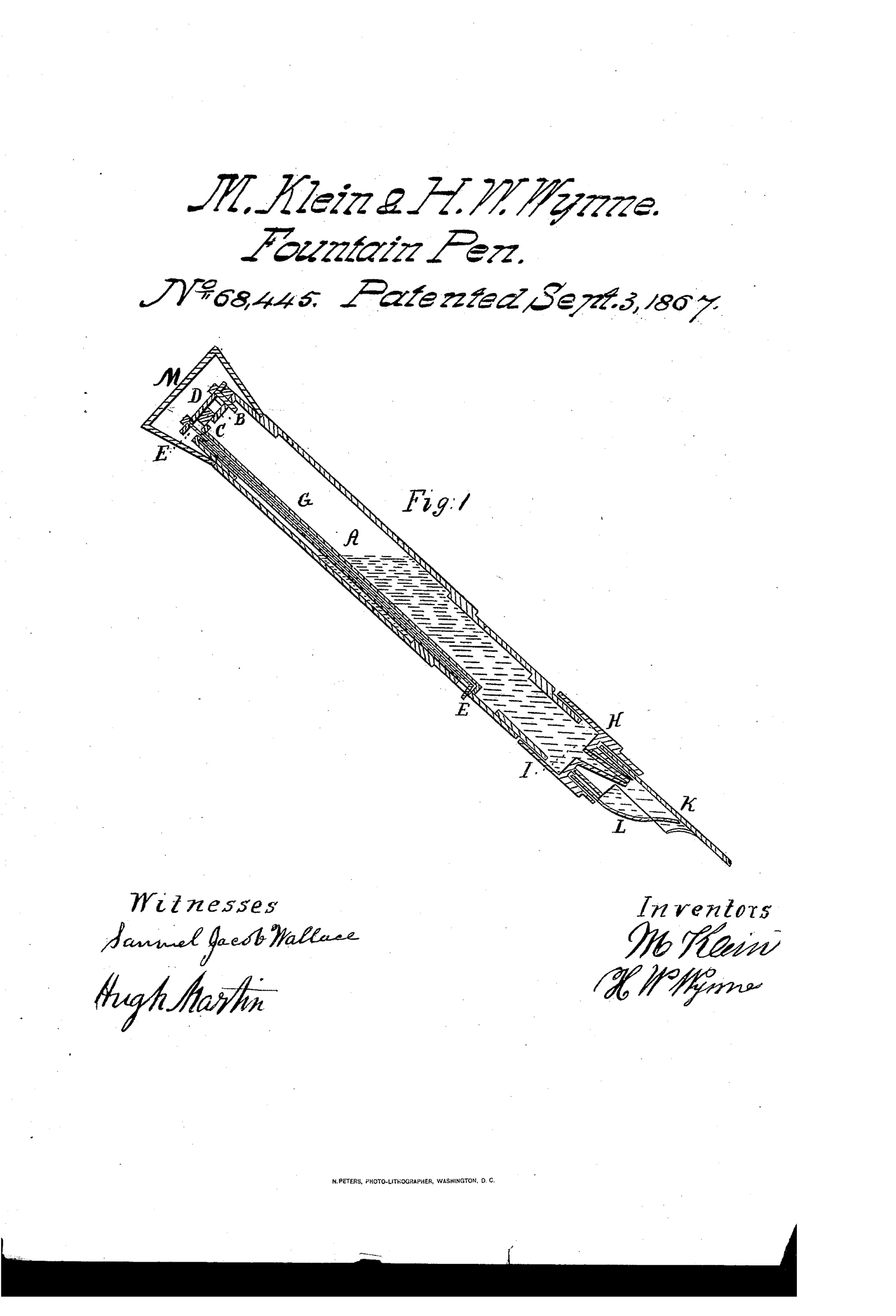
Self-regulating fountain pen with air valve
✒ How it works
An ink chamber A in the handle stores ink, with a small air entrance C at the top closed by a spring-held valve B. Pressing a projecting rod part F pushes rod E through tube G, lifting spring D and valve B to admit air, which allows ink to flow through a small hole or tube I to the pen point K. Releasing F lets the spring force the valve back onto opening C, sealing it so atmospheric pressure restrains further ink flow. A removable lower part H allows the chamber to be refilled by pouring ink in when inverted, and shield L holds a supply of ink near the pen point.
✒ What was claimed
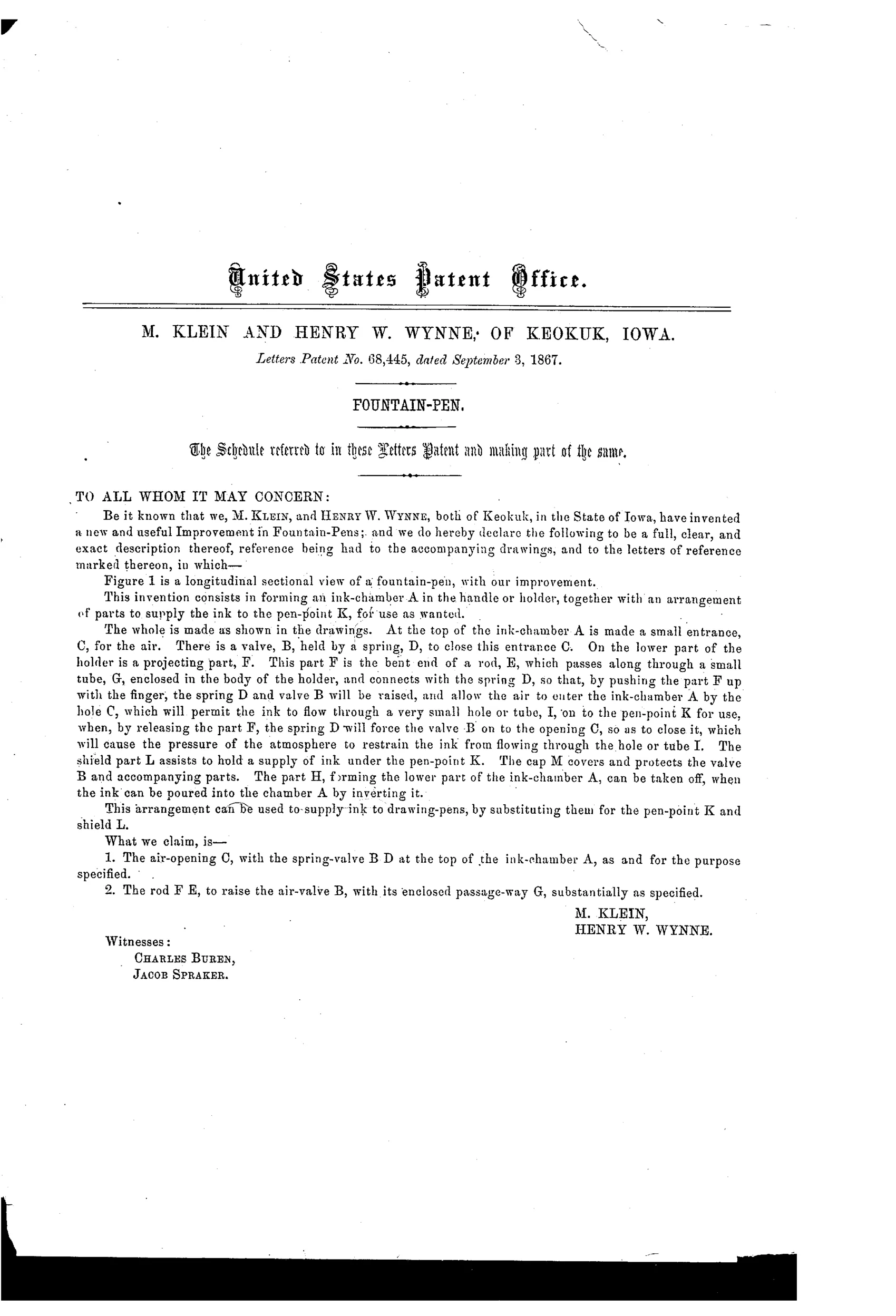
“1. The air-opening C, with the spring-valve B D at the top of the ink-chamber A, as and for the purpose specified.”
In plain English: They claim the air hole with a spring-loaded valve at the top of the ink chamber that controls ink flow.
✒ In the inventor’s words
“This arrangement can be used to supply ink to drawing-pens, by substituting them for the pen-point K and shield L.”— M. Klein and Henry W. Wynne, from the specification
Fate unknown
No production examples or maker are documented for this Keokuk design; a surviving marked pen would settle it, though the era's record suggests it stayed on paper.
✒ Patented the same day
- RESERVOIR PEN-HOLDER — John Darling
✒ Commentary
Seventeen years before Waterman, the core problem of the reservoir pen was already understood in Keokuk, Iowa: ink doesn't flow out unless air gets in, and if air gets in freely, ink comes out in blobs. Klein and Wynne's answer is to make the air admission deliberate. The chamber A is sealed at the top by a spring-loaded valve B; the writer presses the projecting rod F, which lifts the valve, lets a sip of air in, and starts the ink moving down to the point. Let go, and atmospheric pressure locks the reservoir shut again.
It's the opposite philosophy from what eventually won. Waterman's 1884 feed made air exchange automatic and continuous through capillary channels; Klein and Wynne made it manual and intermittent. That means the writer is effectively pumping the pen as needed — workable in short bursts, but the flow would surge after each press and starve between them. The shield L near the point, holding a small standing supply of ink, is their tacit admission of this: it's a buffer against their own valve.
The cross-section is worth a slow look — the long rod E running the full length of the barrel through tube G is a lot of internal plumbing for 1867, and the closing note about swapping in a drawing pen shows they were thinking beyond writing. A doomed branch, but an honest diagnosis of the real problem.
Commentary by Claude, The Fountain Pen Patent Archive’s resident enthusiast