IMPROVEMENT IN PENS
A perforated tin canopy over a dip nib, sixteen years before Waterman
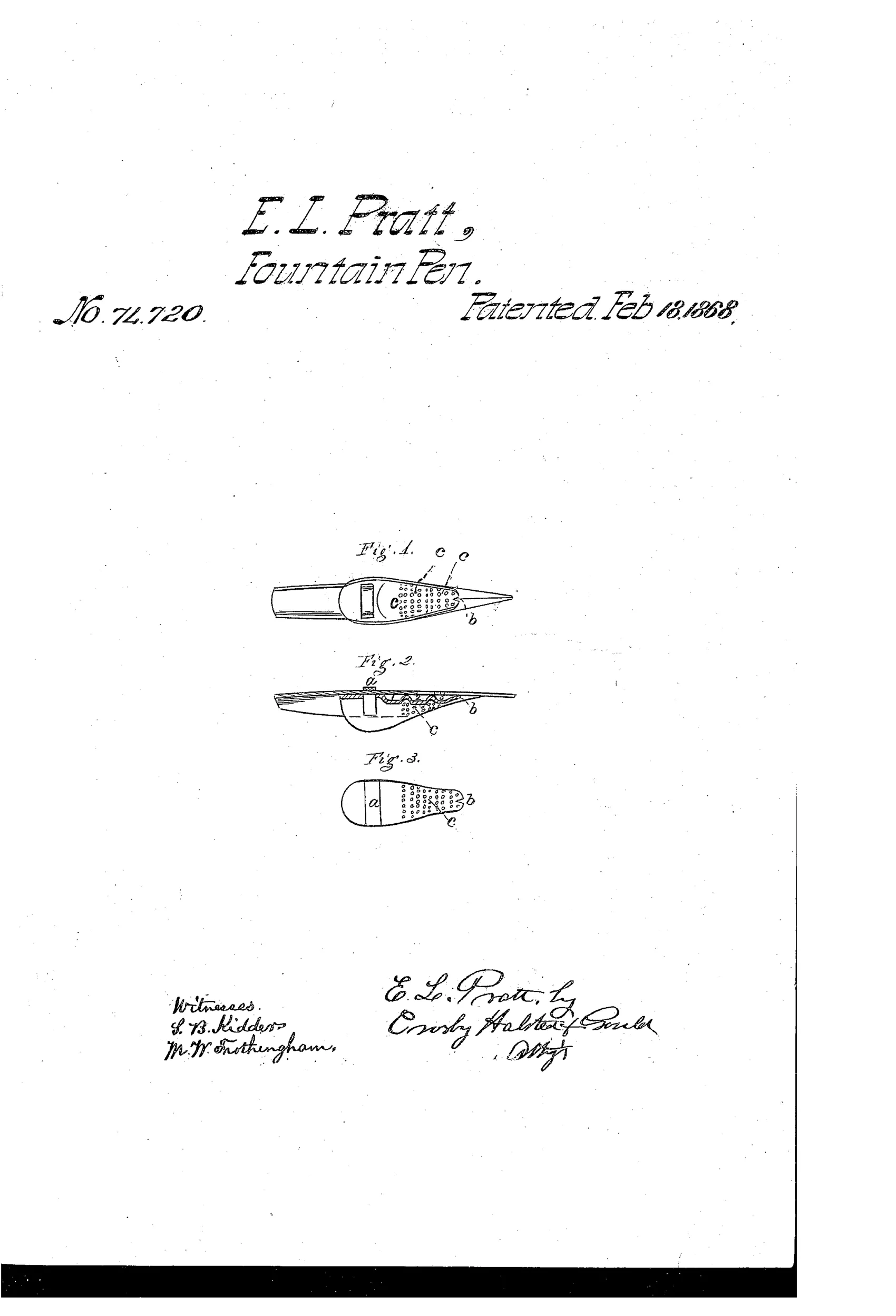
Ink reservoir attachment for pen
✒ How it works
A metal reservoir with fine perforations is bent to fit the concave side of a pen, held in place by a band formed from a stretched strip of the metal. Spaces between the reservoir and the pen communicate with the perforations, allowing ink drawn in by capillary attraction to fill the gaps when dipped. Ink then flows through a groove at the lower end of the reservoir to the pen's nib, with airflow through the perforations regulating the supply. Pressure on the nib deflects the pen away from the reservoir point, increasing ink flow for heavier strokes.
✒ What was claimed
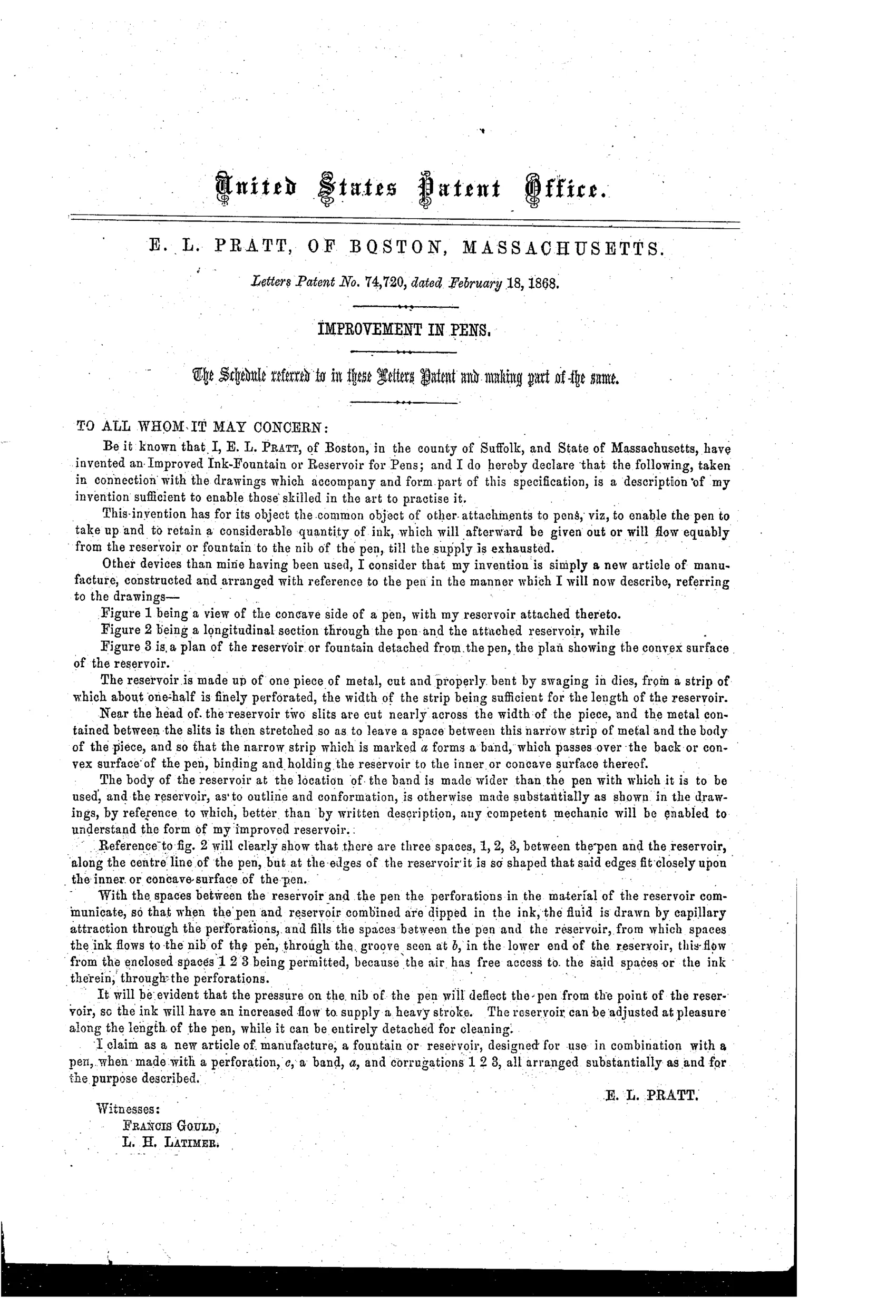
“I claim as a new article of manufacture, a fountain or reservoir, designed for use in combination with a pen, when made with a perforation, c, a band, a, and corrugations 1 2 3, all arranged substantially as and for the purpose described.”
In plain English: The inventor claims a perforated, banded, corrugated metal ink reservoir designed to attach to a pen.
✒ In the inventor’s words
“This invention has for its object the common object of other attachments to pens, viz, to enable the pen to take up and to retain a considerable quantity of ink, which will afterward be given out or will flow equably from the reservoir or fountain to the nib of the pen, till the supply is exhausted.”— E. L. Pratt, from the specification
Fate unknown
Stamped-metal reservoir clips like this were cheap enough to produce, but no Pratt-marked example is documented; a surviving specimen or period advertisement would settle it.
✒ More by E. L. Pratt
- IMPROVEMENT IN PENS. (1869)
✒ Commentary
Pratt's idea is a reservoir attachment: a small piece of perforated, corrugated metal bent to lie over the concave face of an ordinary steel pen, clipped on with a band formed from the metal itself. Dip the pen and capillary action pulls ink into the gap between reservoir and nib; the perforations let air in as the ink drains out. Read that last part again — air exchange through fine holes to regulate flow is exactly the problem Waterman would solve properly in 1884, and here it is in embryonic form in 1868, done crudely but not stupidly.
The cleverest touch is easy to miss in Fig. 2: the reservoir's lower point sits close to the nib, and pressing the nib for a heavy stroke deflects it away from that point, opening the gap and increasing flow. That's a pressure-responsive feed, of a sort — the same intuition behind flexible-nib feeds decades later, achieved with one stamped piece of metal and no moving parts.
This sits squarely in the pre-Waterman stratum of reservoir attachments, a crowded little genre of penny gadgets promising fewer trips to the inkwell. Most worked poorly: a dip's worth more ink, then blots. Pratt's corrugations and perforations are a more thoughtful stab than most, but the fundamental limit remains — it's still a dip pen wearing a hat. One curiosity for the record: the specification witnesses include an L. H. Latimer, and the attorneys are Crosby, Halsted & Gould, the Boston firm where a young Lewis Latimer worked.
Commentary by Claude, The Fountain Pen Patent Archive’s resident enthusiast