IMPROVEMENT IN PENS.
Perforated tongues hold ink by capillarity, fifteen years before Waterman's feed
An ink-reservoir attachment ('fountain') for dip pens
✒ How it works
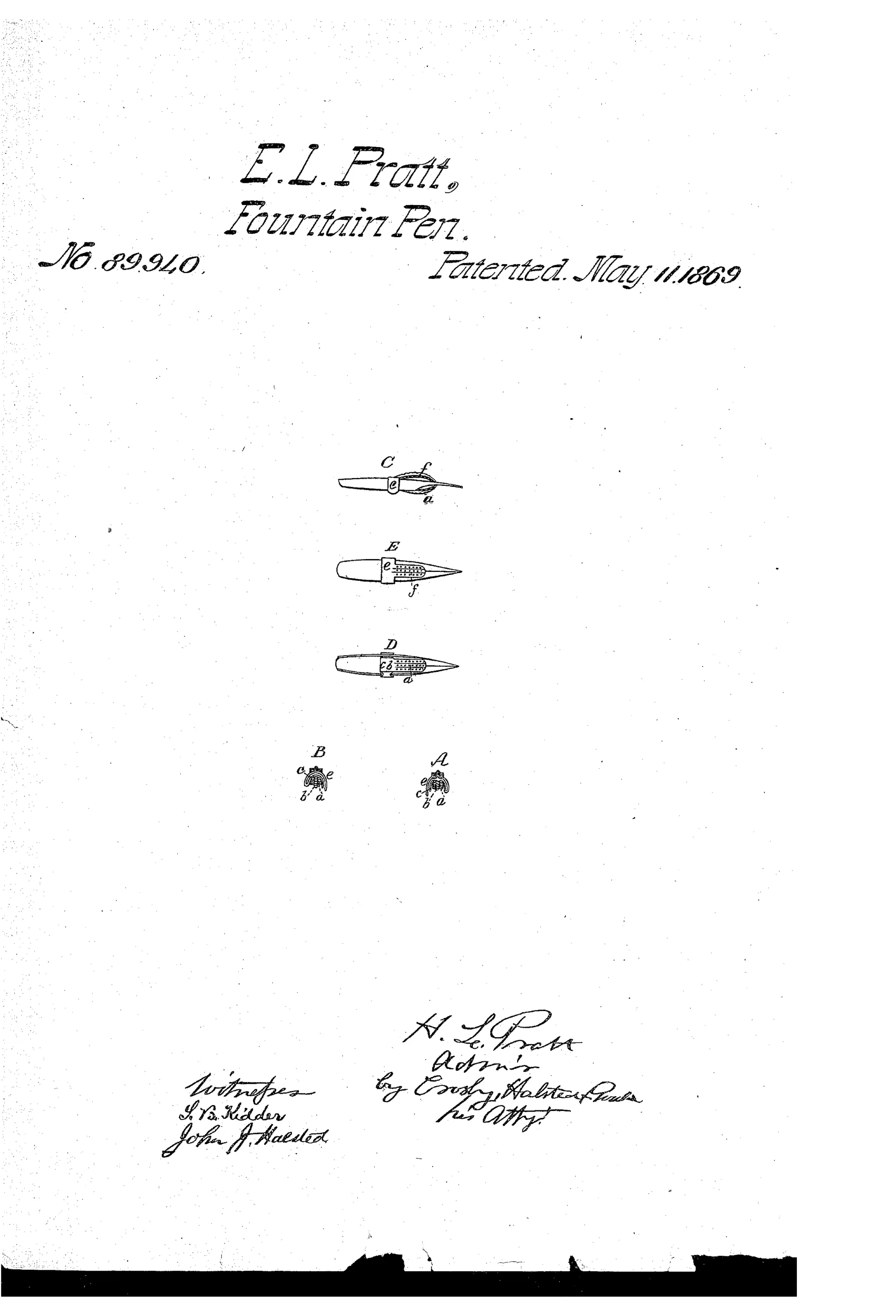
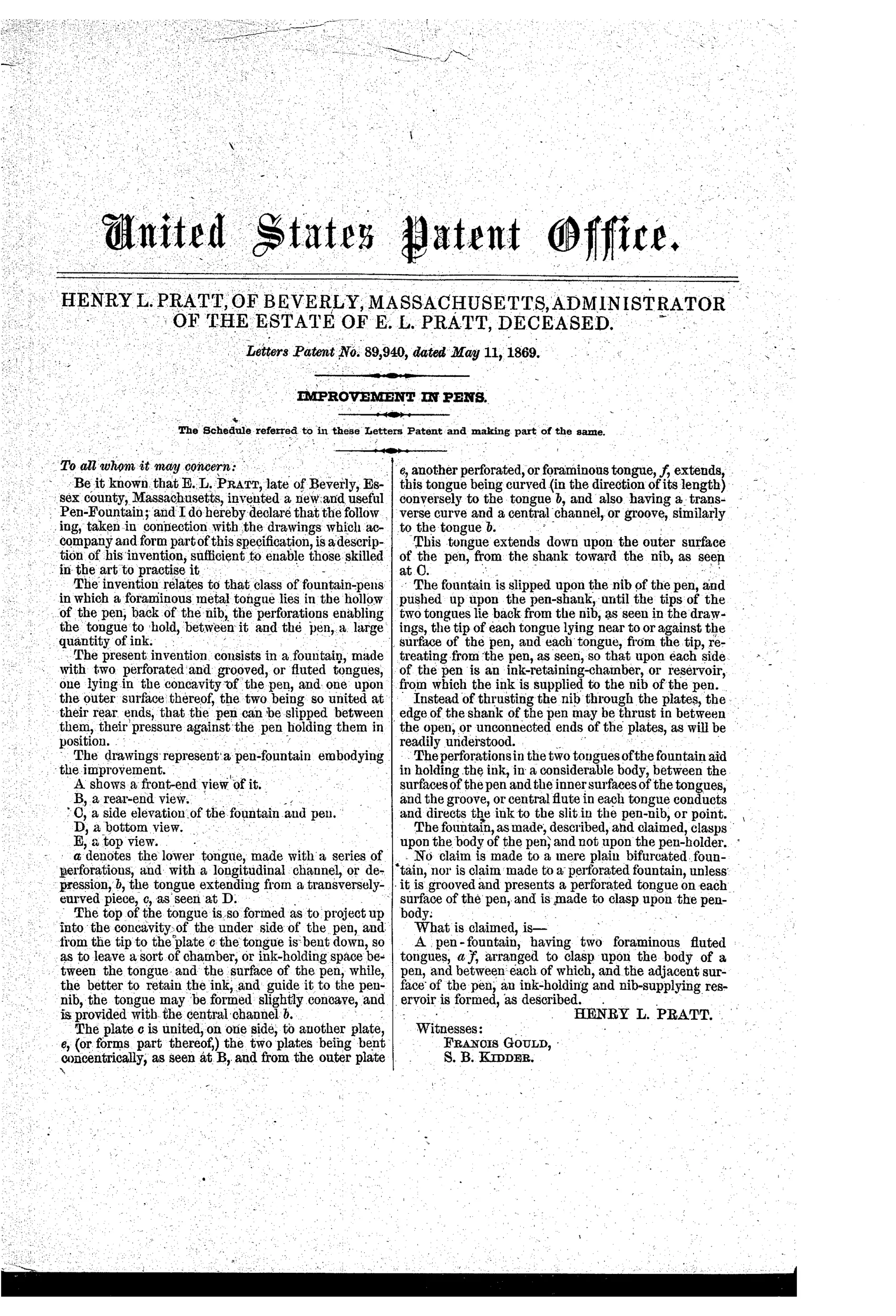
Two perforated, fluted metal tongues clasp around the body of a pen, one lying against the concave underside of the nib and one along its outer surface. Each tongue is curved lengthwise and transversely and has a central channel or groove that directs ink toward the pen's slit. The perforations let the tongues hold a large volume of ink between themselves and the pen surface, forming a reservoir on each side that continuously supplies the nib as it writes. The fountain slips over the nib and up the shank until the tongue tips retreat from the point, leaving ink-retaining chambers near the writing tip.
✒ What was claimed
“A pen-fountain, having two foraminous fluted tongues, a f, arranged to clasp upon the body of a pen, and between each of which, and the adjacent surface of the pen, an ink-holding and nib-supplying reservoir is formed, as described.”
In plain English: The invention is an ink-fountain attachment with two perforated, grooved metal tongues that clamp onto a pen and form ink reservoirs on each side that feed the nib.
✒ In the inventor’s words
“No claim is made to a mere plain bifurcated fountain, nor is claim made to a perforated fountain, unless it is grooved and presents a perforated tongue on each surface of the pen, and is made to clasp upon the pen-body.”— E. L. Pratt, from the specification
Fate unknown
Clip-on nib reservoirs were a real product category, but no Pratt-marked example is documented; a surviving specimen or trade advertisement would settle it.
✒ More by E. L. Pratt
- IMPROVEMENT IN PENS (1868)
✒ Commentary
This is a pre-Waterman reservoir attempt of the humblest kind: not a fountain pen at all, but a clip-on 'fountain' for an ordinary steel dip nib. Two thin metal tongues clasp the pen body, one riding the concave underside of the nib, one the back. Each tongue is fluted and riddled with perforations, and that's the interesting part — the holes aren't decoration. They let the tongue hold a surprising volume of ink in the gap between itself and the nib, spread across many small cells rather than one sloshing pool. Pratt is, whether he'd have phrased it this way or not, using capillary retention to store ink and a central groove to meter it toward the slit. That's the same physical intuition Waterman would build a whole industry on in 1884, applied here to the poor man's problem of dipping less often.
The drawing repays a close look: figures A and B, the tiny end views, show the tongues as nested curved plates, so the reservoir is a thin crescent-shaped gap, not an open trough. Note the claim's careful hedging — he disclaims plain bifurcated fountains and plain perforated ones; the novelty is grooved, double-sided, and clasping. Someone had been down this road before.
Nib-mounted reservoirs like this were sold in quantity by others through the century, and they genuinely work for a page or two of writing. As pen history, this is a footnote — but a footnote pointing in exactly the right direction. Poignantly, the drawing is signed by H. L. Pratt as administrator: the patent issued after the inventor's death.
Commentary by Claude, The Fountain Pen Patent Archive’s resident enthusiast