IMPROVEMENT IN FOUNTAIN-PENS.
A Christmas 1855 patent from the man behind the Protean, thirty years before Waterman
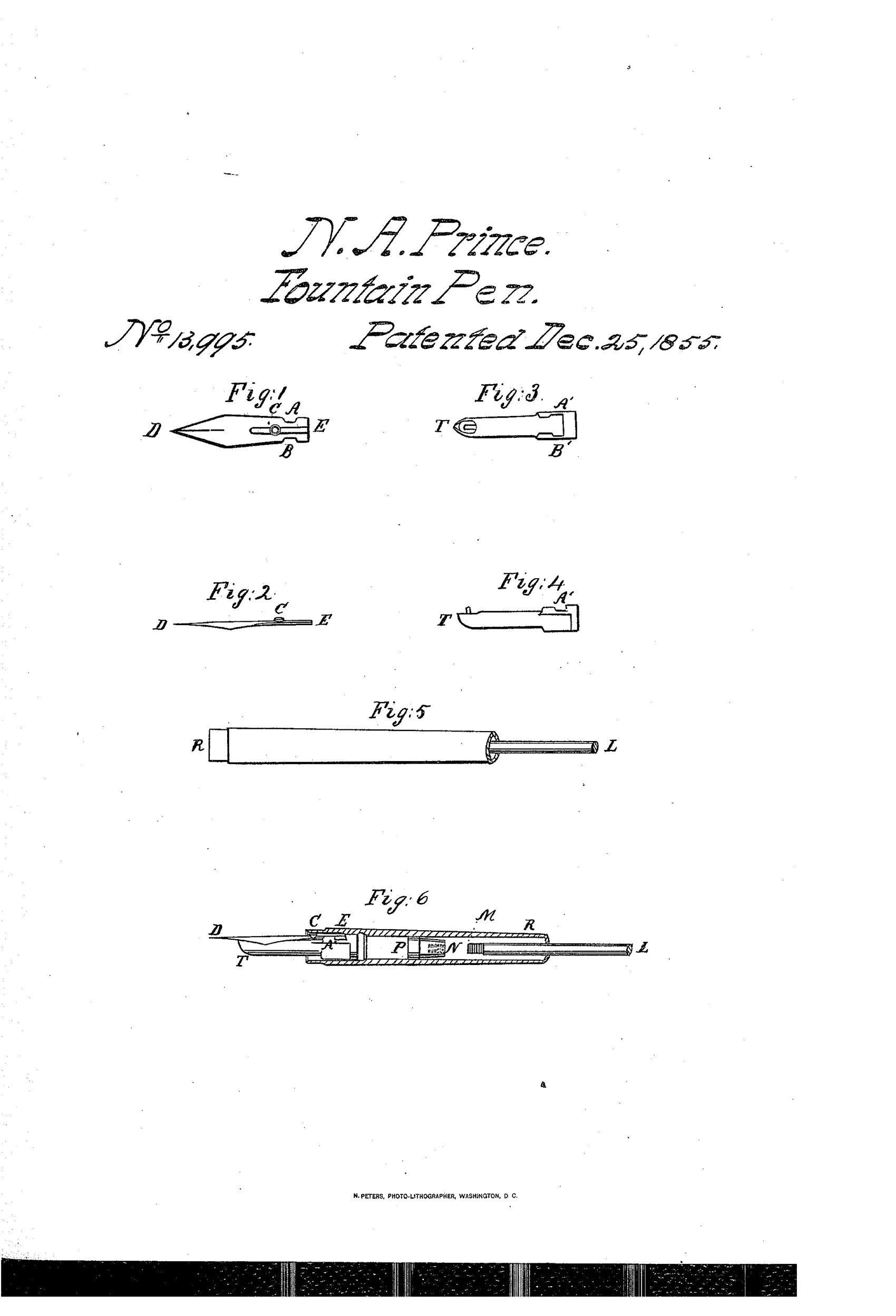

An improved interlocking fountain pen nib and feed
✒ How it works
The pen nib is notched near its heel at points A and B, and the feeding-tube is correspondingly notched at A' and B' so the two lock together and cannot shift laterally or slip apart once inserted in the main reservoir-tube. A raised bead on the back of the pen near its heel contacts the inner wall of the reservoir-tube to limit how far the flexible pen can lift while writing. The main reservoir-tube holds ink and is filled via a detachable piston-rod and piston-head assembly; the piston-rod has a screw-thread that engages a tap-hole in the piston-head so it can be tightened to seal the tube after filling and then removed and set aside.
✒ What was claimed
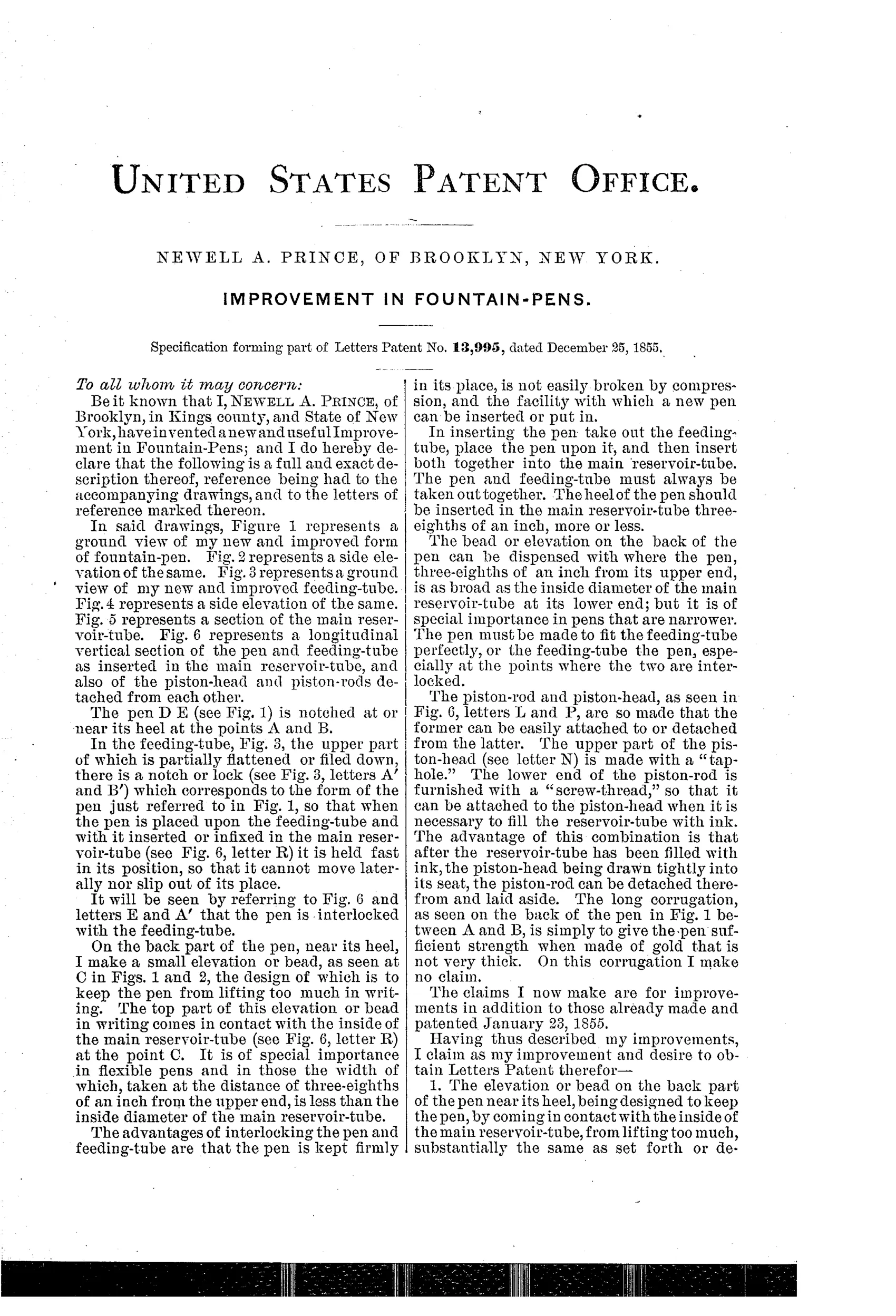
“The pen notched near its heel and the combination of the same with the feeding-tube correspondingly notched, so that the two placed together and infixed in the main reservoir-tube the pen cannot get out of its position, substantially the same as set forth or described in the foregoing specification and the accompanying drawings.”
In plain English: The pen's heel is notched to interlock with a matching notch in the feeding-tube, so that once both are inserted into the main ink reservoir-tube, the pen is held securely in place and cannot slip or shift.
✒ In the inventor’s words
“The advantages of interlocking the pen and feeding-tube are that the pen is kept firmly in its place, is not easily broken by compression, and the facility with which a new pen can be inserted or put in.”— Newell A. Prince, from the specification
Manufactured and sold
Prince manufactured and sold fountain pens commercially in this era — his 'Protean' pens are documented survivors — though whether this exact 1855 configuration shipped unchanged is harder to pin down.
✒ More by Newell A. Prince
- IMPROVED FOUNTAIN-PEN (1855)
✒ Commentary
Newell Prince belongs to the small club of pre-Waterman inventors who actually got fountain pens into people's hands, and this patent shows him working on the unglamorous problem that sank most reservoir pens: keeping the nib and feed in a fixed, repeatable relationship. His answer is purely mechanical — notch the heel of the nib (A, B in Fig. 1), notch the feeding-tube to match (A', B' in Fig. 3), and let the two interlock so that once pushed into the barrel neither part can rotate or creep. Anyone who has fought a misaligned slip-fit nib will recognize what he was after.
The detail worth lingering on is the bead C on the pen's back. It bears against the inside of the barrel and limits how far the flexible nib can lift under writing pressure — a crude but sensible flow governor, decades before feeds learned to regulate ink with capillary channels. He also gives you a detachable screw-in piston rod for filling: you charge the barrel, tighten the piston to seal it, then unscrew the rod and pocket it. That's a self-contained filling system in 1855, even if it asks a lot of the user.
Without Waterman's air-exchange insight, flow would still have been at the mercy of temperature and luck. But Prince was solving real assembly and service problems — his claim even touts how easily a new pen can be swapped in. That's a manufacturer's concern, not a dreamer's.
Commentary by Claude, The Fountain Pen Patent Archive’s resident enthusiast