IMPROVEMENT IN FOUNTAIN-PENS
Cross's needle-in-a-tube stylograph: the reservoir pen that worked before Waterman
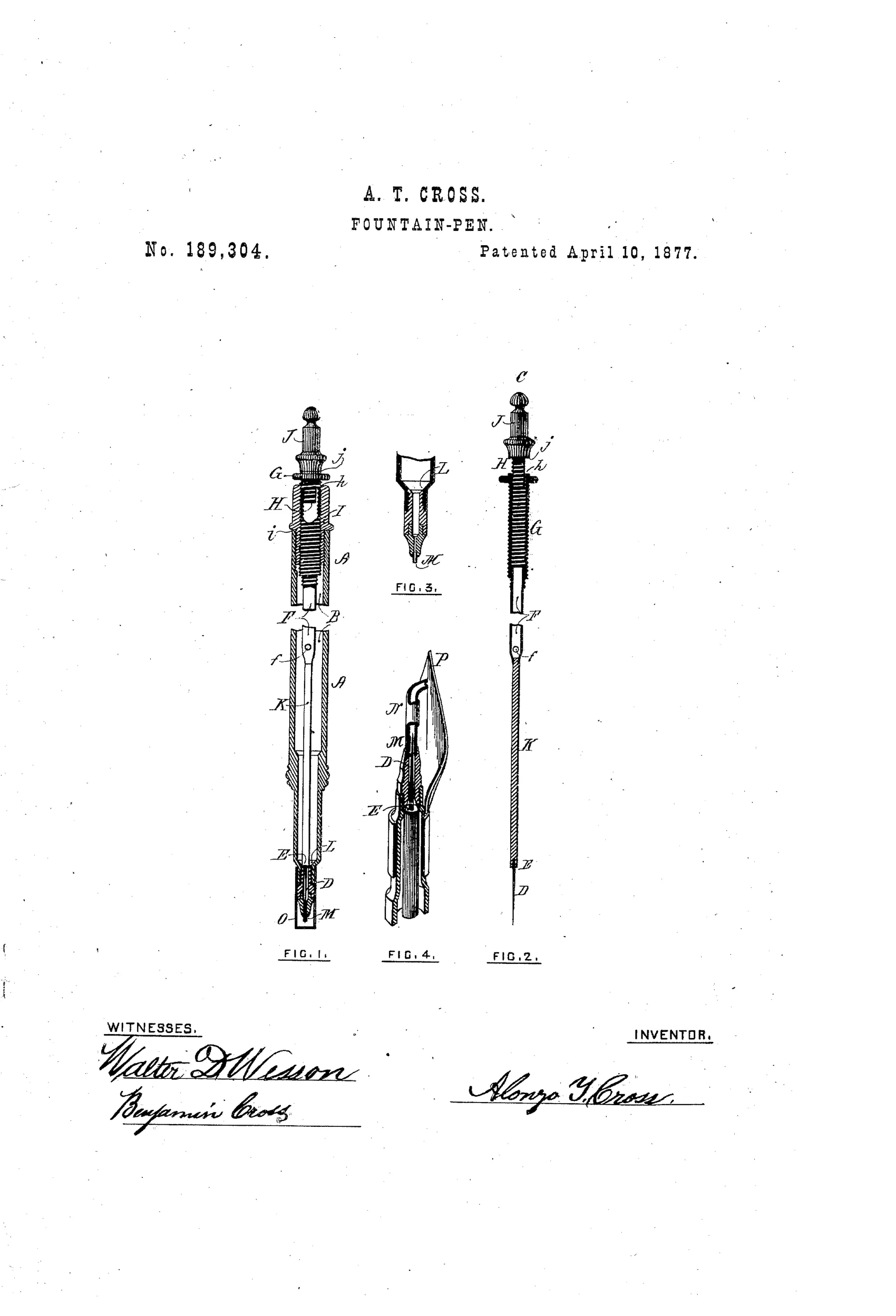
Adjustable-valve fountain pen with capillary writing tube
✒ How it works
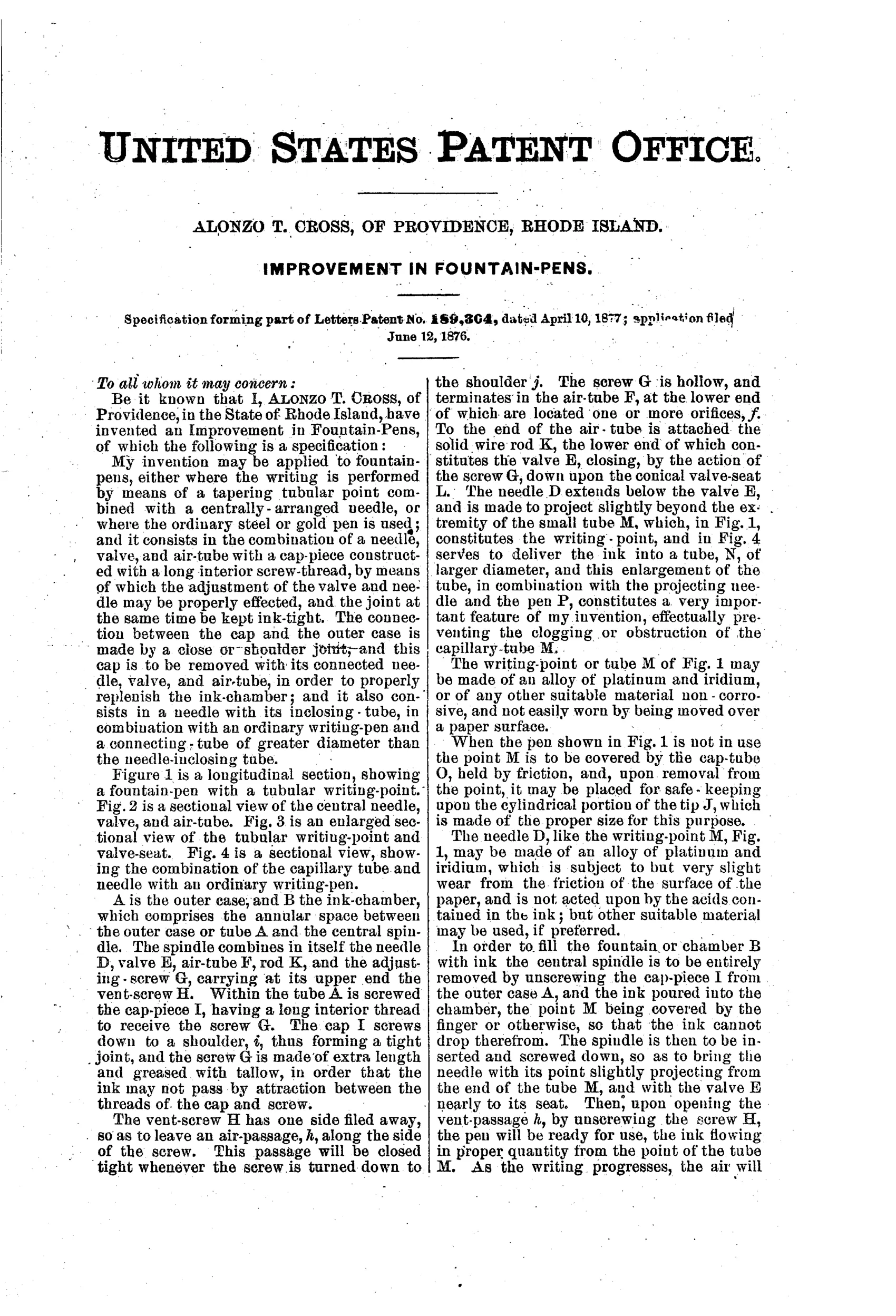
A central spindle inside the outer case combines a needle, valve, air-tube, rod, and adjusting screw, which together control ink flow into the ink chamber B. The needle D projects slightly beyond the capillary writing-point tube M to keep it from clogging, and the valve E seats against a conical valve-seat L to shut off ink flow when the pen is not in use. A vent-screw H, filed flat on one side, opens or closes an air-passage h that allows air to enter the chamber above the ink so that ink can flow from the point as air replaces it. The same needle-and-tube principle can also be adapted to feed ink to an ordinary steel or gold pen point P through a larger bent tube N.
✒ What was claimed
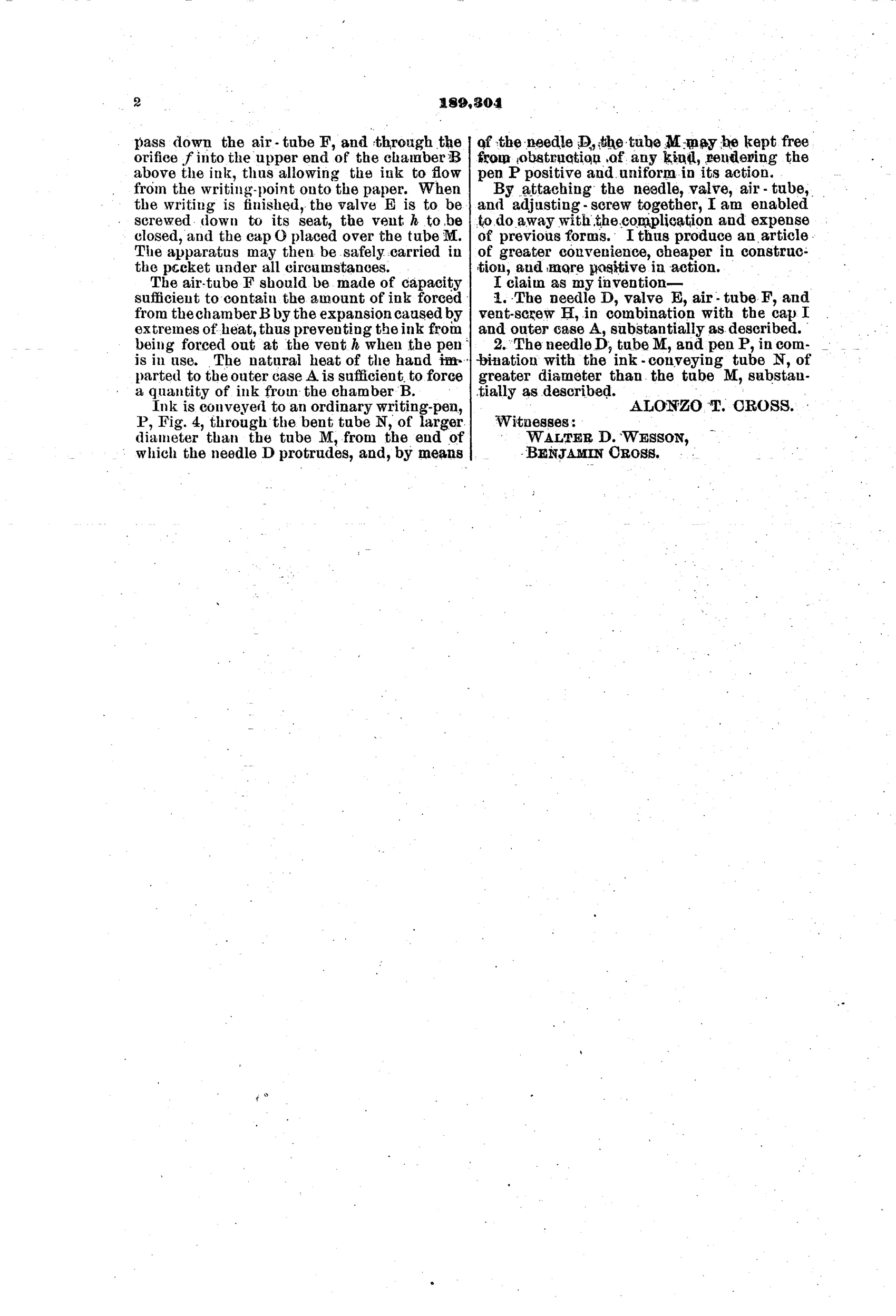
“1. The needle D, valve E, air-tube F, and vent-screw H, in combination with the cap I and outer case A, substantially as described. 2. The needle D, tube M, and pen P, in combination with the ink-conveying tube N, of greater diameter than the tube M, substantially as described.”
In plain English: The invention covers the combination of a needle, valve, air-tube, and vent-screw with the pen's cap and case, as well as the combination of a needle, capillary tube, and pen point fed by a larger ink-conveying tube.
✒ In the inventor’s words
“By attaching the needle, valve, air-tube, and adjusting-screw together, I am enabled to do away with the complication and expense of previous forms.”— Alonzo T. Cross, from the specification
Manufactured and sold
Cross manufactured and sold stylographic pens on this needle-valve principle, and the A.T. Cross Company's stylograph line descends directly from it.
✒ More by Alonzo T. Cross
- IMPROVEMENT IN FOUNTAIN-PENS (1877)
- Improvement in Fountain-Pens (1878)
✒ Commentary
This is Alonzo T. Cross of Providence — yes, that Cross — and this patent is the heart of the stylographic pen, the one branch of the pre-Waterman reservoir family that actually earned its keep. Instead of a nib, the pen writes through a fine capillary tube (M in Fig. 3), with a needle running down its center. The needle does double duty: its tip projects just past the tube mouth to keep the bore from clogging with dried ink, and its shank carries a valve (E) that seats against a conical throat to shut off flow when the pen is idle. Touch the point to paper, the needle lifts a hair, ink flows.
The part a casual reader will miss is the vent-screw H, filed flat on one side. Turn it and you open or close the air passage that lets air replace departing ink — a crude but genuine answer to the air-exchange problem Waterman would solve elegantly seven years later. Cross's own boast in the text, that combining needle, valve, air-tube, and screw into one spindle 'does away with the complication and expense of previous forms,' is fair: this is a consolidation patent, tidying a messy mechanism into one serviceable assembly.
Fig. 4 hedges the bet, adapting the needle-tube feed to an ordinary nib. That branch went nowhere; the stylograph branch became a real product line and, eventually, the ancestor of every technical drafting pen. A dead end for handwriting fashion, but not for engineering.
Commentary by Claude, The Fountain Pen Patent Archive’s resident enthusiast