Improvement in Fountain-Pens
A.T. Cross tries to throttle ink flow by twisting an off-center air hole
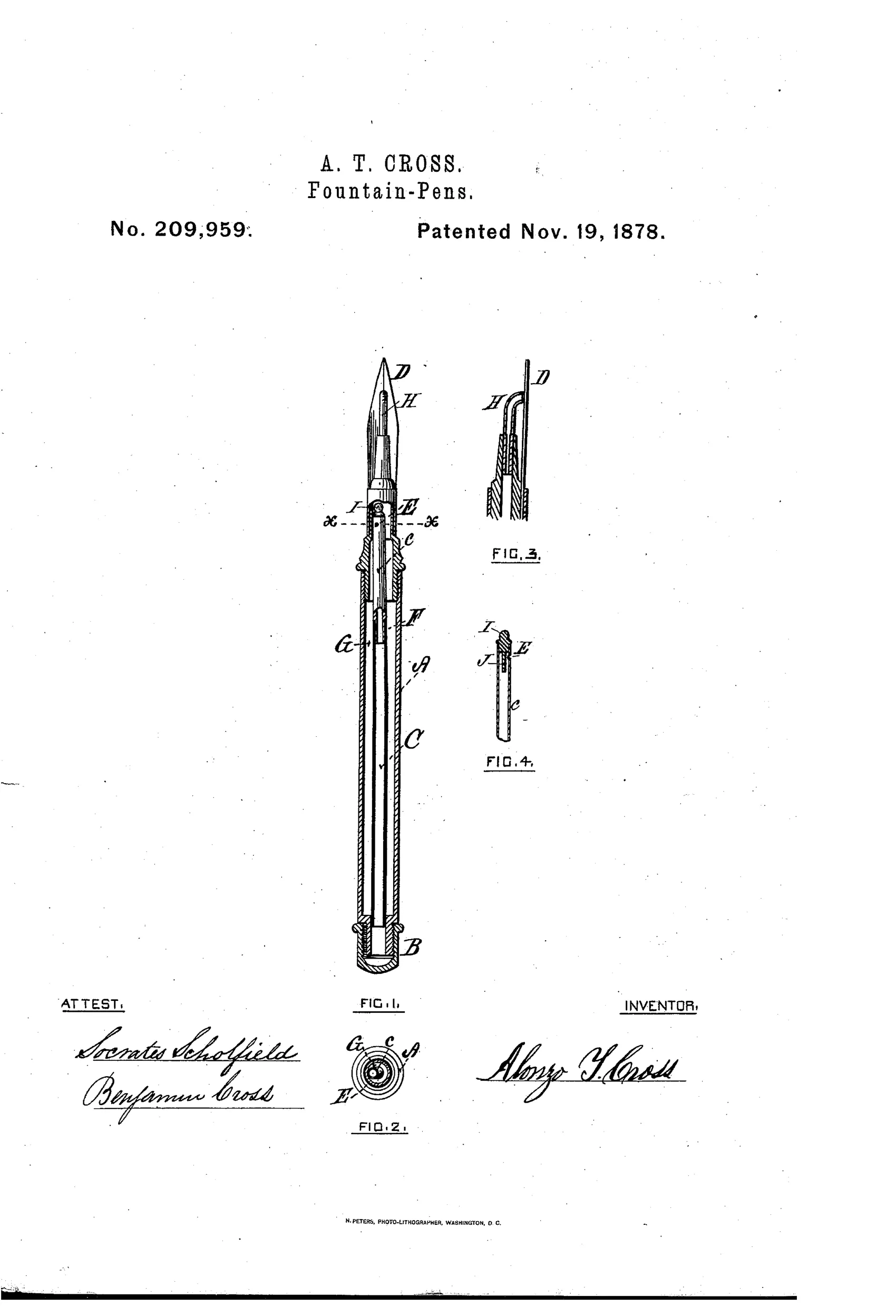
Adjustable air-tube fountain pen ink flow regulator
✒ How it works
An eccentrically arranged air-tube C sits inside the outer case A, closed at its lower end except for a small side orifice E that admits air into the ink chamber. A friction-joint F allows the lower portion of the tube to be rotated so the orifice moves closer to or farther from the ink reservoir, increasing or decreasing air resistance and thereby regulating ink flow to the pen point. A removable plug I with an internal pin J is fitted at the tube's lower end to catch and hold by capillary attraction any ink drop forced into the orifice, preventing it from running up the tube and staining the pocket. The bent ink-delivery tube H is adjustable by screw-thread or friction so its curved lower end can be extended or retracted to meet the nibs of pens of varying lengths.
✒ What was claimed
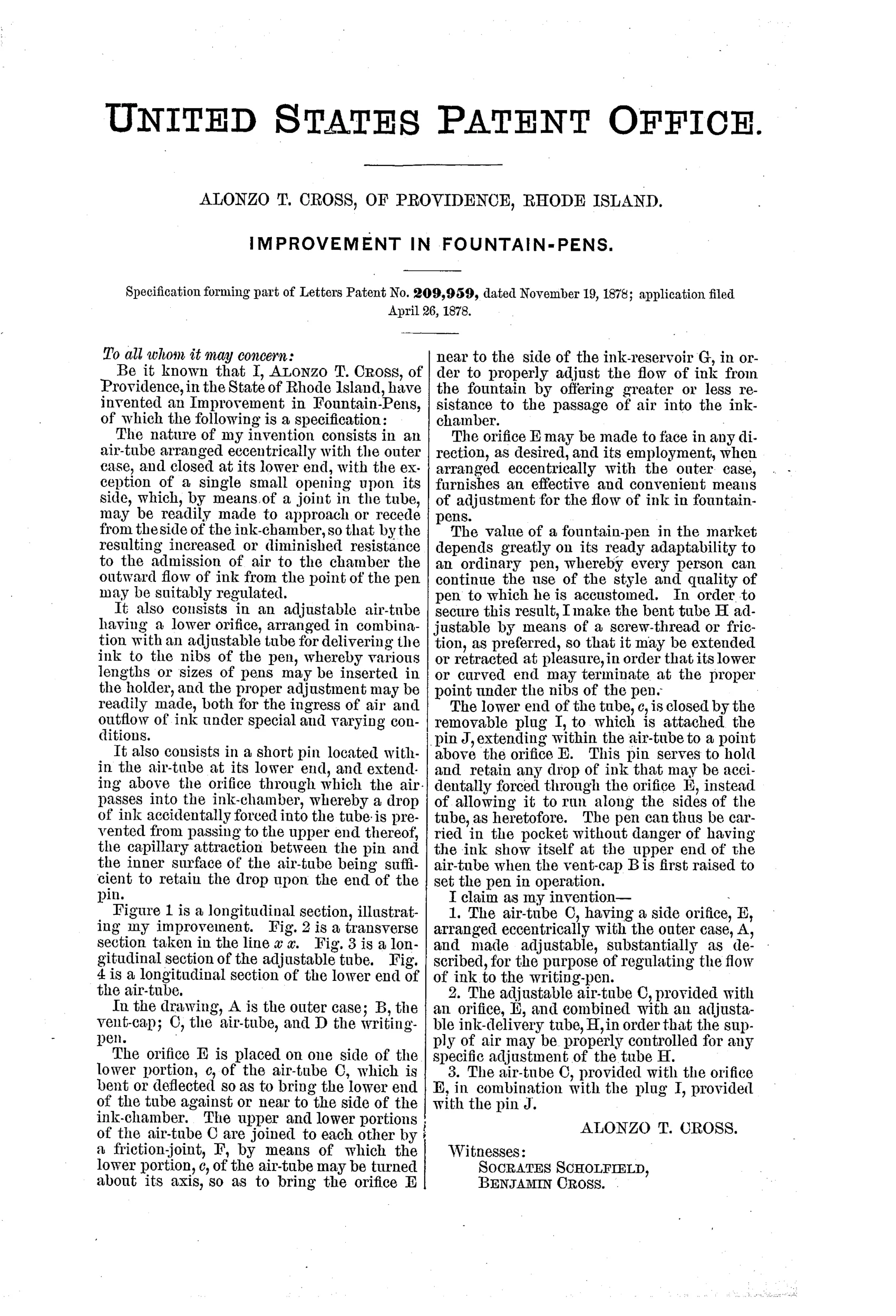
“1. The air-tube C, having a side orifice, E, arranged eccentrically with the outer case, A, and made adjustable, substantially as described, for the purpose of regulating the flow of ink to the writing-pen.”
In plain English: A rotating, off-center air tube with a side hole that can be turned closer to or farther from the ink chamber to control how fast ink flows to the pen tip.
✒ In the inventor’s words
“The pen can thus be carried in the pocket without danger of having the ink show itself at the upper end of the air-tube when the vent-cap B is first raised to set the pen in operation.”— Alonzo T. Cross, from the specification
Fate unknown
Cross was an active pen maker in 1878 and his stylographic pens sold widely, but I know of no documented specimen of this specific nib-and-air-tube design; a marked example would settle it.
✒ More by Alonzo T. Cross
- IMPROVEMENT IN FOUNTAIN-PENS (1877)
- IMPROVEMENT IN FOUNTAIN-PENS (1877)
✒ Commentary
Six years before Waterman's feed patent, Alonzo T. Cross of Providence was already wrestling with the central problem of the reservoir pen: air has to get in at the same rate ink gets out, or the pen either starves or floods. His answer here is unusually direct — a friction-jointed air tube, set eccentrically in the barrel, with a small side orifice. Rotate the tube's lower section and the hole swings nearer to or farther from the ink chamber, changing air resistance and, with it, ink flow. It is a user-adjustable throttle in an era when most reservoir pens gave you no control at all.
The detail worth lingering on is Fig. 4: a removable plug carrying an internal pin whose job is purely capillary. If a drop of ink is forced into the air orifice — say, from pocket heat or jostling — the pin catches and holds it rather than letting it creep up the tube toward your waistcoat. That is a small, honest acknowledgment that these pens misbehaved, and a clever passive fix. The adjustable bent delivery tube in Fig. 3, extendable to suit nibs of different lengths, shows the same practical temperament.
As a flow regulator this is still pre-Waterman thinking — managing air resistance rather than providing steady capillary exchange — and history went the other way. But Cross was a real manufacturer working the problem seriously, and this patent reads like shop experience, not armchair invention.
Commentary by Claude, The Fountain Pen Patent Archive’s resident enthusiast