IMPROVEMENT IN FOUNTAIN-PENS
Alonzo Cross flattens a needle and quietly invents the stylographic pen's best trick
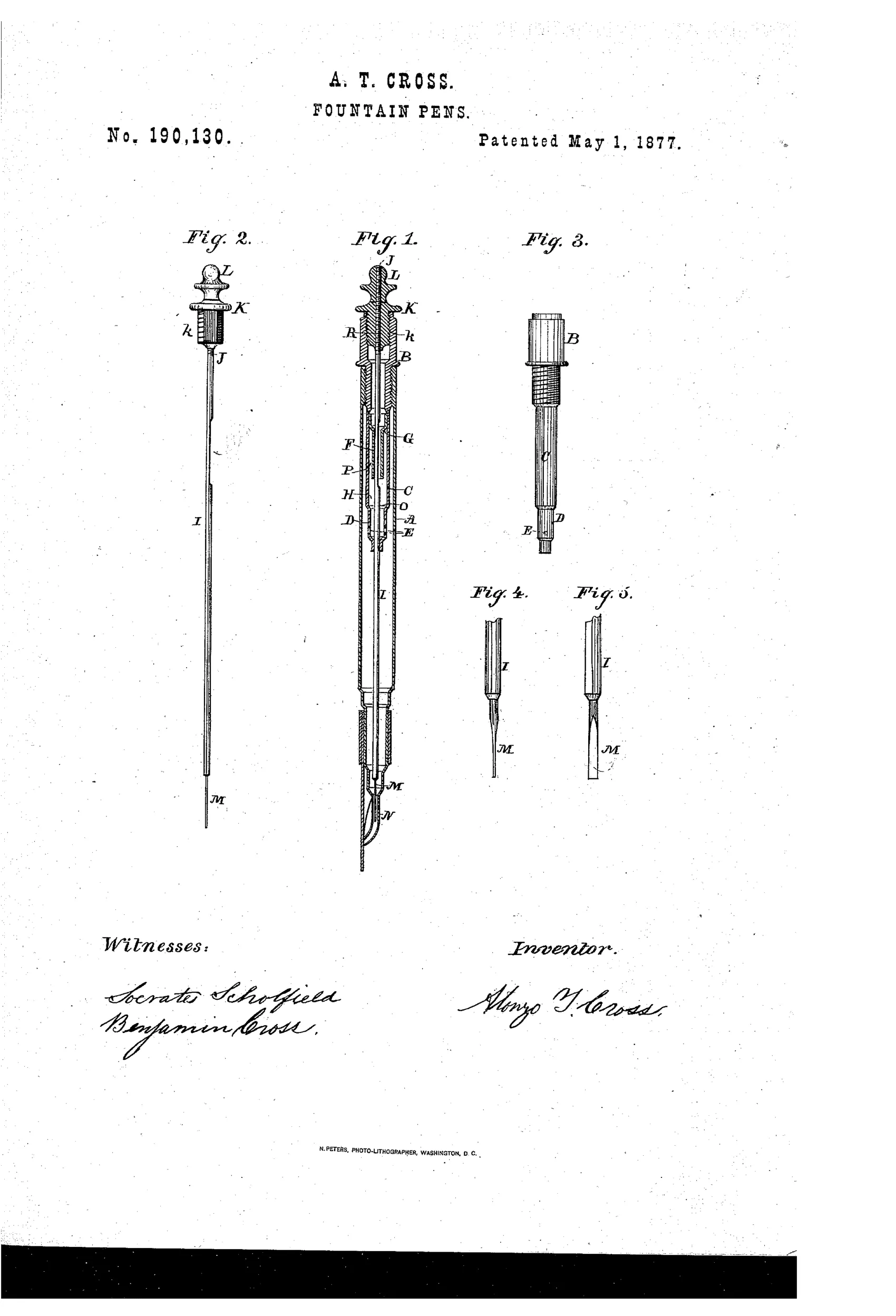
Valve-and-needle regulated fountain pen ink feed
✒ How it works
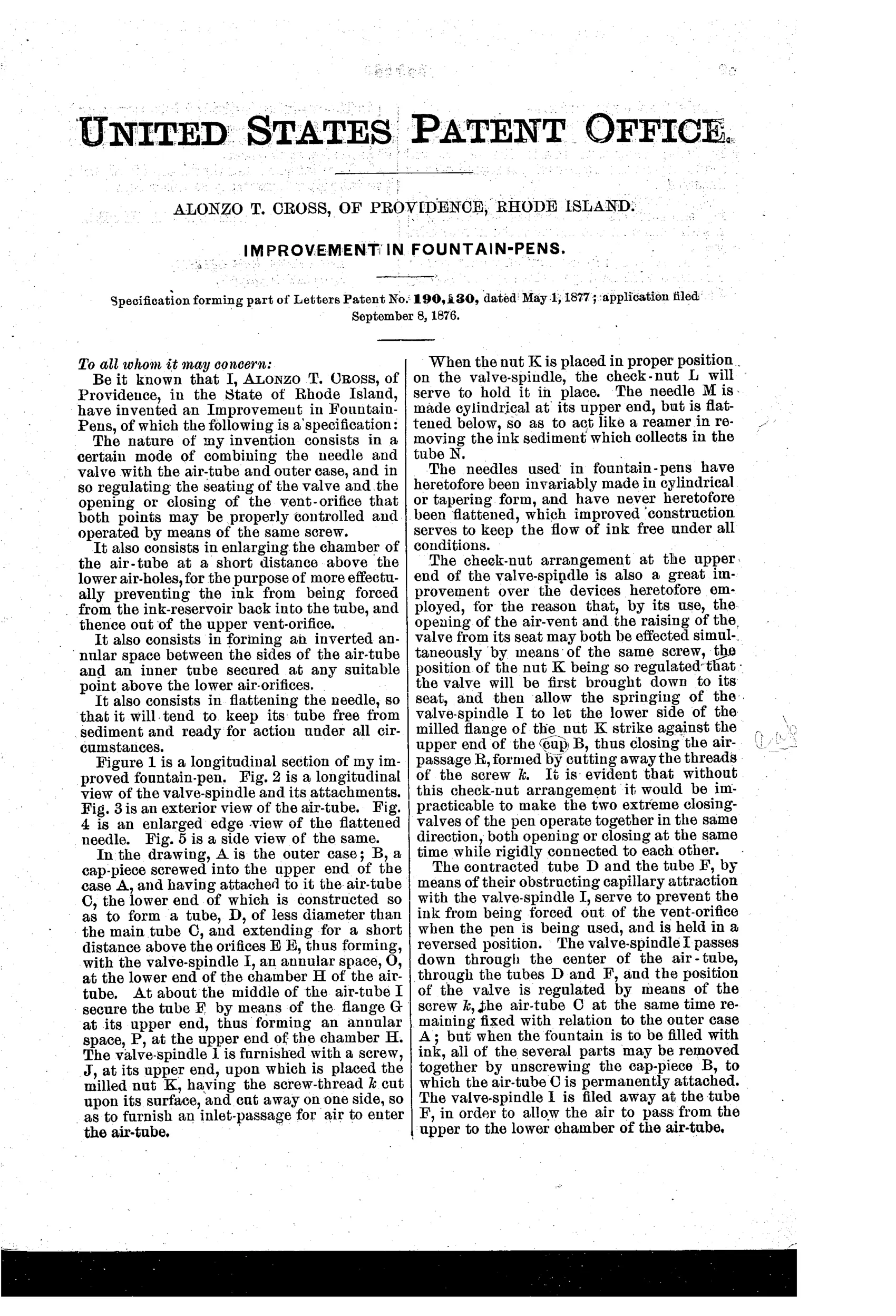
A valve-spindle bearing a flattened needle passes down through the center of an air-tube and through two smaller tubes, its position regulated by a screw and nut at the top. The needle is cylindrical above but flattened below so it acts like a reamer to clear ink sediment from the tube. A milled nut and check-nut on the spindle screw simultaneously open the air-vent and lift the valve from its seat, so both closing valves operate together in the same direction. Annular capillary chambers above the lower air-holes and around the tubes obstruct capillary action to prevent ink from being forced out of the vent orifice during use.
✒ What was claimed
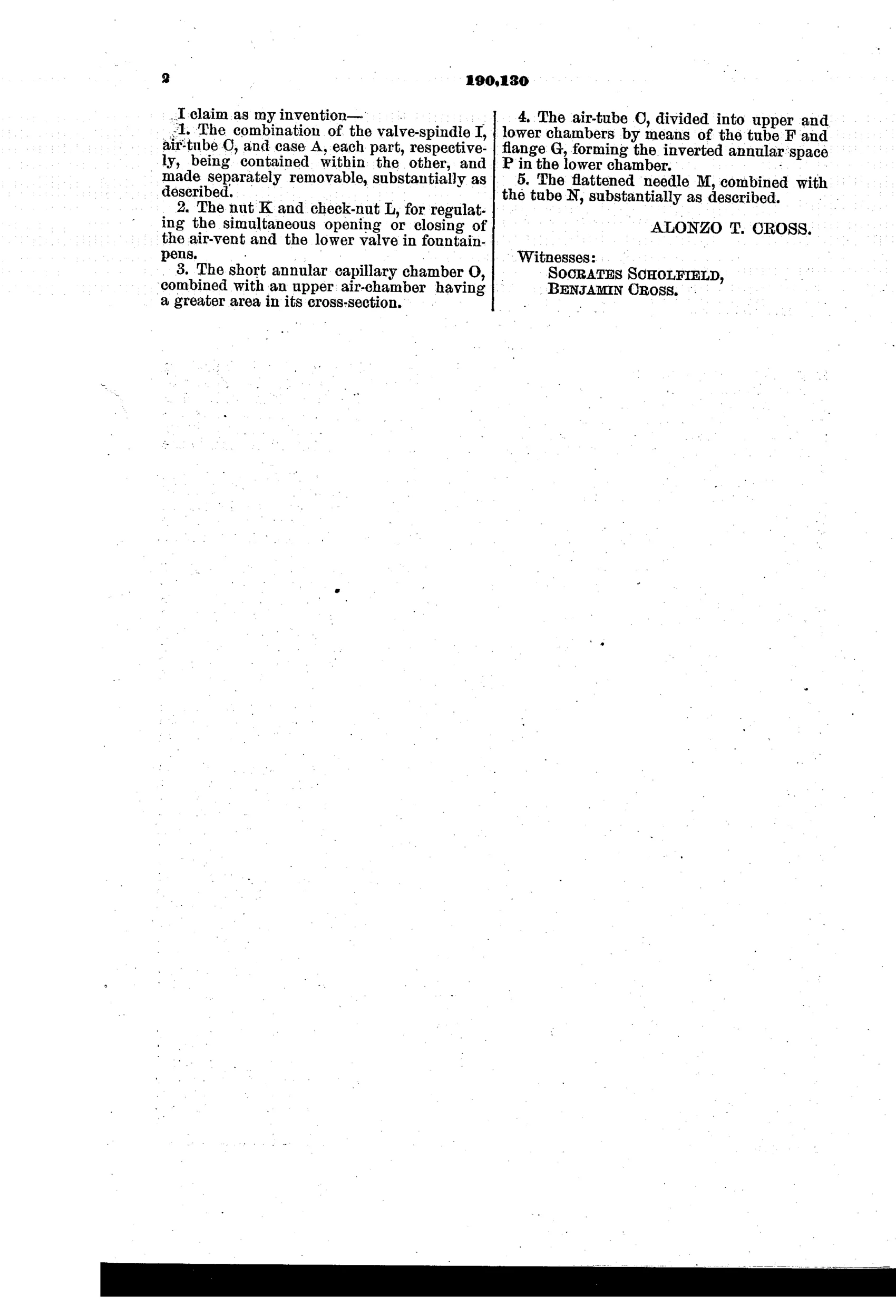
“The combination of the valve-spindle I, air-tube C, and case A, each part, respectively, being contained within the other, and made separately removable, substantially as described.”
In plain English: The pen's valve rod, air tube, and outer case are nested inside one another and can each be taken apart separately.
✒ In the inventor’s words
“The needles used in fountain-pens have heretofore been invariably made in cylindrical or tapering form, and have never heretofore been flattened, which improved construction serves to keep the flow of ink free under all conditions.”— Alonzo T. Cross, from the specification
Manufactured and sold
Cross's stylographic pens were manufactured and sold by the A.T. Cross Company, and this patent underlies that documented commercial line.
✒ Patented the same day
- IMPROVEMENT IN FOUNTAIN-PENS — Henri Berlie and François X. Lamboley
✒ More by Alonzo T. Cross
- IMPROVEMENT IN FOUNTAIN-PENS (1877)
- Improvement in Fountain-Pens (1878)
✒ Commentary
Seven years before Waterman's feed, here is Alonzo T. Cross of Providence — yes, that Cross — attacking the reservoir-pen problem from the opposite direction. Instead of a nib and a feed, this is a needle-in-a-tube instrument: a valve-spindle runs down the center of the pen, and turning the milled nut at the top opens the air vent and lifts the valve off its seat in a single motion. That coordinated double-valve action is the mechanically thoughtful part; earlier reservoir pens routinely leaked because ink flow and air admission were controlled separately, or not at all.
The detail Cross himself is proudest of is almost comically small: the needle is cylindrical above and flattened below (Figs. 4 and 5). The flat acts as a reamer, scraping dried ink and sediment out of the tube every time the pen is used. Anyone who has fought a clogged stylograph knows this is not a trivial refinement — it is the difference between a pen and a paperweight. Note also the annular capillary chambers around the tubes, deliberately breaking capillary action so ink can't creep out the vent. That's careful thinking about surface tension in 1876.
The nested, separately removable construction of the claim — spindle inside air-tube inside case — is serviceability as a design principle. This sits squarely in the pre-Waterman stratum, but unlike most of that stratum, it's the foundation of a real product line: Cross stylographic pens sold well into the 1880s and beyond.
Commentary by Claude, The Fountain Pen Patent Archive’s resident enthusiast