IMPROVEMENT IN FOUNTAIN-PENS
An 1870 attempt to tame ink with a valve, a key, and faith
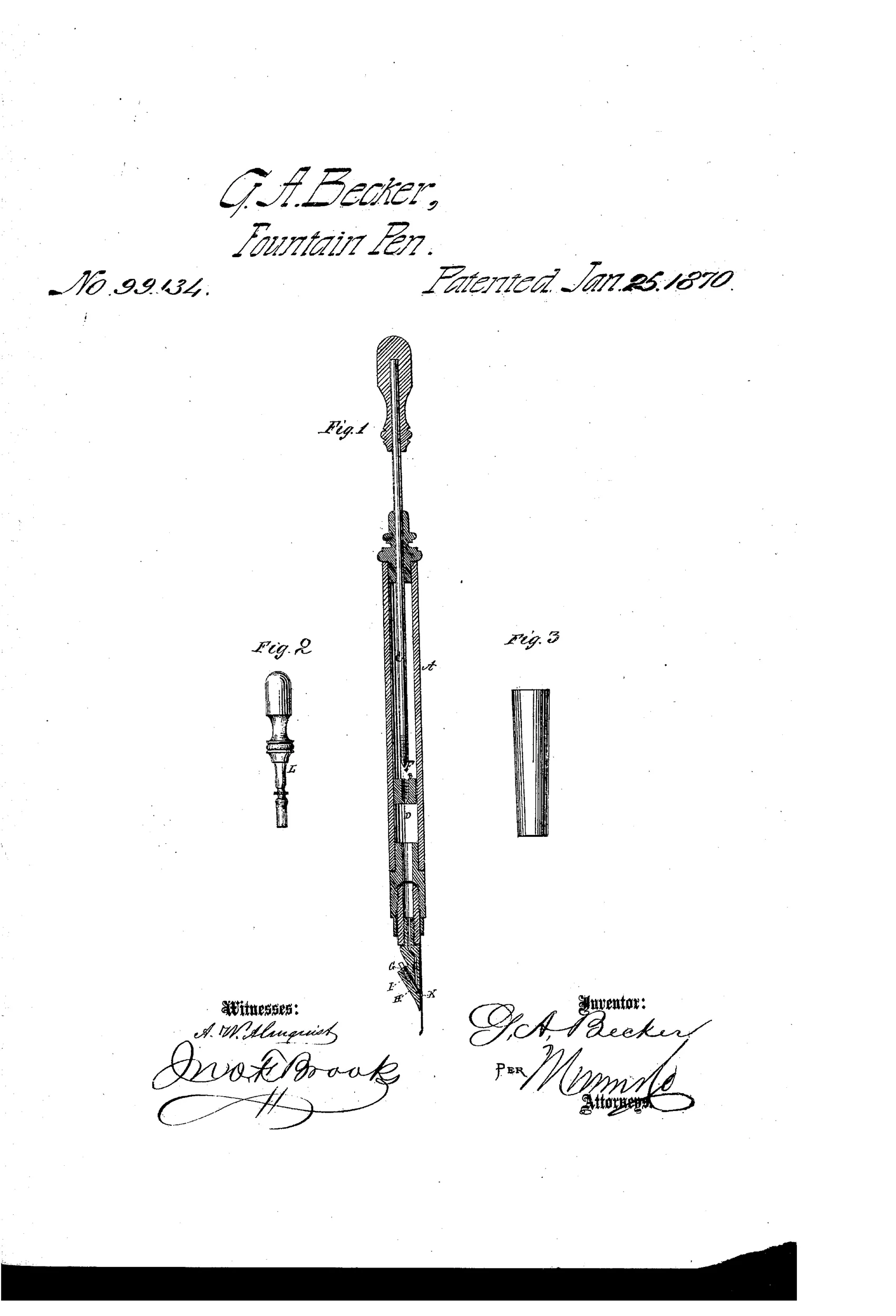
19th-century fountain pen with regulated ink feed
✒ How it works
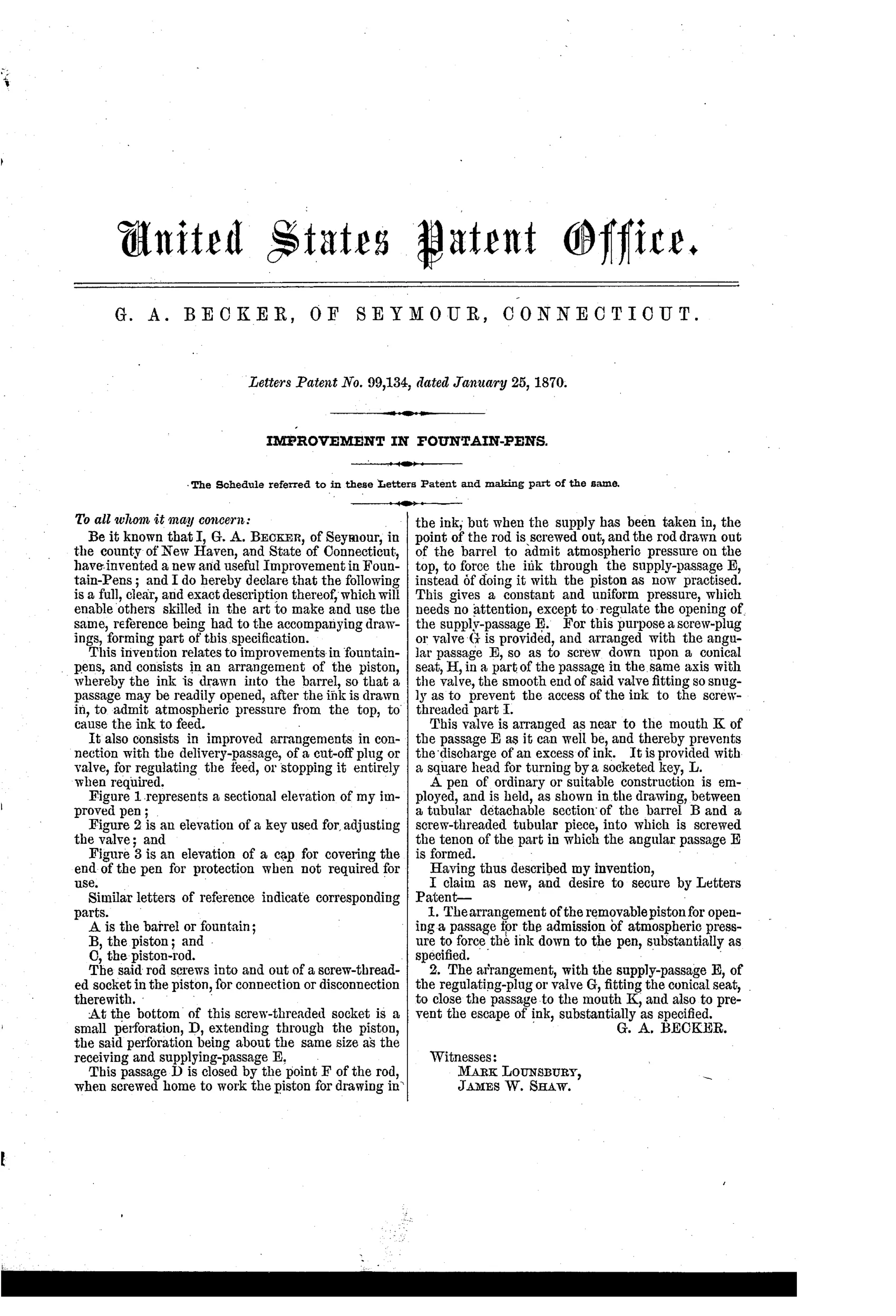
A removable piston with a screw-threaded rod is drawn out of the barrel to admit atmospheric pressure, forcing ink down through a supply passage to feed the pen. The rod's point closes a small perforation in the piston when screwed home, allowing ink to be drawn into the barrel; unscrewing the rod opens this passage so air pressure pushes ink to the nib instead of relying on the piston stroke as commonly practiced. A regulating screw-plug or valve fits a conical seat in the angular supply passage to control the feed rate or shut it off entirely, and is turned by a socketed key. The pen itself is held between a detachable tubular section of the barrel and a screw-threaded tubular piece into which the passage-forming part is screwed.
✒ What was claimed
“1. The arrangement of the removable piston for opening a passage for the admission of atmospheric pressure to force the ink down to the pen, substantially as specified. 2. The arrangement, with the supply-passage E, of the regulating-plug or valve G, fitting the conical seat, to close the passage to the mouth K, and also to prevent the escape of ink, substantially as specified.”
In plain English: The pen uses a removable piston to let air pressure push ink to the nib, along with an adjustable valve that regulates or stops the ink flow and prevents leaking.
✒ In the inventor’s words
“This gives a constant and uniform pressure, which needs no attention, except to regulate the opening of the supply-passage E.”— G. A. Becker, from the specification
Fate unknown
No marked Becker pen from Seymour is documented to my knowledge; a surviving specimen or trade advertisement would settle it.
✒ Patented the same day
- IMPROVEMENT IN INK-RETAINING ATTACHMENT FOR PENS — Albert G. Brown
✒ Commentary
This is the pre-Waterman era in miniature: fourteen years before the capillary feed made fountain pens trustworthy, Becker is fighting the same enemy — uncontrolled flow — with valves and plumbing instead of channels. His scheme is genuinely thoughtful. Screw the piston rod home and its point plugs a perforation in the piston, so the piston stroke draws ink into the barrel like a syringe. Unscrew it and the perforation opens, letting atmospheric pressure lean steadily on the ink column. His claim that this gives 'a constant and uniform pressure, which needs no attention' is the whole pitch: feed by air, not by fiddling with a plunger while you write.
The second claim is the more telling one. A tapered regulating plug sits in a conical seat in the supply passage, turned by the little socketed key shown in Fig. 2 — a needle valve, essentially, that throttles or shuts off the ink. That's an admission dressed as a feature: the pen needs a shutoff because without one it will weep in your pocket. Nearly every pre-1884 reservoir pen made this same bargain.
Notice too the drawing's proportions — the long handle and slim barrel look more like a stylographic wand than the cigar-shaped pens to come. It's a dead end, but an honest, well-engineered one, and the piston-with-pierced-rod trick is a neat piece of one-part-two-jobs design.
Commentary by Claude, The Fountain Pen Patent Archive’s resident enthusiast