FOUNTAIN-PEN.
The 1884 feed patent the whole modern fountain pen industry dates from
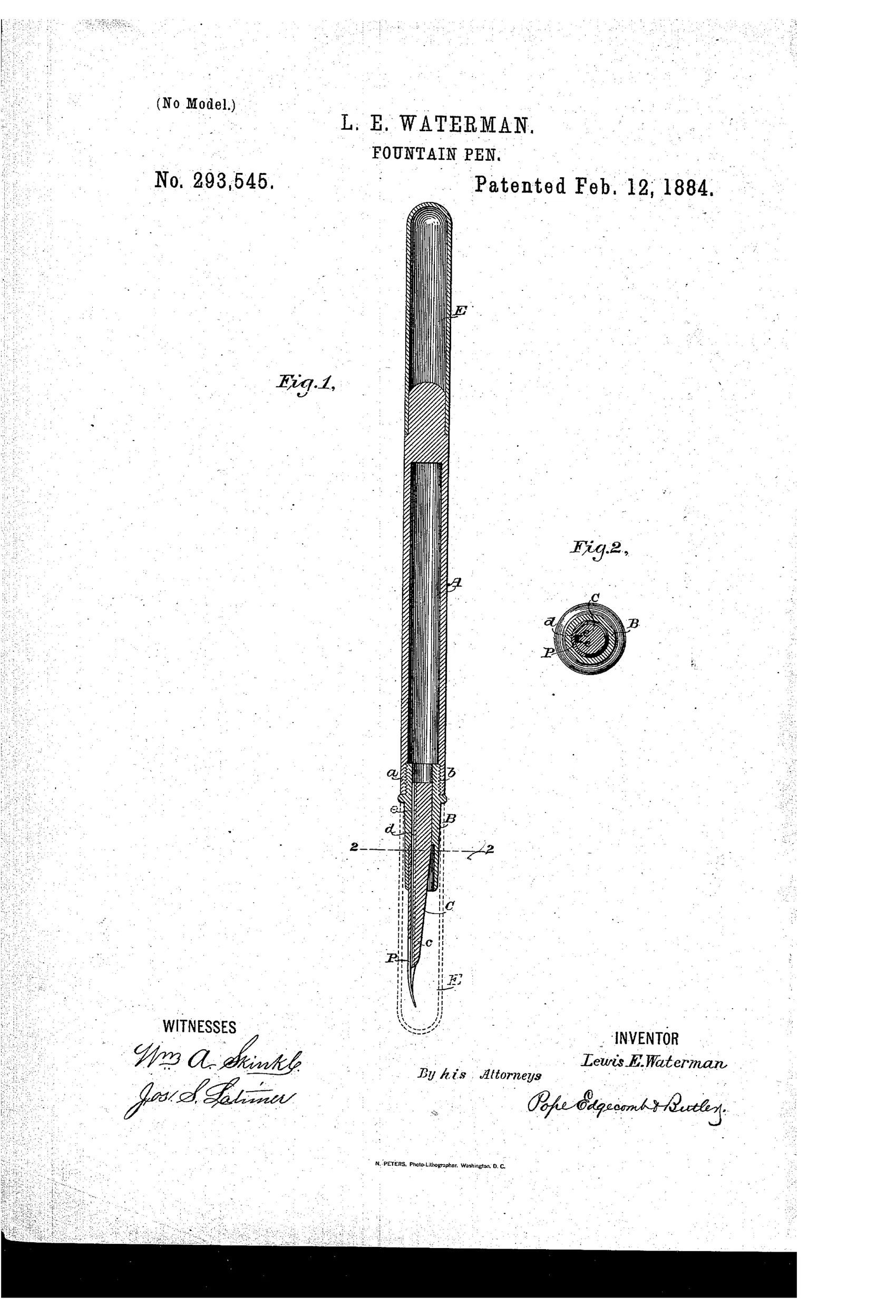
Fountain pen with regulated ink-feed mechanism.
✒ How it works
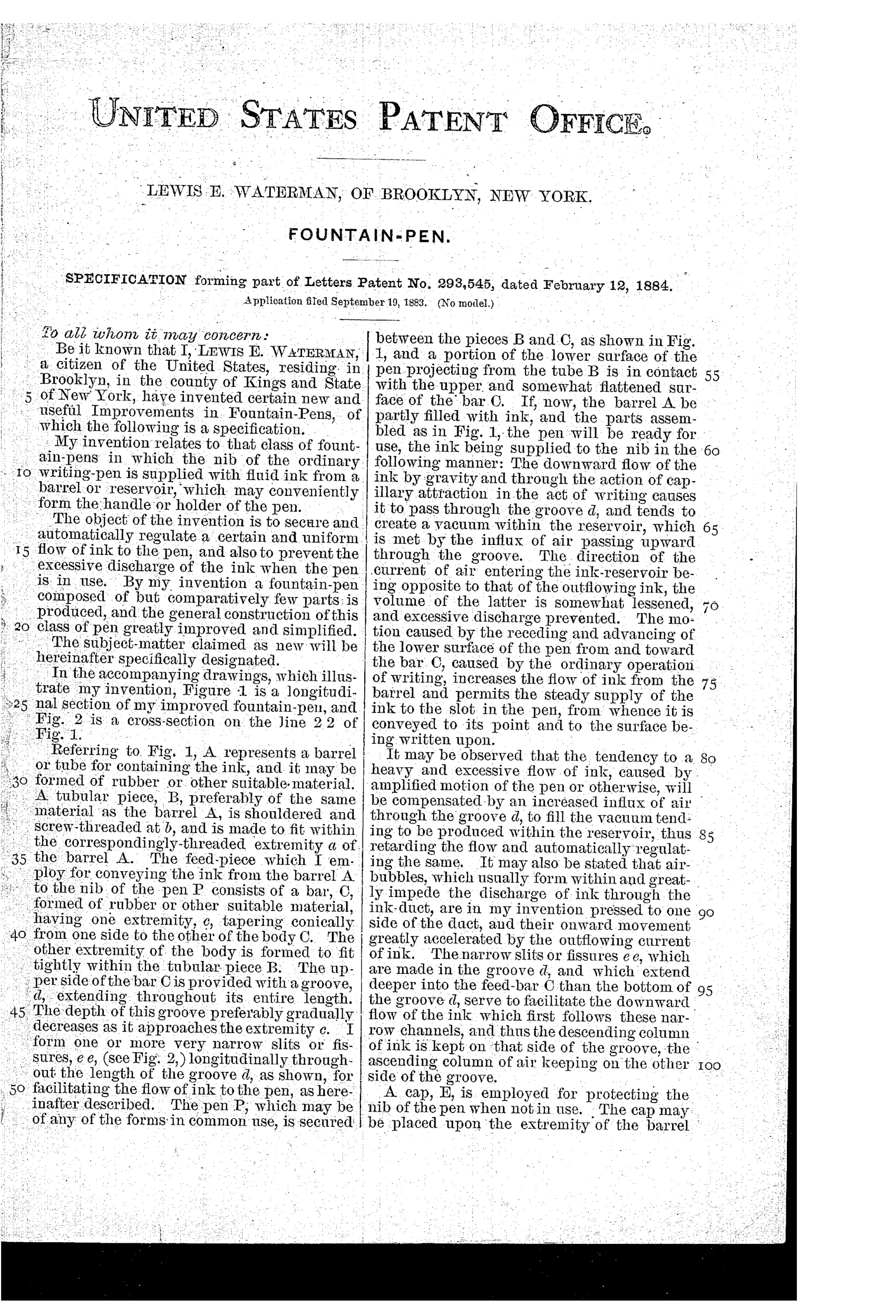
An ink barrel connects via a threaded tube to a feed-bar bearing a longitudinal groove that channels ink down to the nib by gravity and capillary attraction. Narrow longitudinal fissures cut into the sides of the groove, deeper than the groove itself, keep the descending ink and ascending air on opposite sides of the channel, preventing air bubbles from blocking flow. As ink flows out, air is drawn upward through the same groove to replace it, and this counter-current automatically reduces excessive flow, self-regulating the ink supply during writing. A protective cap fits over the nib end and can be posted on the barrel to lengthen the holder while writing.
✒ What was claimed
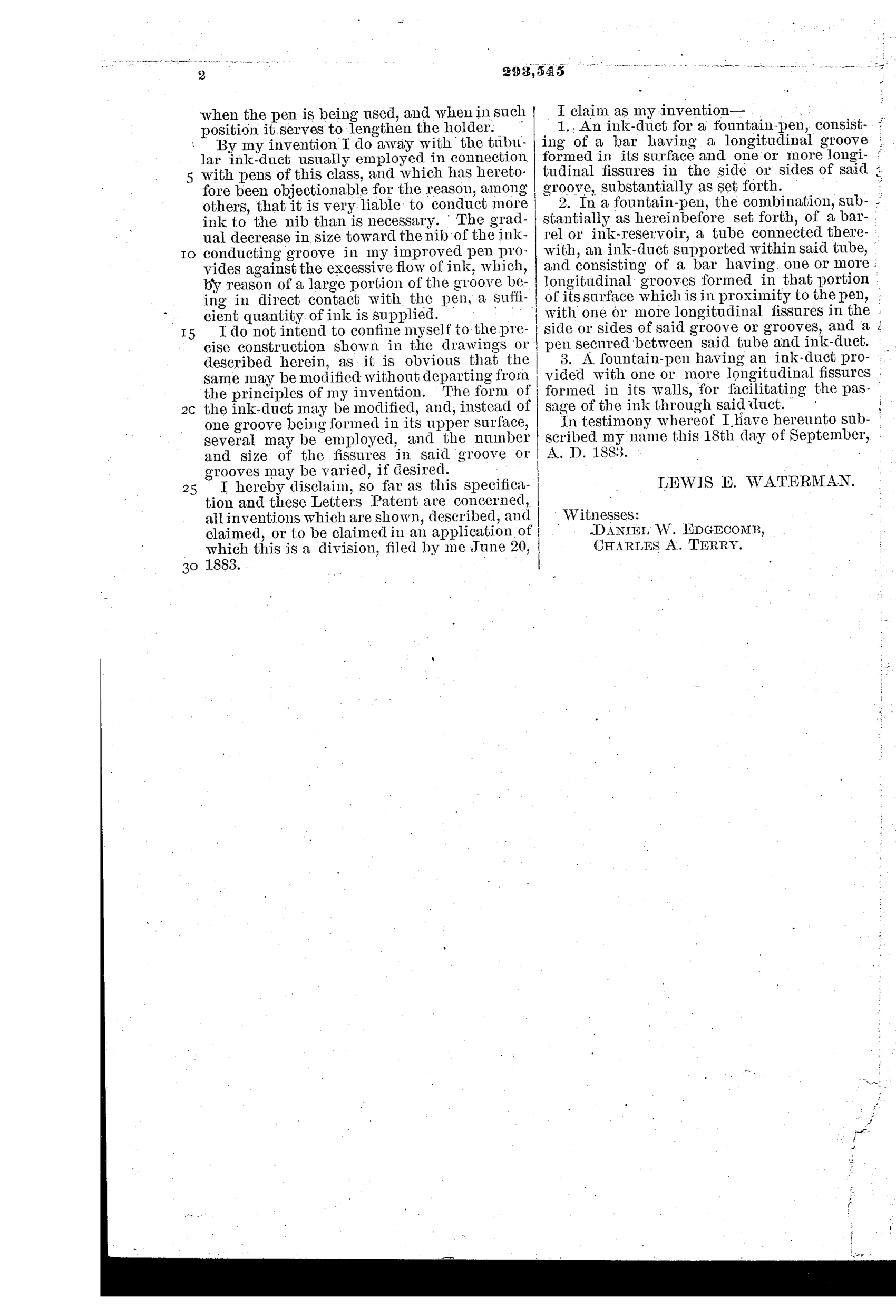
“1. An ink-duct for a fountain-pen, consisting of a bar having a longitudinal groove formed in its surface and one or more longitudinal fissures in the side or sides of said groove, substantially as set forth.”
In plain English: The invention claims a feed bar with a lengthwise groove that has one or more narrow slits cut into its sides to control ink flow.
✒ In the inventor’s words
“The direction of the current of air entering the ink-reservoir being opposite to that of the outflowing ink, the volume of the latter is somewhat lessened, and excessive discharge prevented.”— Lewis E. Waterman, from the specification
Manufactured and sold
This is the foundational Waterman feed; the company built its business on it and countless surviving pens embody the design.
✒ More by Lewis E. Waterman
- FOUNTAIN-PEN. (1896)
- FOUNTAIN-PEN. (1898)
✒ Commentary
This is the one. Patent 293,545 is the founding document of the reliable fountain pen, and the whole trick is in the tiny cross-section of Fig. 2, which most eyes slide right past. Waterman cuts a longitudinal groove in the feed bar to carry ink down to the nib — nothing new there; reservoir pens had done that for decades and flooded or starved unpredictably. His addition is the narrow fissures cut into the sides of that groove, deeper than the groove itself. Those hairline slits are capillary channels: ink clings to them and descends in an orderly film, while air bubbles up the open center of the groove to replace it in the barrel.
Before this, the fundamental problem was that ink and air fought over the same passage. The pen would refuse to write until pressure equalized, then dump a blot on the page. Waterman's counter-current arrangement makes the exchange continuous and, as he notes, self-limiting — the incoming air stream actually throttles excessive outflow. The claim language is admirably narrow: a bar, a groove, fissures in its sides. He patented exactly the working part and nothing else.
Everything that follows in this category — Parker's Lucky Curve, the overfeed and underfeed wars, every self-filler — is a refinement of, or a workaround built on, this idea. The drawing even shows the cap posting on the barrel, a habit pens keep to this day.
Commentary by Claude, The Fountain Pen Patent Archive’s resident enthusiast