FOUNTAIN STYLUS-PEN.
A horse-hair writing point and 'irritant' strands, filed two years before Waterman
Fountain pen with capillary stylus point
✒ How it works
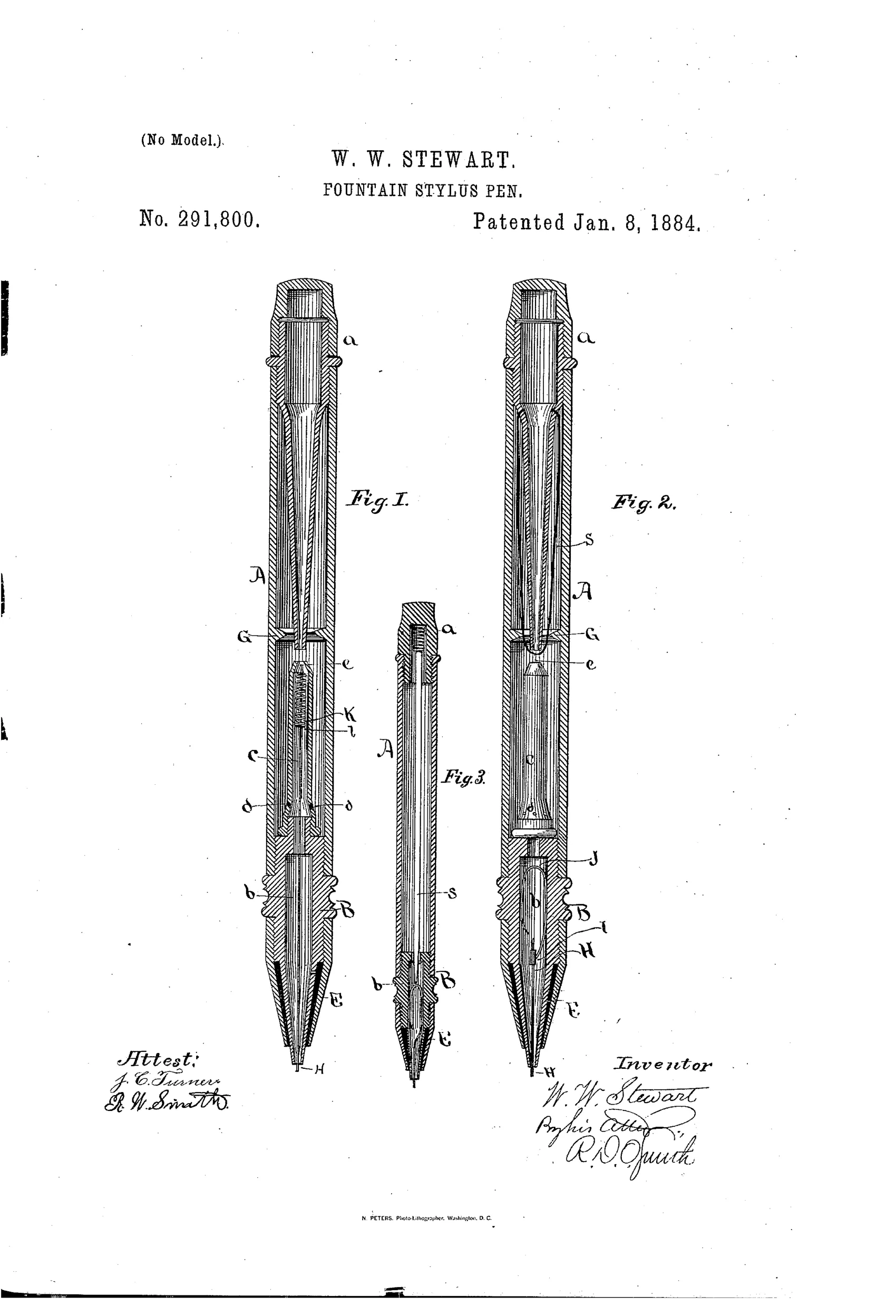
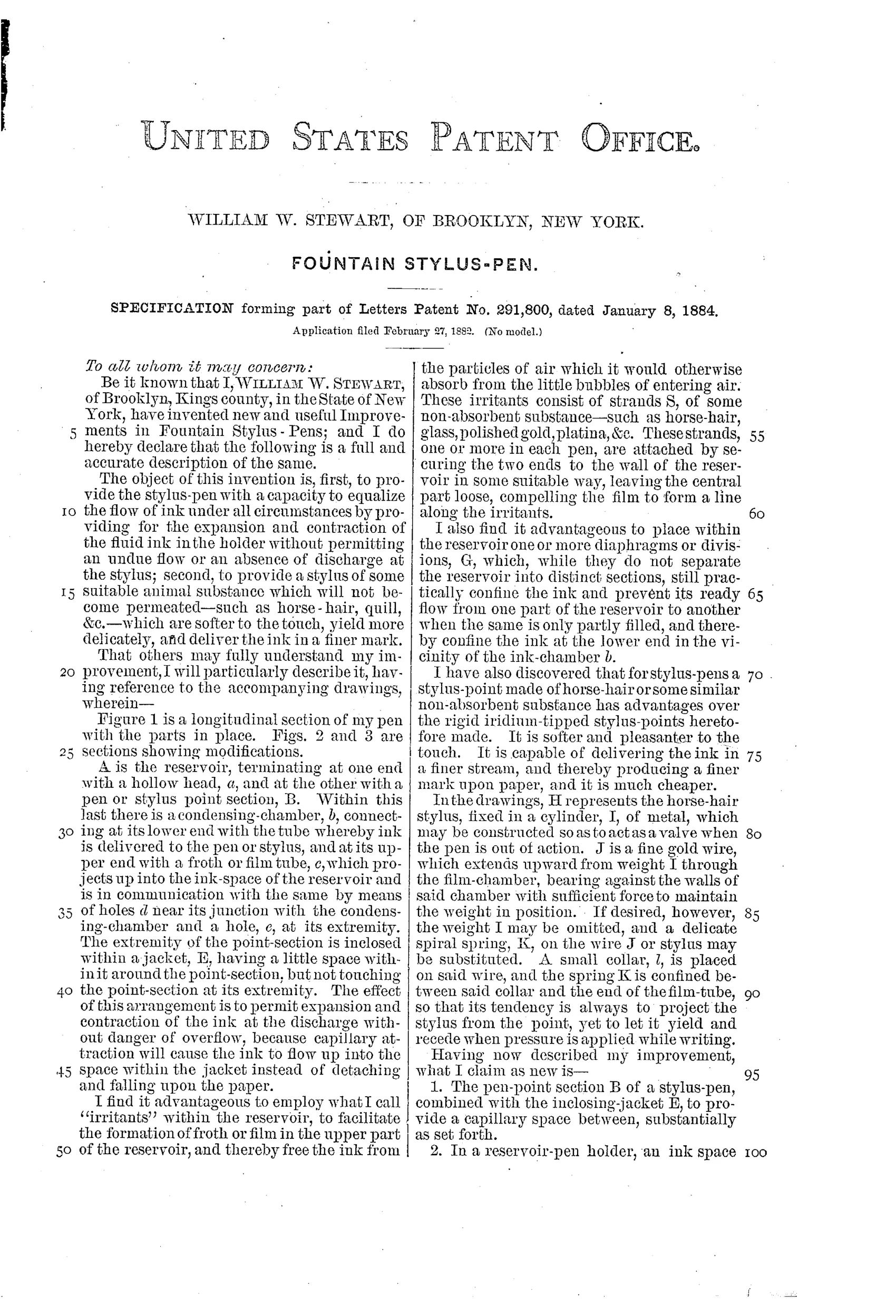
The pen holds ink in a reservoir with a hollow head and a condensing chamber that connects to the writing point. Diaphragms (G) partly divide the ink space to keep ink confined near the point without stopping flow, while non-absorbent 'irritant' strands (S) of horse-hair, glass, or metal in the reservoir create a film or froth to release trapped air. The point itself is a soft horse-hair or similar non-absorbent stylus enclosed in a jacket (E) that leaves a capillary space around it, allowing ink to expand or contract there instead of overflowing onto the paper. A spring (K) or weight (I) on a gold wire (J) keeps the stylus pressed toward the point but lets it yield when writing.
✒ What was claimed
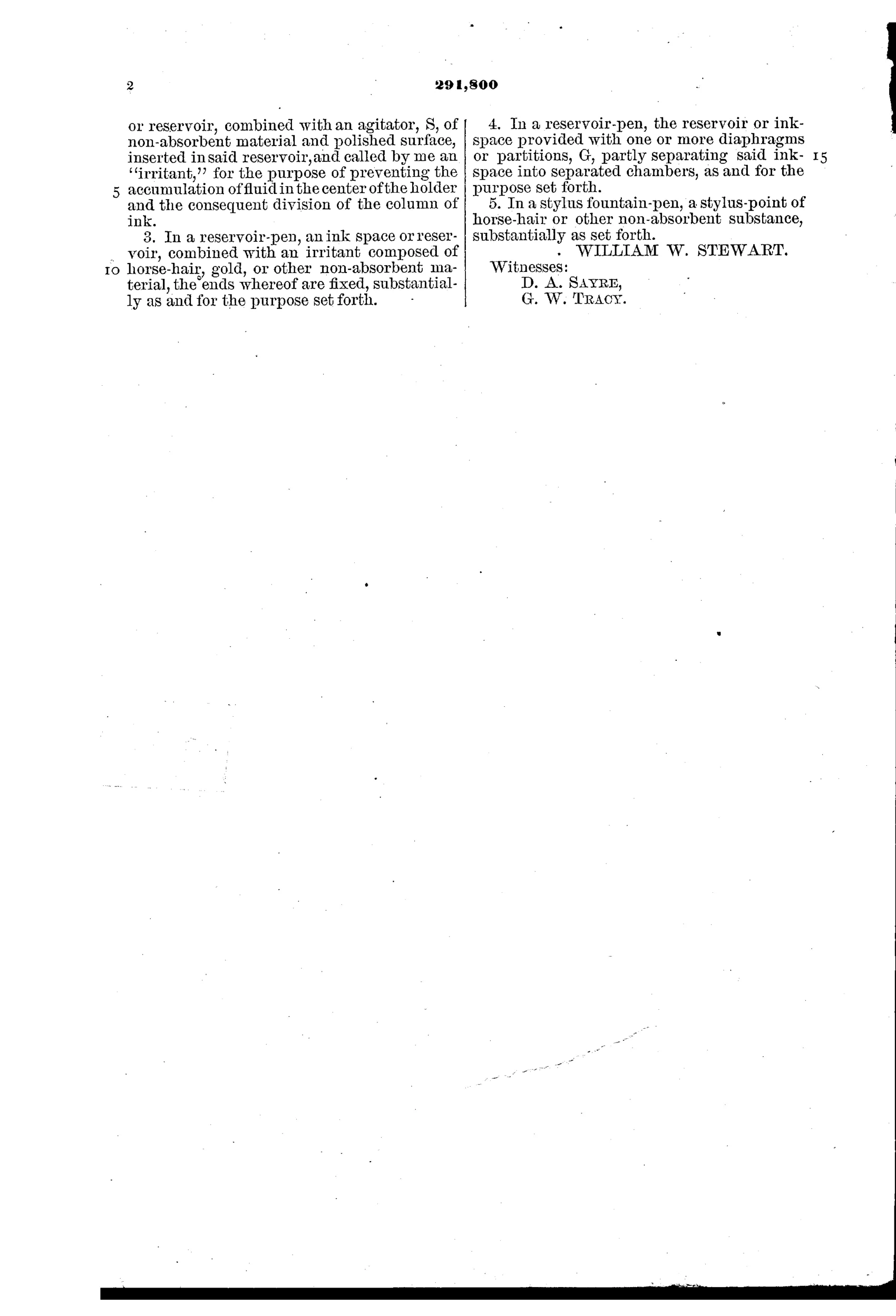
“1. The pen-point section B of a stylus-pen, combined with the inclosing-jacket E, to provide a capillary space between, substantially as set forth.”
In plain English: The claim covers a pen point enclosed in a jacket that leaves a small capillary gap around it to manage ink flow.
✒ In the inventor’s words
“These irritants consist of strands S, of some non-absorbent substance—such as horse-hair, glass, polished gold, platina, &c.”— William W. Stewart, from the specification
Paper patent — likely never produced
No Stewart stylus pen of this description is known to collectors, and the horse-hair point seems commercially impractical against the established needle-valve stylographs; a marked example would overturn this.
✒ More by William W. Stewart
- FOUNTAIN PEN-HOLDER. (1886)
- FOUNTAIN-PEN. (1897)
- FOUNTAIN-PEN. (1897)
- FOUNTAIN-PEN (1899)
✒ Commentary
Stewart filed this in February 1882, squarely in the pre-Waterman era when everyone knew reservoir pens leaked and nobody agreed on why. His diagnosis was air: ink won't flow smoothly unless air can get back into the reservoir, and trapped bubbles cause blots. His cure is the strangest part of the patent — strands of horse-hair, glass, or polished gold wire loose inside the ink chamber, which he calls 'irritants,' meant to break surface tension and let air bubbles froth free instead of vapor-locking the pen. It's a crude, physical answer to the same problem Waterman would solve two years later with orderly capillary channels in the feed.
The writing end is equally unorthodox. Instead of a nib or the needle-and-tube of a true stylograph, Stewart uses a soft non-absorbent stylus — again horse-hair — sprung inside a jacket, with a deliberate capillary gap between stylus and jacket that acts as an overflow buffer when the ink expands. Look closely at Figs. 1 and 2 and you can see the spring K and the weighted wire J holding the point forward; it yields under writing pressure like a tiny shock absorber.
This sits with the stylographic pens of MacKinnon and Cross, then genuinely popular, but Stewart's fibrous point is a departure from their proven needle valve. The air-management instinct was right; the execution reads like a dead end the feed wars soon made irrelevant.
Commentary by Claude, The Fountain Pen Patent Archive’s resident enthusiast