FOUNTAIN-PEN
A wire skeleton inside the ink channel, taming bubbles by surface tension
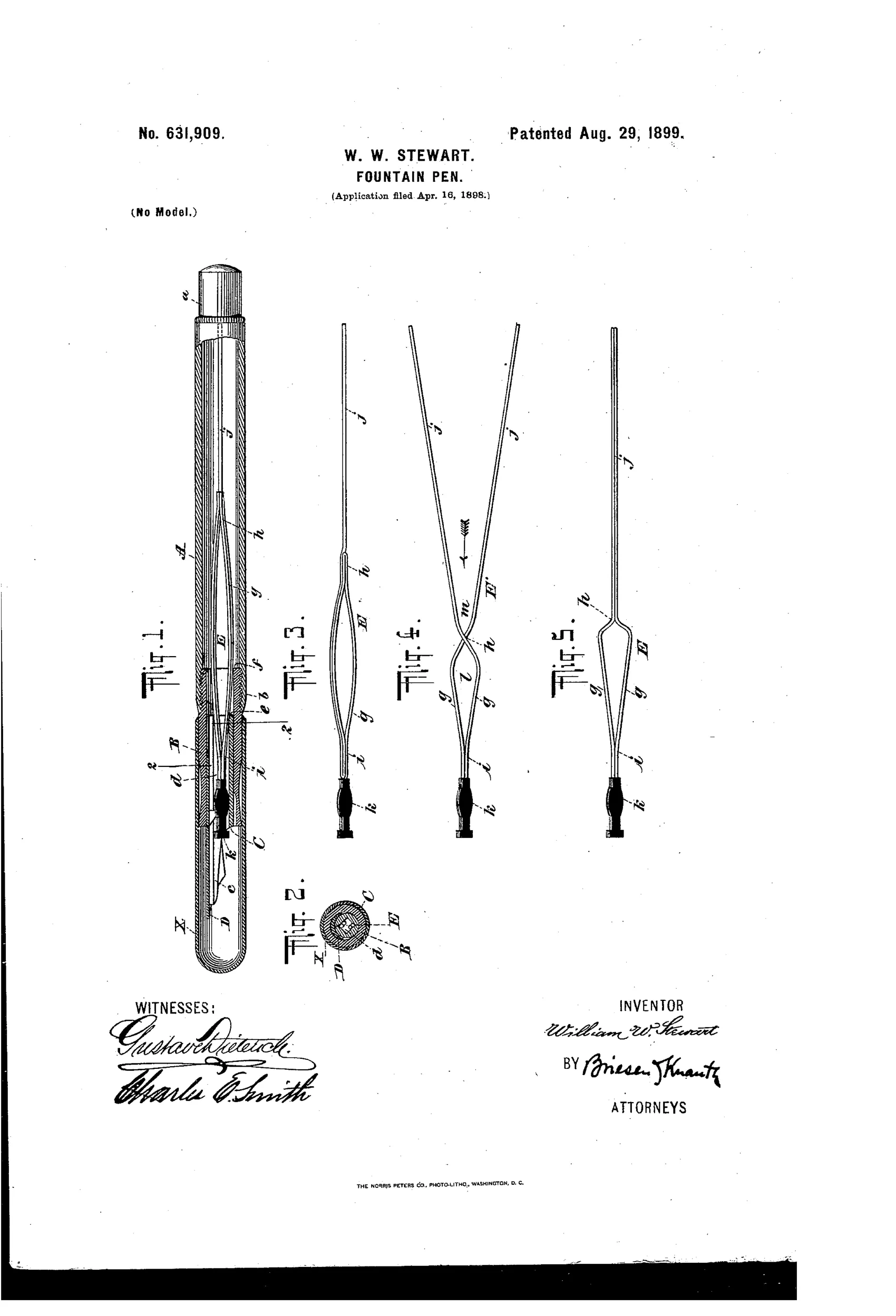
Fountain pen with internal ink-flow regulating skeleton
✒ How it works
A hollow handle or reservoir is closed at the top and fitted at its lower end with a nozzle secured by threads, within which a feeder-bar contacts the pen-nib. A conduit of varying diameter runs through the handle, nozzle, and feeder-bar, remaining constantly open at the lower end beneath the nib to form an unsealed air passage. Inside this conduit a 'skeleton' of converging metal strands (such as silver) presses against the conduit walls at points where the diameter changes, creating a nucleus that retains sealing globules of ink and air in place. This arrangement allows ink to flow steadily around the retained globules while air bubbles pass upward, preventing the ink from dropping or flowing too freely from the pen.
✒ What was claimed
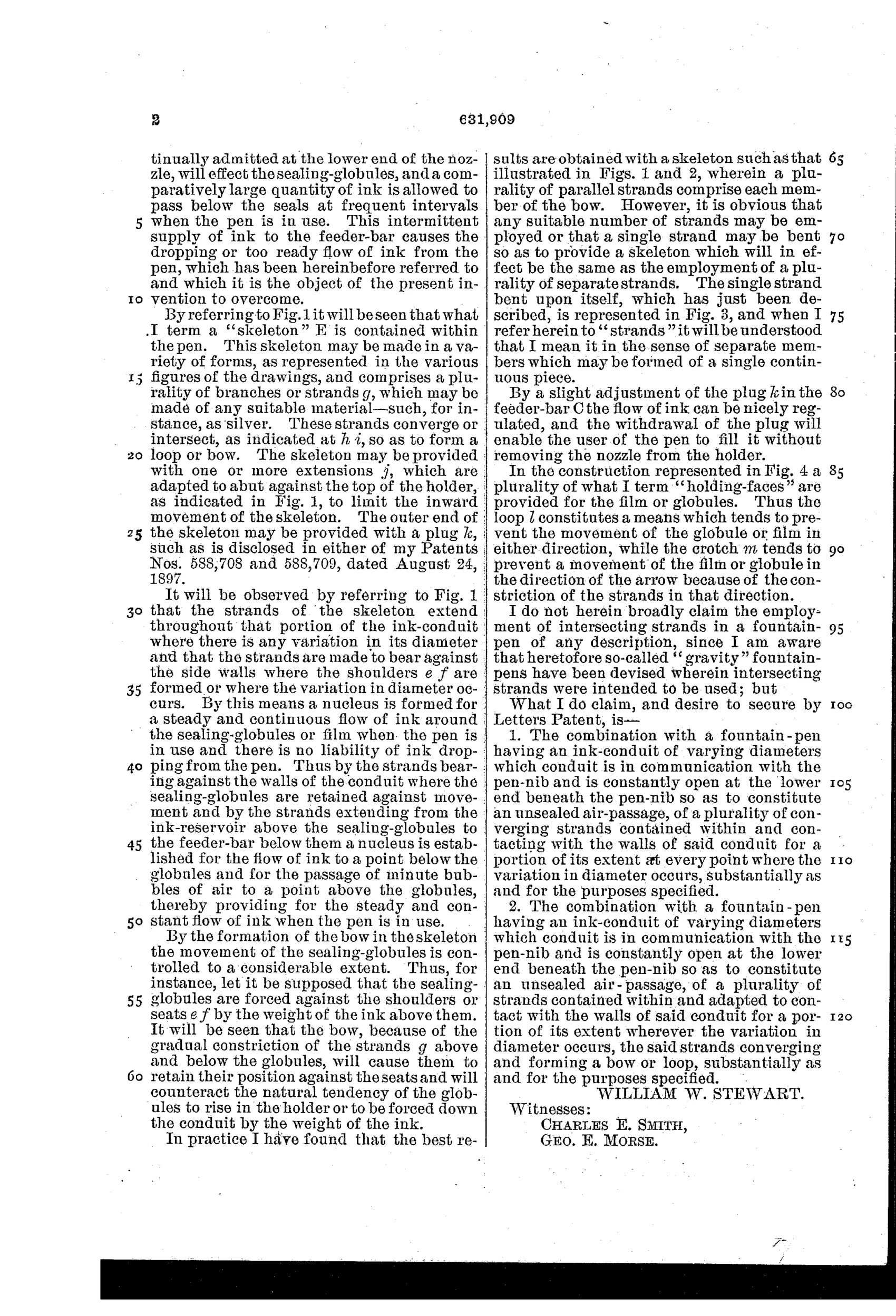
“The combination with a fountain-pen having an ink-conduit of varying diameters which conduit is in communication with the pen-nib and is constantly open at the lower end beneath the pen-nib so as to constitute an unsealed air-passage, of a plurality of converging strands contained within and contacting with the walls of said conduit for a portion of its extent at every point where the variation in diameter occurs, substantially as and for the purposes specified.”
In plain English: The pen combines a variable-diameter, always-open ink channel beneath the nib with a set of converging internal strands that press against the channel walls wherever the diameter changes, controlling ink and air flow.
✒ In the inventor’s words
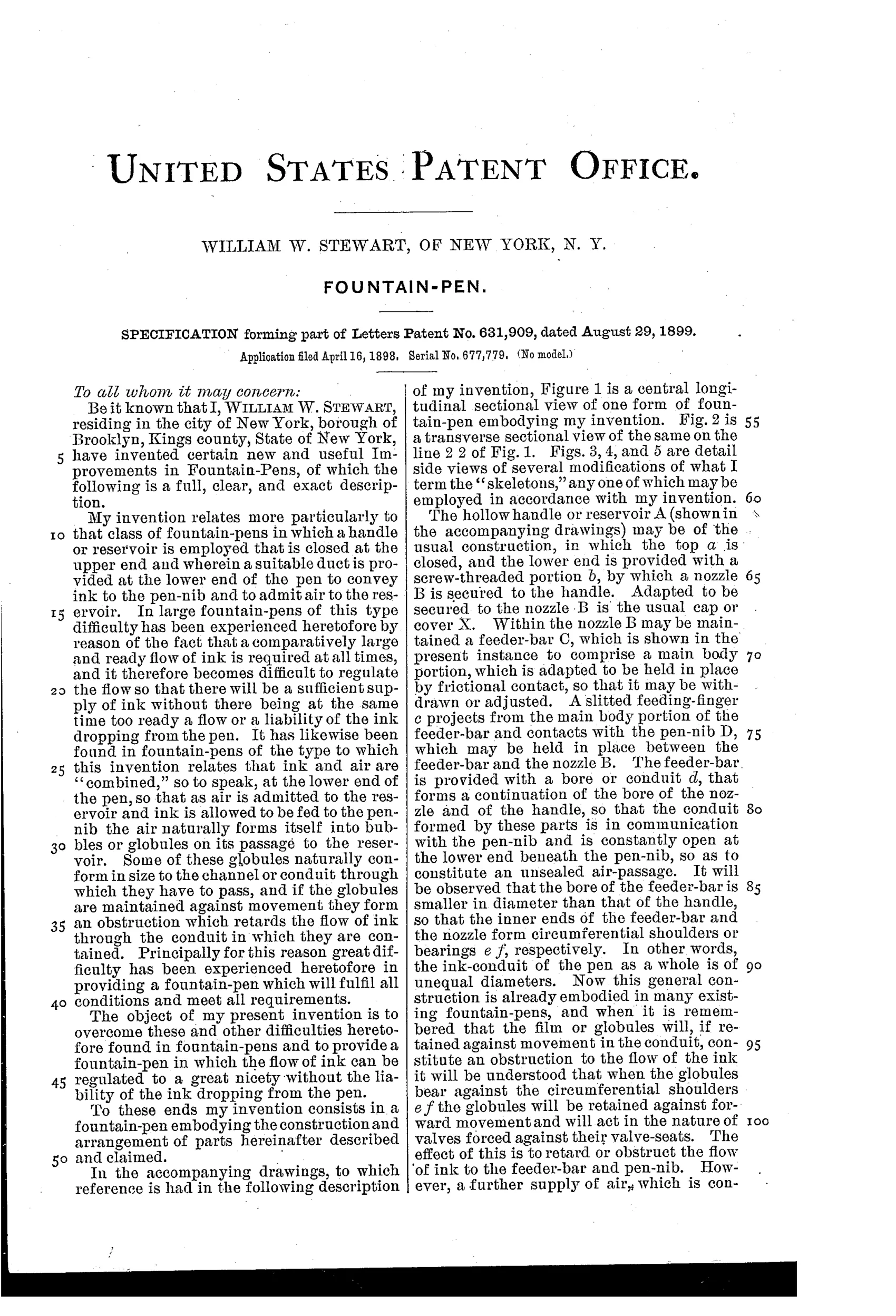
“It has likewise been found in fountain-pens of the type to which this invention relates that ink and air are "combined," so to speak, at the lower end of the pen, so that as air is admitted to the reservoir and ink is allowed to be fed to the pen-nib the air naturally forms itself into bubbles or globules on its passage to the reservoir.”— William W. Stewart, from the specification
Fate unknown
No known production pen matches this wire-skeleton conduit; a marked specimen or trade advertisement citing the patent would settle it.
✒ More by William W. Stewart
- FOUNTAIN STYLUS-PEN. (1884)
- FOUNTAIN PEN-HOLDER. (1886)
- FOUNTAIN-PEN. (1897)
- FOUNTAIN-PEN. (1897)
✒ Commentary
Stewart is attacking the era's central problem — how to let air into the reservoir at the same measured rate ink comes out — but from an unusual direction. Instead of Waterman's cut capillary fissures in a hard rubber feed, he threads a bundle of converging silver wire strands down the ink conduit itself. Wherever the bore changes diameter, the strands press against the walls and create what he calls a nucleus: a spot where a globule of ink or air parks itself and acts as a natural valve. Ink slides around the held globule; air bubbles climb past it; nothing dumps out all at once.
The candor of the specification is worth noting. Stewart openly says the lower end of the conduit is unsealed — a constantly open air passage under the nib — and relies entirely on surface tension around his wire strands to keep the pen from drooling. That is either elegant or reckless depending on your ink, your temperature, and how the pen rides in a pocket. Figures 3 through 5 show he knew the geometry mattered: three variants of the skeleton, one bulged into a bow, one crossed with holding faces, each a different guess at where the globules should sit.
Wire and fiber feed-assists did have a real if minor life in the trade, so this isn't pure fantasy. But as a complete regulating system it feels fragile next to the cut-channel feeds that were already winning by 1899. A clever sidebar in the feed wars, not a contender.
Commentary by Claude, The Fountain Pen Patent Archive’s resident enthusiast