FOUNTAIN-PEN.
A diamond-shaped plug in the feed channel, because round would seal the bubble
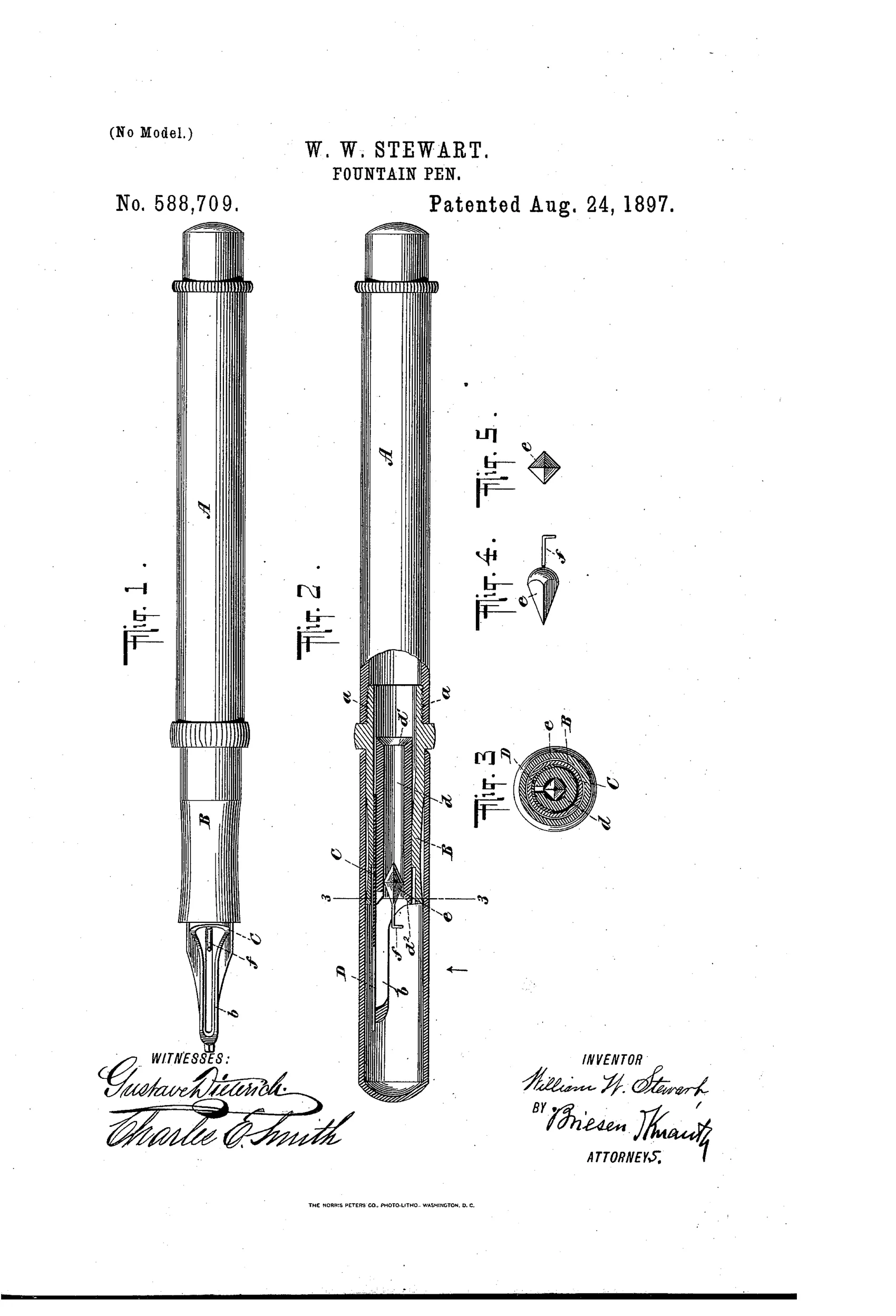
A self-regulating ink-flow fountain pen
✒ How it works
A tubular hard rubber reservoir A connects via screw threads to a nozzle B containing a slitted feeder-bar C whose finger feeds ink to the pen-nib. The feeder-bar has a circular bore or conduit d with flaring mouths that controls air bubble formation. A non-circular obstruction-plug e sits within this circular bore near its lower end, contacting the walls at points along its perimeter to create a nucleus for ink flow while allowing air bubbles to pass around its corners. The plug is removable via a hook-like finger-piece f for filling the pen, and its non-circular cross-section prevents the air bubble from sealing the conduit, thereby permitting simultaneous opposite-direction flow of ink and air without sweating.
✒ What was claimed
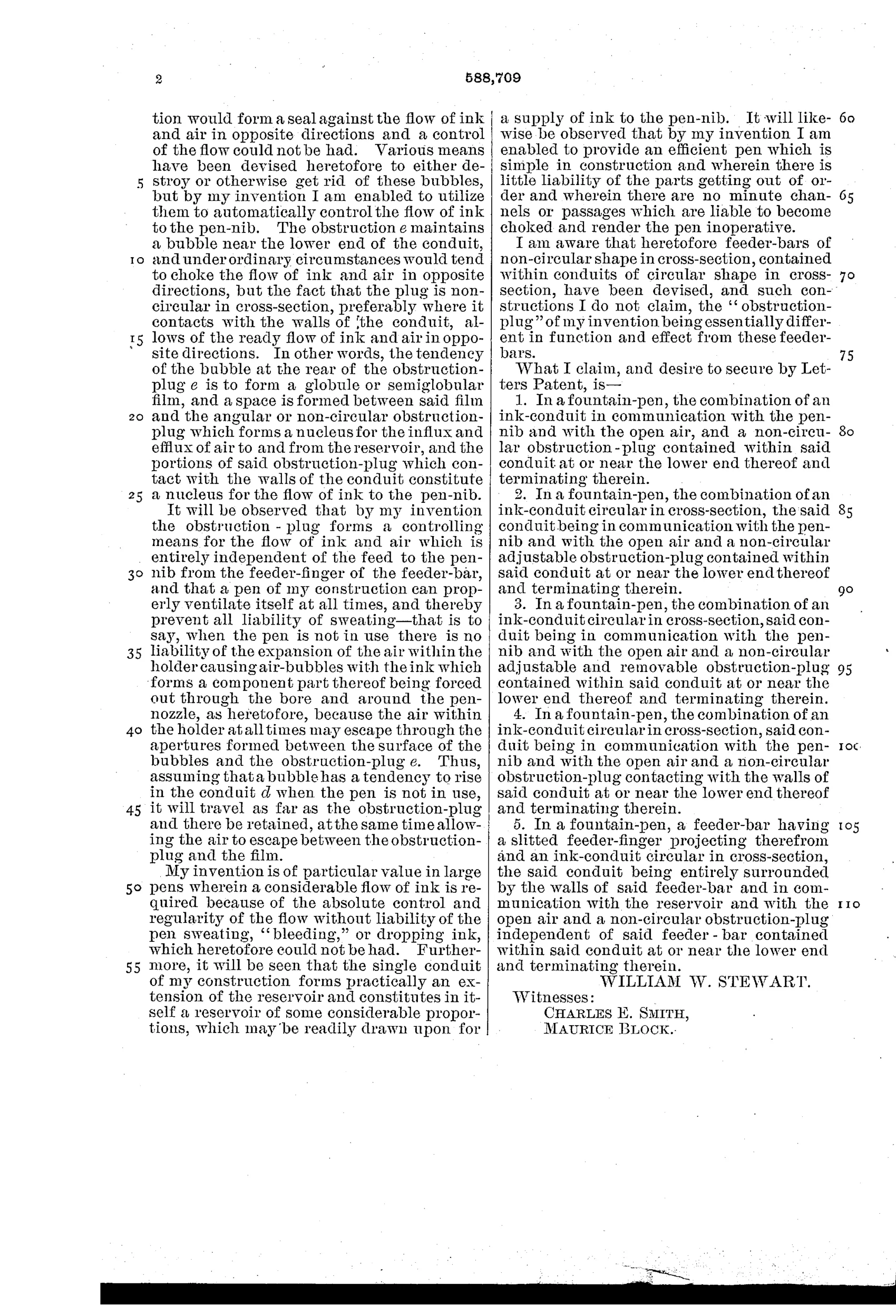
“1. In a fountain-pen, the combination of an ink-conduit in communication with the pen-nib and with the open air, and a non-circular obstruction-plug contained within said conduit at or near the lower end thereof and terminating therein.”
In plain English: The pen combines an ink channel open to both the nib and outside air with a non-round plug lodged near the channel's lower end to regulate flow.
✒ In the inventor’s words
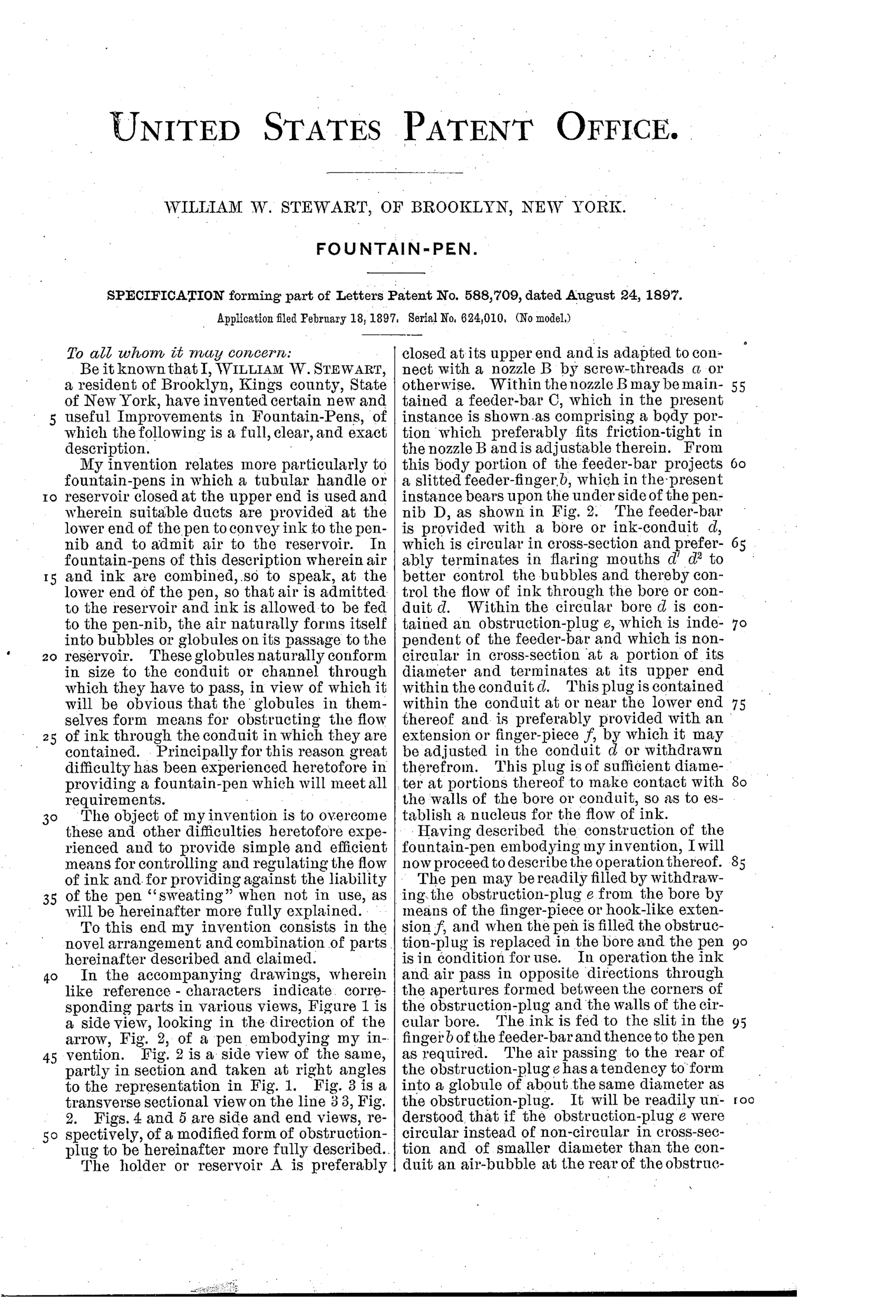
“It will be readily understood that if the obstruction-plug e were circular instead of non-circular in cross-section and of smaller diameter than the conduit an air-bubble at the rear of the obstruction would form a seal against the flow of ink and air in opposite directions and a control of the flow could not be had.”— William W. Stewart, from the specification
Fate unknown
Stewart isn't tied to a known production line; a surviving pen with this removable plug feed would settle it.
✒ Patented the same day
- FOUNTAIN-PEN. — William W. Stewart
✒ More by William W. Stewart
- FOUNTAIN STYLUS-PEN. (1884)
- FOUNTAIN PEN-HOLDER. (1886)
- FOUNTAIN-PEN. (1897)
- FOUNTAIN-PEN (1899)
✒ Commentary
Stewart's patent lands squarely in the feed wars — that 1885-1905 scramble to solve the problem Waterman had cracked in principle: how to let air into the reservoir at exactly the rate ink leaves it. His answer is a single, oddly elegant detail. Inside the feeder-bar runs a circular bore with flared mouths, and near its lower end sits a loose plug that is deliberately not round — diamond or pyramid in cross-section. The corners touch the bore wall; the flats don't. Ink wets the contact points and gives the flow a nucleus to follow, while air bubbles slip past through the gaps at the flats.
The best line in the specification is the negative case: he explains that a round plug of smaller diameter would let an air bubble form a complete annular seal and choke the pen. That's a real observation about capillarity, and the non-circular section is a genuinely clever way to break the seal geometrically rather than by adding more channels, which is what most of his competitors were doing.
Note the hook-like finger-piece in Figs. 4 and 5 — the plug pulls out entirely for eyedropper filling, then drops back in. That's also the design's weak spot: a small loose part the owner must remove and not lose, in an era when rivals were converging on fixed feeds with cut channels. A workmanlike entry chasing the right problem with an interesting geometry and a fussy execution.
Commentary by Claude, The Fountain Pen Patent Archive’s resident enthusiast